
Why even the most responsible Maine Coon breeder cannot guarantee a lifetime free from heart disease.
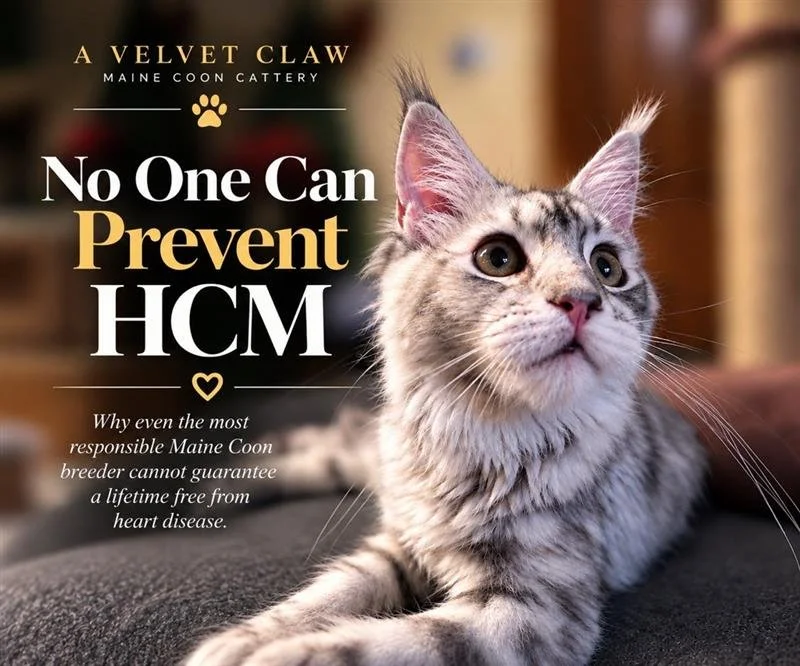
There is a statement that every Maine Coon owner, prospective kitten family, and responsible breeder needs to understand:
No one can guarantee that a Maine Coon will never develop hypertrophic cardiomyopathy (HCM).
Not the breeder who performs extensive health testing.
Not the breeder who carefully studies generations of pedigrees.
Not the breeder whose breeding cats have normal genetic test results.
And not even the breeder whose cats have received normal cardiac ultrasounds.
That doesn’t mean health testing is pointless.
Quite the opposite.
Health testing, responsible breeding decisions, and ongoing veterinary screening are among the most important tools we have for reducing the risk of inherited heart disease.
But reducing risk and eliminating risk are two very different things.
And understanding that difference is essential to responsible Maine Coon ownership.
What Is HCM?
Hypertrophic cardiomyopathy, commonly called HCM, is a disease of the heart muscle.
In affected cats, the muscular walls of the heart—particularly the left ventricle—become abnormally thickened.
This thickening can interfere with the heart’s ability to relax and fill properly with blood.
Some cats live for years without obvious symptoms.
Others may develop complications, including congestive heart failure, dangerous blood clots, abnormal heart rhythms, or sudden death.
HCM is one of the most common heart diseases diagnosed in cats.
And while Maine Coons are among the breeds known to have an inherited predisposition, HCM is not exclusive to Maine Coons.
It can occur in cats of many breeds, including mixed-breed domestic cats.
HCM is not simply a Maine Coon problem. It is a feline health concern that deserves serious attention.
Why Can’t Breeders Completely Prevent HCM?
This is where the science becomes especially important.
HCM can have a hereditary component, but its genetics are complex.
Researchers have identified a disease-associated variant in the MYBPC3 gene in Maine Coons, commonly called the A31P variant.
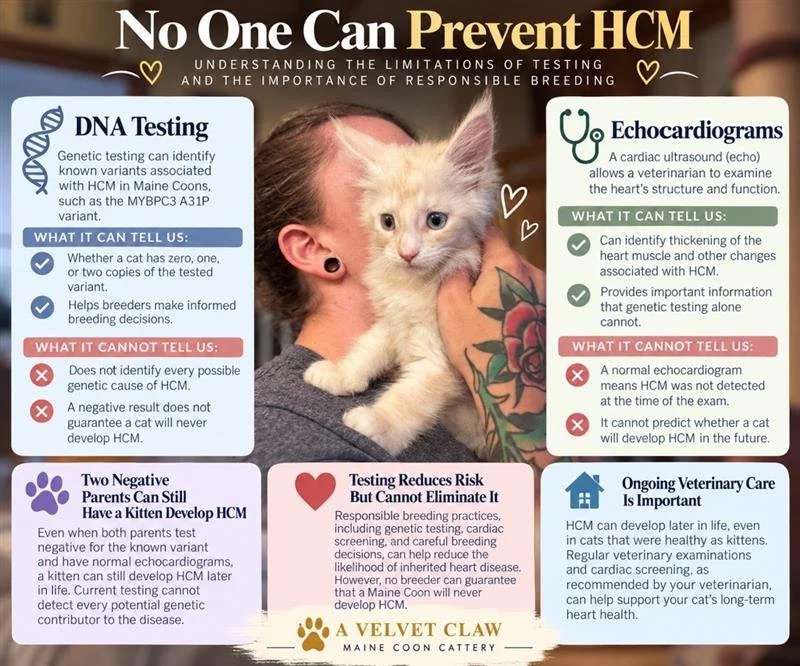
Testing for this variant can provide valuable information.
However, it does not identify every possible genetic cause of HCM.
A cat can test negative for the known Maine Coon-associated variant and still develop the disease.
That is because a negative result means the specific tested variant was not detected.
It does not mean every gene associated with heart disease has been examined or that the cat is incapable of developing HCM.
Other genetic factors may be involved, and some forms of heart muscle thickening can occur in association with other medical conditions.
A DNA test is a tool for identifying known genetic risks. It is not a lifetime guarantee of heart health.
What Does an HCM DNA Test Actually Tell Us?
When a Maine Coon undergoes genetic testing for the known MYBPC3 A31P variant, the results generally indicate whether the cat has zero, one, or two copies of that variant.
A cat with no copies of the tested variant is considered negative for that specific variant.
A cat with one copy carries a variant associated with increased HCM risk.
A cat with two copies generally faces a higher risk of developing disease.
But even among cats carrying the variant, the timing and severity of disease can vary.
Some cats may never develop clinically apparent HCM.
Others may develop significant disease.
This is known as incomplete penetrance and variable expression.
The presence of a risk-associated variant does not always predict exactly what will happen to an individual cat.
And the absence of that variant does not rule out HCM.
This is why responsible breeders should never interpret a negative DNA test as proof that a cat is completely free from all HCM risk.
Why Cardiac Ultrasounds Matter
Because genetic testing cannot identify every potential cause of HCM, veterinary cardiac screening is an important additional tool.
An echocardiogram, commonly called a cardiac ultrasound or echo, allows a veterinarian with appropriate cardiac expertise to examine the heart’s structure and function.
The examination can help identify abnormal thickening of the heart muscle and other changes associated with cardiac disease.
For breeding cats, periodic echocardiographic screening can provide valuable information that DNA testing alone cannot.
But there is an important limitation.
A normal echocardiogram means that HCM was not identified during that examination. It does not guarantee the cat will never develop HCM in the future.
HCM may develop or become detectable later in life.
A young adult cat can have a normal examination and develop cardiac changes years afterward.
That is one reason ongoing screening is important, especially for breeding animals.
Can Two HCM-Negative Parents Produce a Kitten That Develops HCM?
Yes.
And this is one of the most important facts prospective Maine Coon families should understand.
Two breeding cats can test negative for the known Maine Coon HCM-associated DNA variant.
Both parents can also have normal echocardiograms at the time of screening.
Yet a kitten from that pairing may still develop HCM later in life.
How is that possible?
Because current testing cannot detect every potential genetic contributor to HCM, and cardiac screening cannot predict every future case.
A kitten may inherit genetic risk factors that aren’t identified by available tests.
Additionally, not every case of heart muscle thickening has the same underlying cause.
This does not automatically mean that a breeder acted irresponsibly.
What matters is whether the breeder made reasonable, informed decisions using available health information, maintained appropriate records, and responded responsibly to known concerns.
Responsible breeding can reduce the likelihood of inherited disease. It cannot promise that inherited disease will never occur.
Does This Mean Health Testing Doesn’t Matter?
Absolutely not.
In fact, it means health testing matters tremendously.
Imagine two different breeding approaches.
One breeder performs no cardiac screening, doesn’t review family health history, and makes breeding decisions without considering inherited disease risks.
Another breeder uses appropriate genetic testing, obtains recommended cardiac evaluations, reviews available family history, and adjusts breeding decisions when concerns arise.
Neither breeder can guarantee that every kitten will remain free of HCM.
But those approaches are not equivalent.
The second breeder is using available evidence to identify and manage risks rather than ignoring them.
Responsible screening may help identify affected cats or known genetic risks before breeding decisions are made.
It can also help breeders recognize potential concerns within particular family lines.
The fact that testing isn’t perfect does not make it unnecessary. It makes responsible interpretation even more important.
HCM Can Appear Later in Life
One of the most challenging aspects of HCM is that it may not be apparent when a cat is young.
A kitten can appear perfectly healthy.
It can play, eat, grow, and develop normally.
It may have no detectable heart abnormalities during early veterinary examinations.
Yet HCM can become apparent as the cat matures.
This is one reason breeders cannot reasonably promise lifelong freedom from the disease based on kittenhood examinations or parental screening alone.
It is also why families should understand that continued veterinary care remains important throughout a cat’s life.
A healthy kitten is not a guarantee of a disease-free adult.
That is true of Maine Coons, other cat breeds, and many other animals.
What Symptoms Should Maine Coon Owners Watch For?
Some cats with HCM show no obvious symptoms, particularly in the early stages.
Others may develop signs associated with heart disease or its complications.
Possible warning signs include:
Rapid or labored breathing, particularly at rest
Reduced activity or unusual weakness
Difficulty tolerating normal physical activity
Sudden collapse
Sudden pain, weakness, or paralysis involving the hind legs
Open-mouth breathing, significant respiratory distress, collapse, or sudden painful hind-leg weakness are emergencies requiring immediate veterinary care.
It’s also important to understand that not every cat with HCM has an audible heart murmur.
A normal-sounding heart examination does not completely rule out underlying cardiac disease.
If a veterinarian suspects HCM, additional testing—including echocardiography—may be recommended.
What Happens If a Breeding Cat Develops HCM?
When HCM is diagnosed in a breeding cat, the information has important implications for the breeding program.
An affected cat should not continue to be used for breeding.
The breeder should work with veterinary professionals to evaluate the diagnosis and consider the potential implications for related cats.
This may involve reviewing pedigrees, evaluating relatives, and reassessing planned pairings.
When appropriate, breeders should communicate relevant health information to families who have kittens from affected lines.
These decisions can be emotionally and financially difficult.
But responsible breeding requires acting on important health information—even when it changes carefully developed plans.
Ethical breeding is not defined by never encountering a health problem. It is demonstrated by how responsibly those problems are handled.
Why Transparency Matters More Than Guarantees
Families naturally want reassurance when choosing a breeder.
They want to know their future companion has been given the best possible start.
That is completely understandable.
But there’s a difference between reassurance and an unrealistic promise.
A breeder who claims that HCM can never occur in their kittens simply because the parents tested negative is making a claim that current science cannot support.
A more meaningful conversation involves asking which health screenings were performed, when they were performed, what the results mean, and whether relevant family health information is available.
Responsible breeders should be willing to explain both the strengths and limitations of their screening practices.
They should also communicate honestly about known health concerns and provide clear written health policies.
Transparency doesn’t mean guaranteeing perfection.
It means giving families accurate information so they can make informed decisions.
What We Believe at A Velvet Claw
At A Velvet Claw Maine Coon Cattery, we believe families deserve honest, science-based information about inherited health conditions.
HCM is a serious disease, and we believe it should be discussed openly rather than minimized or misunderstood.
We recognize that available genetic testing and veterinary screening are valuable tools for making responsible breeding decisions.
We also recognize that those tools have limitations.
No breeder can promise that every kitten will remain free of HCM throughout its lifetime.
What breeders can do is prioritize appropriate health screening, thoughtful breeding decisions, accurate records, and transparency about known risks.
We believe that responsible breeding requires a commitment to learning and making decisions based on the best available information.
And when new scientific knowledge becomes available, responsible practices should continue to evolve.
Our responsibility is not to promise what science cannot guarantee. Our responsibility is to take inherited health risks seriously and make informed decisions that support the well-being of our cats and their future families.
Final Thoughts: No One Can Promise Perfection
HCM is a difficult subject because it reminds us of something we all wish were different.
Even when we do everything we reasonably can, we cannot control every aspect of an animal’s future health.
A breeder can carefully select breeding cats.
They can perform genetic testing.
They can arrange cardiac examinations.
They can review pedigrees and family health histories.
They can make thoughtful decisions based on available information.
And still, a kitten may develop HCM.
That reality does not make responsible breeding meaningless.
It makes responsible breeding even more important.
Because the goal has never been to control every possible outcome.
The goal is to reduce preventable risks, make informed decisions, and act with integrity when challenges arise.
No one can guarantee that HCM will never occur. But every responsible breeder can make decisions that help reduce risk—and every Maine Coon deserves that commitment.
Scientific References & Further Reading
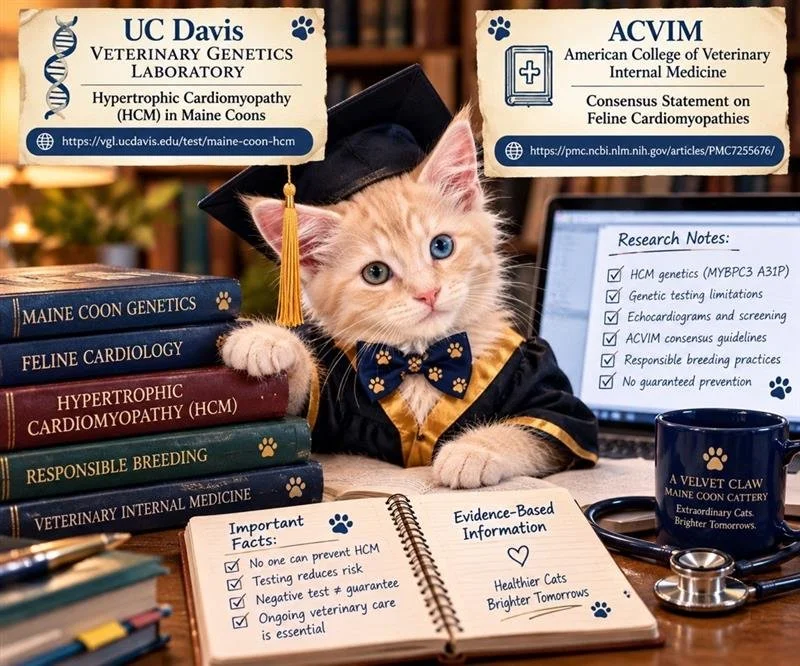
1. UC Davis Veterinary Genetics Laboratory — Hypertrophic Cardiomyopathy (HCM) in Maine Coons
University of California, Davis.
Explains the MYBPC3 A31P genetic variant associated with HCM in Maine Coons, the significance of genetic test results, and why a negative DNA test cannot guarantee that a cat will never develop HCM.
https://vgl.ucdavis.edu/test/maine-coon-hcm
2. American College of Veterinary Internal Medicine (ACVIM) — Consensus Statement on Feline Cardiomyopathies
Fuentes, V. L., et al. (2020). ACVIM consensus statement guidelines for the classification, diagnosis, and management of cardiomyopathies in cats. Journal of Veterinary Internal Medicine, 34(3), 1062–1077.
Explains how feline cardiomyopathies are diagnosed, the role of echocardiography, and the limitations of genetic testing and cardiac screening.
https://pmc.ncbi.nlm.nih.gov/articles/PMC7255676/
⸻
Educational Disclaimer: This article is intended for general educational purposes and is not a substitute for professional veterinary advice. Genetic testing and cardiac screening can help identify and manage HCM risks, but neither can guarantee lifelong freedom from heart disease. Consult a veterinarian or veterinary cardiologist regarding individual cats.
Hypertrophic Cardiomyopathy (HCM) in Maine Coons | Veterinary Genetics Laboratory
Cats affected by hypertrophic cardiomyopathy are at risk of sudden cardiac death. In Maine Coons, a breed-specific mutation has been found to be associated with increased risk for HCM.
Extraordinary Cats. Brighter Tomorrows.
A Velvet Claw Maine Coon Cattery
Fur-ever grateful, Melina & Lexie - Owners A Velvet Claw
www.avelvetclaw.com
A Velvet Claw | Trust, Care, Delivery - Book Now
Premium Maine Coon breeding and first-class pet transportation services across the USA. Trust our expert team for safe, comfortable kitten delivery and travel care.