
Ask someone what they know about Maine Coons, and there's a pretty good chance you'll hear: “They're HUGE!” And yes—Maine Coons are a naturally large breed. Their substantial bodies, long frames, enormous paws, impressive tails and larger-than-life presence are part of what makes them so spectacular. It's also completely understandable that someone searching for a Maine Coon kitten might dream about bringing home a gigantic 25-pound cat.
But here's something we think prospective Maine Coon families should understand: Bigger isn't automatically better. Responsible Maine Coon breeding isn't a competition to produce the heaviest cat possible.
Size is only one characteristic of this incredible breed—and it should never become more important than health, structure, temperament, genetic diversity and overall well-being.
Let's talk about why.
1. Maine Coons Are Large—But There's a Normal Range
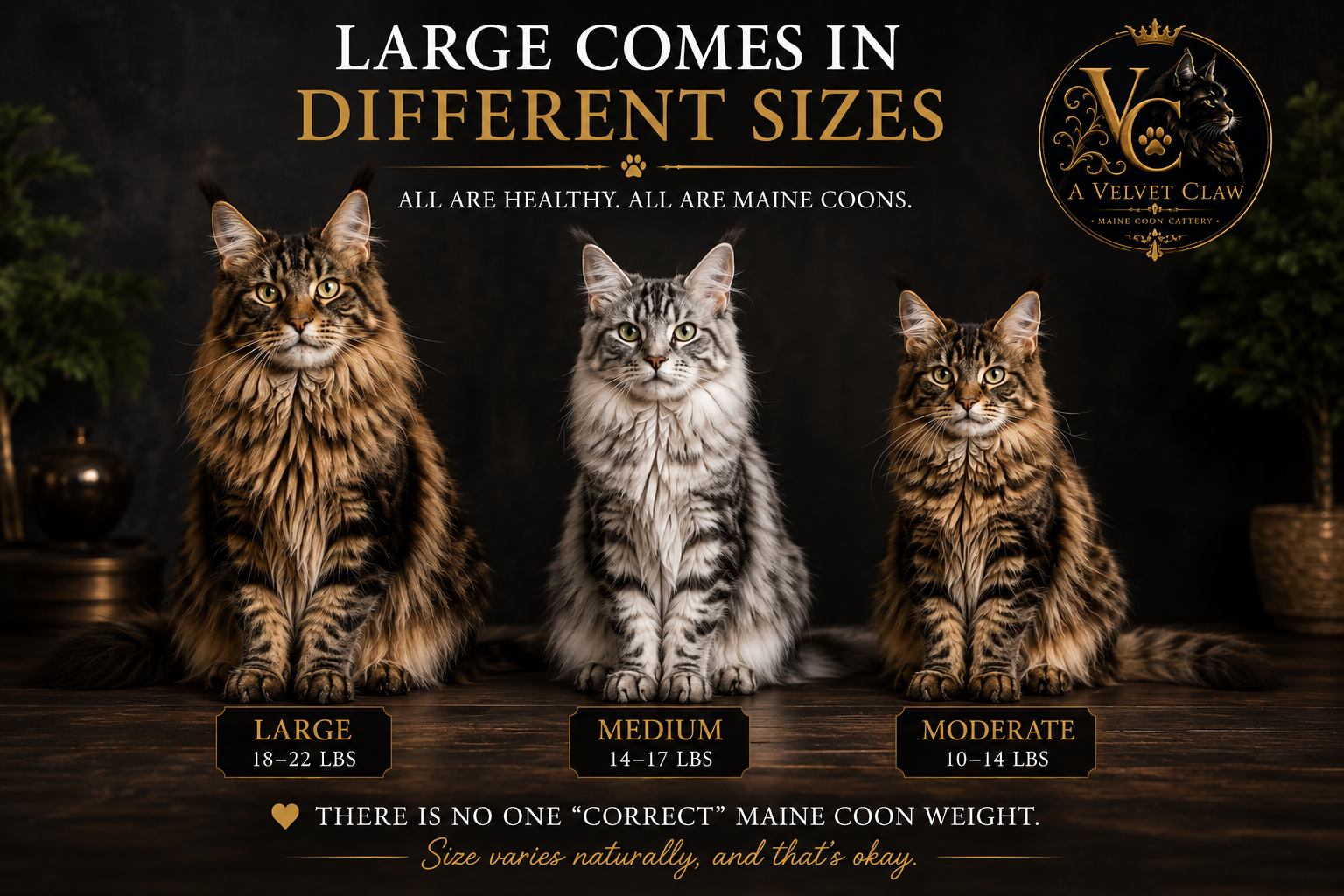
Maine Coons are one of the largest domestic cat breeds, but that doesn't mean every Maine Coon will become enormous. Just like people, individual cats vary.
Adult size can be influenced by:
Genetics
Sex
Family lines
Nutrition
Body structure
Activity level
Age
Overall health
Some Maine Coons will naturally mature into exceptionally large adults. Others will be more moderate in size. Both can be perfectly wonderful examples of the breed. A Maine Coon doesn't somehow become “less Maine Coon” because it doesn't reach an impressive number on the scale.
2. Weight and Size Aren't the Same Thing
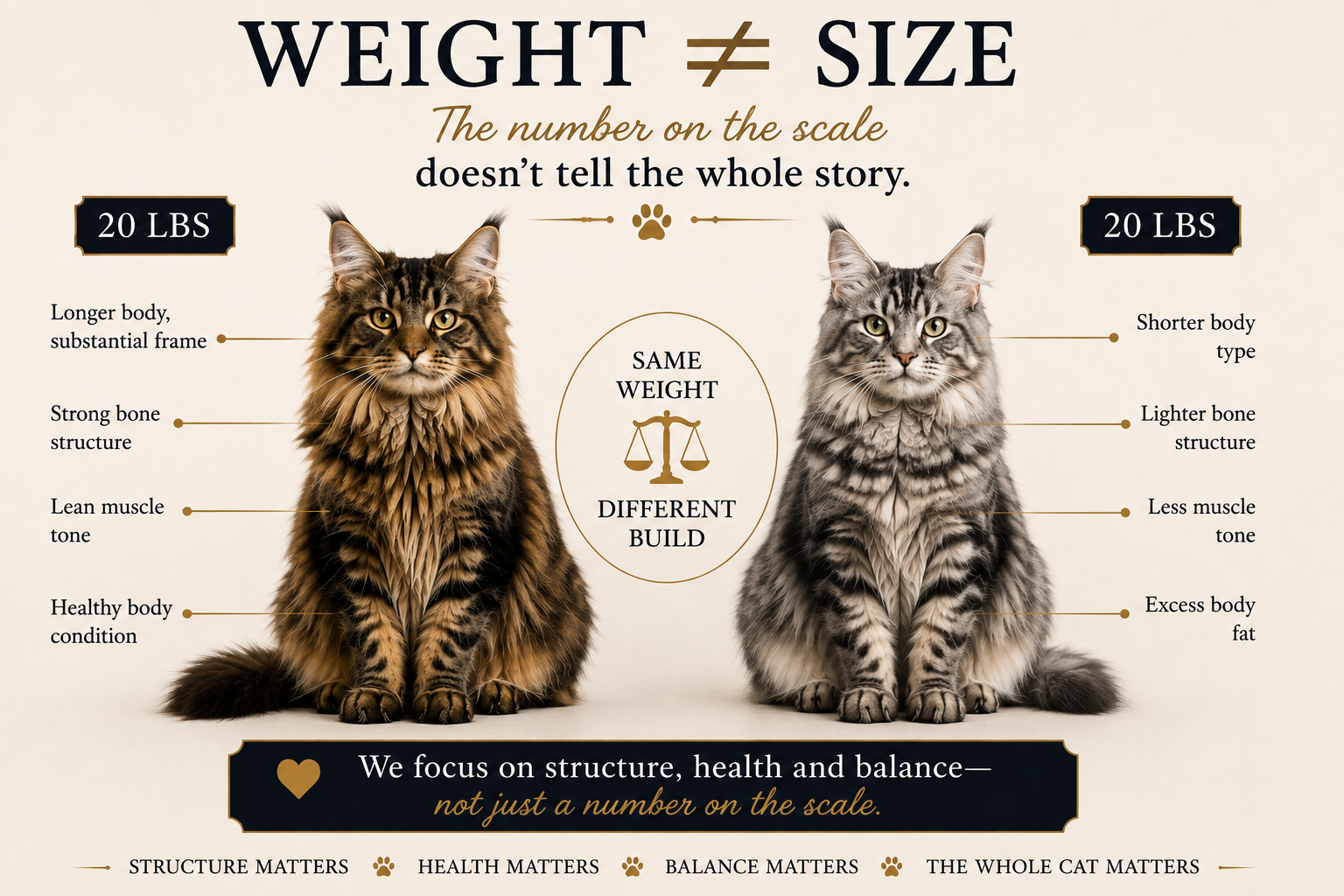
This distinction is incredibly important. When people say they want a “huge Maine Coon,” they're often focused on weight. But a heavy cat isn't necessarily a large, well-structured cat. A Maine Coon may have a long body, substantial bone, broad chest and powerful frame without being excessively heavy. Likewise, a cat can weigh more simply because it's carrying too much body fat.
Those aren't the same thing. Responsible breeders should be interested in the whole structure of the cat, not simply the number displayed on a scale. A healthy 18-pound Maine Coon with a long, muscular frame may actually be physically larger than a shorter cat weighing more because of excess body fat.
The scale doesn't tell the whole story.
3. We Can't Promise a Kitten's Adult Weight
This is something prospective families sometimes find surprising. A breeder can look at the parents. We can study the pedigree. We can consider previous offspring from those lines. We can watch how quickly a kitten is developing. All of that may give us clues.
But we still can't look at a young kitten and guarantee: “This kitten will weigh exactly 25 pounds.” Genetics don't work that neatly. Two large parents can produce kittens that mature at different sizes. Even littermates can grow into noticeably different adults.
A breeder may be able to discuss what's typical within their lines, but an exact adult weight is still a prediction—not a promise.
4. The Biggest Kitten Isn't Necessarily the Biggest Adult
There's always that one kitten. You know the one. The chunky baby sitting in the food bowl while everyone else politely eats around them. 😂 It's tempting to assume: “That's going to be the biggest one!”
Maybe. Maybe not. Early kitten size doesn't perfectly predict adult size. Some kittens grow rapidly early and slow down later. Others seem smaller initially and experience tremendous growth as they mature.
Maine Coons also have a famously long developmental period. So choosing the biggest kitten in a litter because you want the biggest adult Maine Coon isn't a reliable strategy. Growth isn't a race—and the kitten leading at three months doesn't necessarily finish first.
5. Maine Coons Take a Long Time to Mature
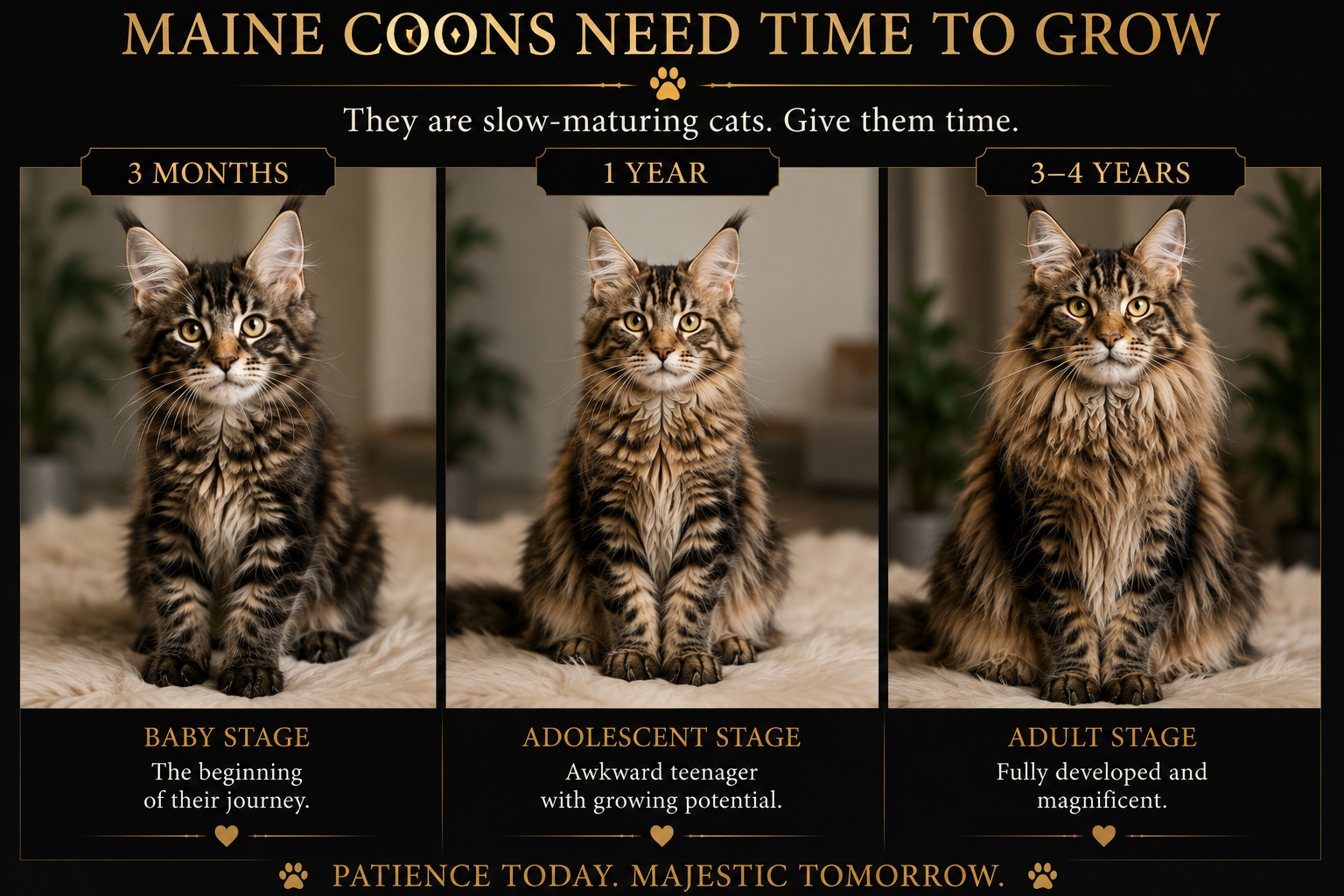
This is another reason focusing too heavily on early size can be misleading. Maine Coons are slow-maturing cats. Their bodies continue developing well beyond kittenhood. They may continue filling out, developing muscle, growing coat and changing physically for several years.
That lanky adolescent Maine Coon who looks like they're approximately 73% legs and ears may eventually become a magnificent, substantial adult. 😂 Give them time. A Maine Coon doesn't need to look enormous at six months old to eventually develop into an impressive cat.
6. Males and Females May Develop Differently
Sex can influence average adult size. Males often mature larger and heavier than females, although there's plenty of individual variation. That doesn't mean females should be pushed toward extreme size to compete with males. A beautiful female Maine Coon should look appropriate for her individual frame and structure.
The goal isn't to make every Maine Coon as large as possible. The goal is a balanced, healthy cat.
7. Chasing Extremes Can Create the Wrong Breeding Priorities
This is where responsible breeding becomes especially important. Imagine choosing breeding cats primarily because they're enormous. If size becomes the most important selection criterion, what happens to everything else? What if the largest cat has a temperament you wouldn't want to reproduce? What if another cat has better structure? What if health information favors a different breeding prospect?
What if another pairing provides greater genetic diversity? What if the slightly smaller cat better complements your queen? Responsible breeders have to look at the entire picture.
If the question becomes: “Which cat will give us the biggest kittens?”
instead of: “Which pairing gives us the best opportunity for healthy, well-structured, wonderful Maine Coons?”
then the priorities have become backwards.
8. Structure Matters More Than a Number
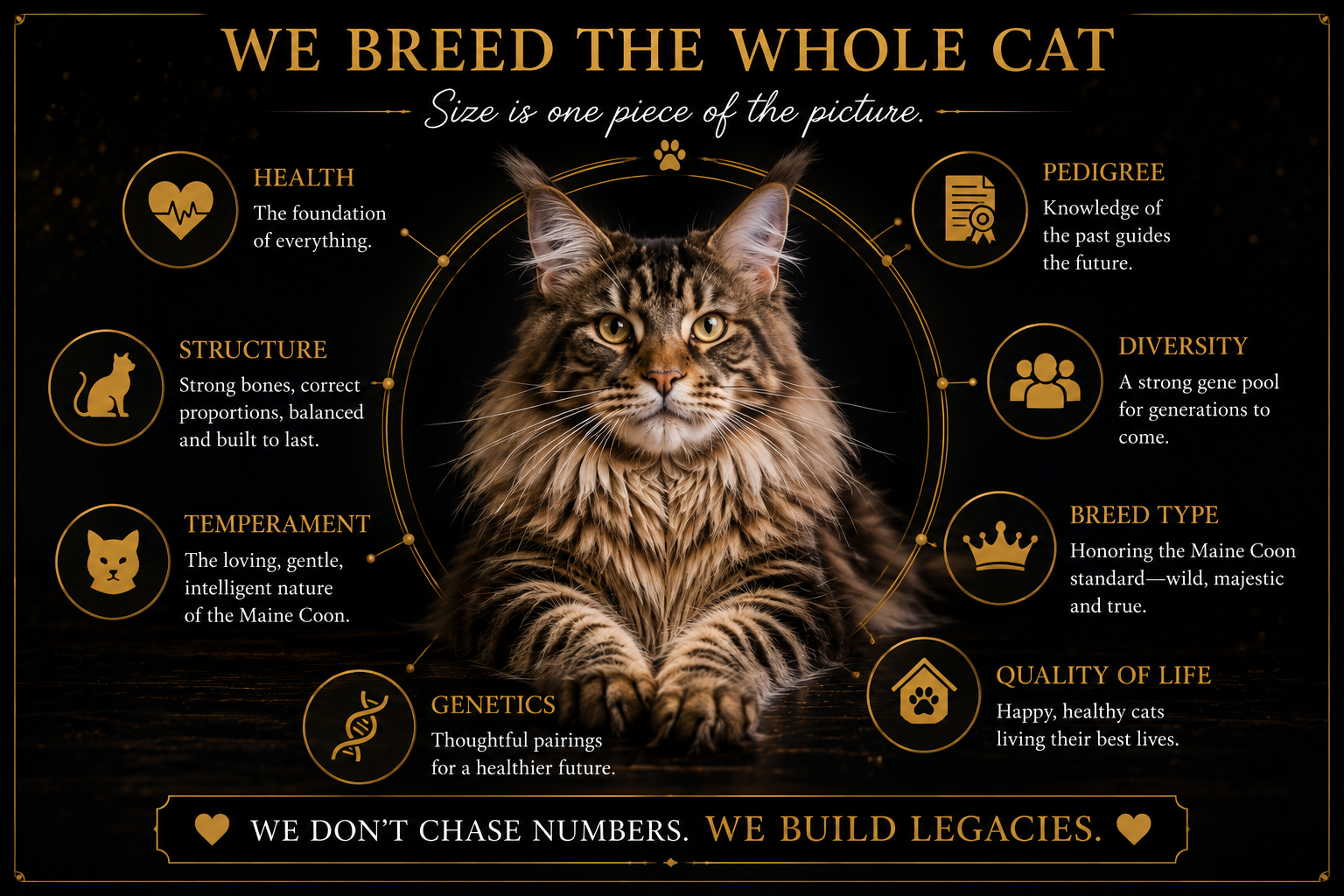
Maine Coons should have the substantial appearance associated with the breed. But there's much more to structure than body weight. Breeders consider characteristics such as overall balance, proportions, musculature, bone, head structure, profile, muzzle, ears, tail and the way the entire cat comes together.
A Maine Coon should look balanced. Simply adding pounds doesn't improve structure. And deliberately trying to create increasingly massive cats shouldn't replace thoughtful selection for the overall cat.
We aren't breeding numbers on a scale. We're breeding living animals.
9. Health Has to Come Before Bragging Rights
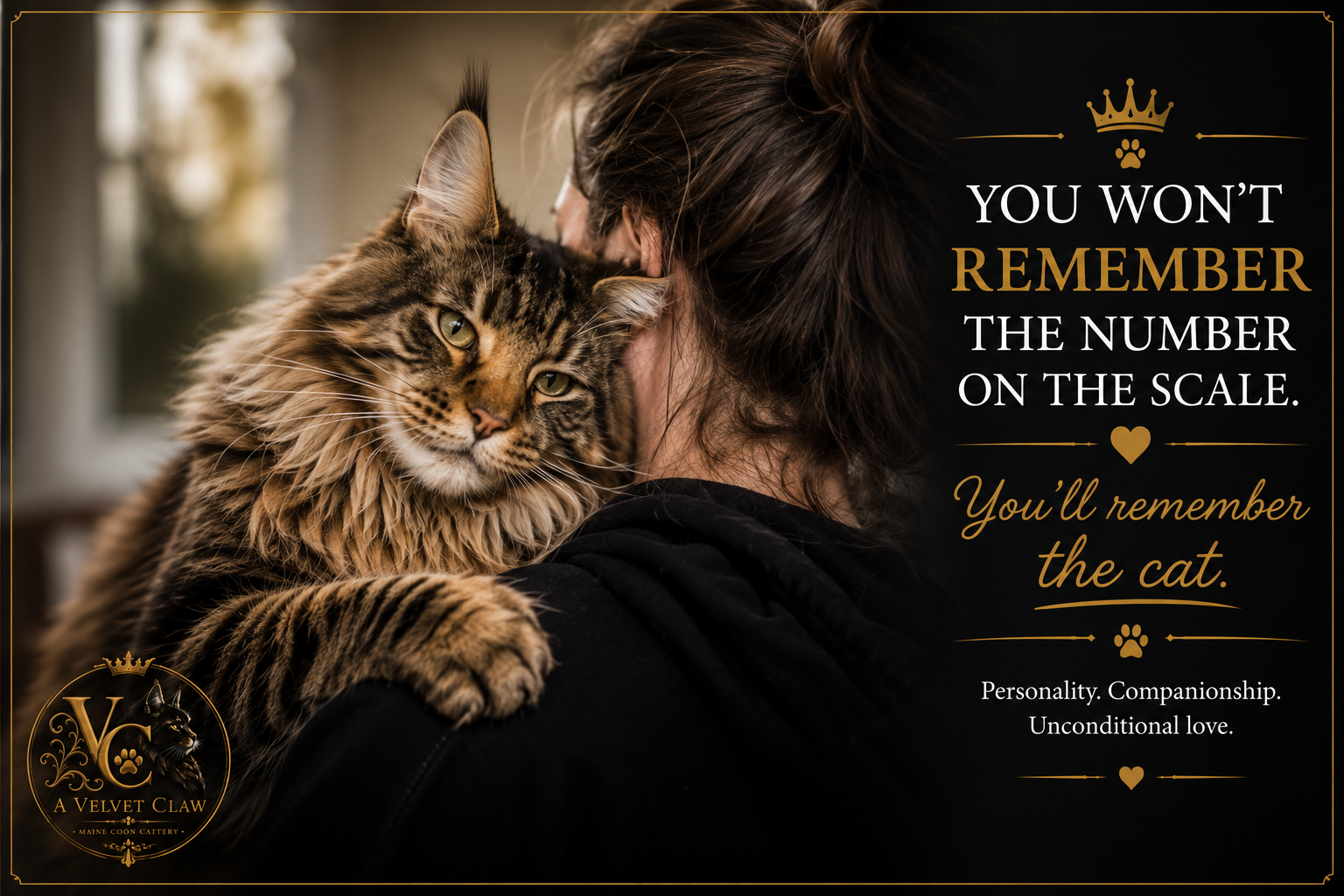
There's something undeniably fun about telling someone: “My Maine Coon weighs 22 pounds!” We get it. 😂 They're impressive cats. But no bragging right is worth compromising a cat's health. Responsible breeders should be thinking about the future: Will this cat have a body capable of comfortably carrying its frame? Are we selecting for sound structure? Are we considering cardiac health? Are we considering hips and mobility? Are we maintaining appropriate body condition? Are we making breeding decisions based on the entire cat rather than one dramatic trait?
A healthy, athletic Maine Coon who can comfortably run, jump, climb and play is far more important than reaching an arbitrary number on the scale.
10. Bigger Doesn't Mean Healthier
A larger Maine Coon isn't automatically healthier. And a moderately sized Maine Coon isn't automatically less healthy. Health is far more complicated than size. That's why responsible breeding programs use multiple pieces of information when evaluating breeding cats.
Health testing.
Pedigrees.
Family history.
Temperament.
Structure.
Genetic diversity.
Development.
Veterinary care.
And yes, breed characteristics—including size. But size belongs on the list. It shouldn't be the list.
11. Bigger Doesn't Mean Better Temperament Either
Maine Coons are famous for their personalities for good reason. They're often described as social, playful, intelligent and wonderfully interactive companions. For most families, those qualities will matter far more over the next decade than whether their cat weighs 18 pounds or 23. Imagine choosing between:
A gigantic Maine Coon whose temperament isn't a good match for your home. Or a slightly smaller Maine Coon who follows you everywhere, chirps when you talk to them, sleeps beside you and fits beautifully into your family.
Which characteristic actually affects your daily life more? The personality attached to those giant paws matters.
12. Responsible Breeders Don't Guarantee “Giant” Kittens
Be cautious anytime an exact adult size is treated like a guarantee. Breeders can certainly tell families about the size of their breeding cats and what they've observed within their lines. They may reasonably say: “We tend to produce substantial cats.”
That's very different from promising: “This kitten WILL be 25 pounds.”
No breeder controls every gene a kitten inherits or exactly how that kitten will develop. Responsible breeders should be comfortable saying: “We don't know exactly how big this kitten will become.”
Sometimes the most responsible answer isn't the most exciting answer. It's simply the truthful one.
13. A Maine Coon's Value Isn't Measured in Pounds
This is perhaps the biggest message we'd like prospective families to take from this article. Your Maine Coon's value isn't determined by the number on the veterinarian's scale. A 16-pound Maine Coon isn't inferior to a 22-pound Maine Coon. The smaller cat didn't “fail” to become a real Maine Coon. What matters is that your cat is healthy, loved and thriving. Someday you'll probably remember the way your Maine Coon greeted you at the door.
The ridiculous chirps. The enormous tail blocking your television. The way they followed you into the bathroom despite absolutely nobody inviting them. 😂 The giant paws on your face at 5:00 a.m. The years you spent together.
You probably won't look back and think: “If only they had weighed four more pounds.”
What Responsible Breeders Actually Breed For
So if responsible Maine Coon breeders aren't simply trying to produce the largest cats possible, what are they trying to accomplish? Ideally, we're looking at the whole cat.
We want:
Health.
Sound structure.
Wonderful temperament.
Genetic diversity.
Breed characteristics.
Quality of life.
Longevity.
And thoughtful improvement from one generation to the next. Size absolutely has a place within the Maine Coon breed. It's part of what makes them Maine Coons. But responsible breeding requires balance.
We're Breeding Maine Coons—not Numbers on a Scale
There will always be naturally enormous Maine Coons. And yes, they're spectacular. But there will also be beautiful Maine Coons who fall somewhere in the middle of the breed's natural size range. They're spectacular too.
At A Velvet Claw, our goal isn't to see how many pounds we can produce. Our goal is to make thoughtful breeding decisions that prioritize the entire cat. Because we'd rather produce a healthy, beautifully structured Maine Coon with a wonderful temperament than chase an arbitrary number just so we can say: “Look how huge this one is.”
The best Maine Coon isn't necessarily the biggest one. It's the one whose health, structure, temperament and quality of life were never sacrificed just to make them bigger. 🖤💛🐾
Fur - ever grateful: Lexie & Melina
Maine Coon size • Maine Coon adult size • Maine Coon weight
How big do Maine Coons get • Responsible Maine Coon breeding