
A Velvet Claw Maine Coon Cattery | Extraordinary Cats. Brighter Tomorrows. | DENTAL HEALTH WEEK FINALE 🧷

🦷 How to Build a Stress-Free Dental Care Routine for Your Cat
A healthier smile doesn’t have to come with a struggle.
Let’s be realistic.
Most cats aren’t going to wake up in the morning, stretch their paws, and politely ask you to brush their teeth.
Some might tolerate it.
Some might actually learn to enjoy the attention.
And others?
Well, they may look at you like you’ve personally offended generations of their ancestors! 😹
But here’s the good news: dental care doesn’t have to be a battle.
With patience, positive reinforcement, and a routine designed around your cat’s individual personality, you can make oral care a much more comfortable experience.
At A Velvet Claw Maine Coon Cattery, we believe that responsible cat ownership is about more than knowing what your cat needs.
It’s about finding gentle, realistic ways to provide that care throughout their lifetime.
As we wrap up our week of feline dental health education, let’s put everything we’ve learned into one simple plan.
🐾 First, Understand Your Cat’s Comfort Level
Before you ever reach for a toothbrush, pay attention to how your cat responds to being handled.
Does your Maine Coon enjoy having their cheeks rubbed?
Will they tolerate a gentle touch near their mouth?
Do they pull away when you try to lift their lip?
Every cat is different.
Some kittens are naturally curious and cooperative, while others need more time to develop trust.
Adult cats can learn new routines, too.
Even senior cats may become comfortable with gentle dental care when the introduction is gradual and their mouths are healthy.
The most important rule: Never force the process.
If your cat is frightened, struggling, or showing signs of pain, stop and try again another time.
If you suspect dental disease or oral pain, schedule a veterinary examination before attempting brushing.
🪥 Step 1: Choose the Right Supplies
You don’t need an enormous collection of dental products to get started.
A few carefully selected items can make the process easier.
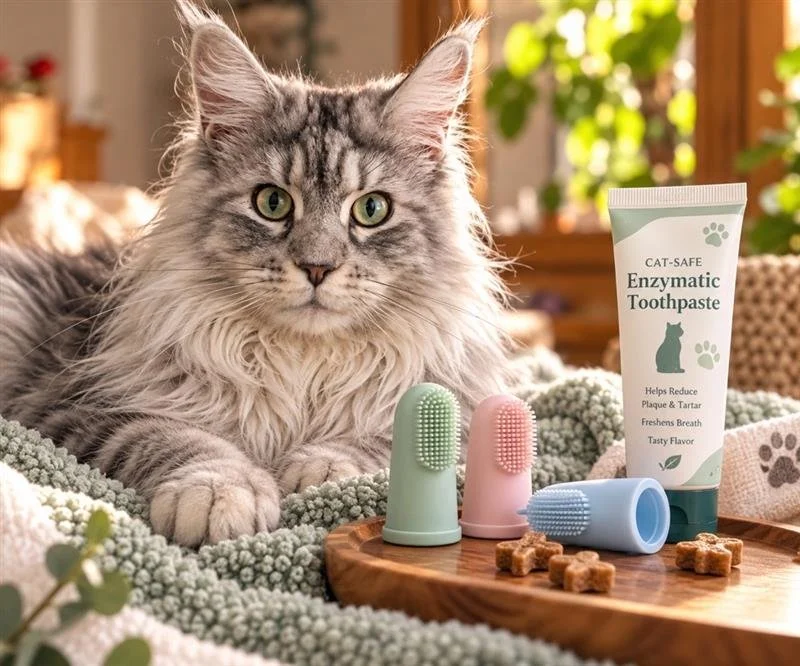
What you’ll need
Cat-safe enzymatic toothpaste: Choose toothpaste specifically formulated for cats. Never use human toothpaste.
A gentle brushing tool: A soft silicone finger brush may be comfortable for some cats. A small, soft-bristled feline toothbrush may be more effective for cleaning certain tooth surfaces.
A favorite reward: A small treat, praise, or affection can help create a positive association.
A calm environment: Choose a quiet space where your cat feels secure.
At A Velvet Claw, we especially appreciate the gentle approach of soft finger brushes when a cat tolerates them.
However, the best tool is one that safely fits your cat’s mouth and effectively cleans the teeth without causing discomfort.
Always supervise finger-brush use, as cats may bite unexpectedly.
Remember: The goal is gentle plaque removal, not vigorous scrubbing.
❤️ Step 2: Make Mouth Handling a Positive Experience
Before introducing toothpaste or brushing, practice getting your cat comfortable with gentle facial handling.
Start with something simple.
While your cat is relaxed, gently stroke their cheeks.
If they remain comfortable, briefly touch the outside of their lips.
Reward them immediately.
Over several short sessions, gradually work toward lifting the lip just enough to see the outside of the teeth.
Don’t worry about opening the entire mouth.
Most brushing focuses on the outer surfaces of the teeth, particularly along the gumline.
If your cat pulls away, return to an easier step.
Small, positive experiences build trust.
🐱 Step 3: Introduce the Toothpaste
Once your cat is comfortable with gentle mouth handling, introduce a tiny amount of cat-safe toothpaste.
Allow your cat to sniff it.
Some cats may enjoy licking a small amount from your finger.
Others may need several introductions before they feel comfortable.
That’s perfectly okay.
The goal is to help your cat associate the toothpaste with something familiar and pleasant.
Never force toothpaste into your cat’s mouth.
And remember: cat toothpaste is designed differently from human toothpaste, which may contain ingredients unsafe for cats.
🦷 Step 4: Begin Brushing — Just a Few Seconds at First
When your cat is comfortable with the earlier steps, it’s time to introduce gentle brushing.
Start by lifting the lip slightly.
Using your chosen brushing tool and cat-safe toothpaste, gently brush the outer surface of one or two teeth.
Focus on the area near the gumline without pressing hard.
Then stop.
Yes, really!
Your first successful brushing session might last only a few seconds.
That’s a win.
Over time, gradually increase the number of teeth you brush as your cat becomes more comfortable.
Work toward cleaning the outer surfaces of the teeth on both sides of the mouth.
Daily brushing is ideal because plaque forms continuously.
Consistency matters more than the length of any single session.
👑 Step 5: Find the Best Time of Day
Cats often thrive on predictable routines.
Try introducing dental care at a time when your cat is naturally relaxed.
For example:
After a quiet cuddle session
Before a favorite reward
During a familiar evening routine
When your cat approaches you for affection
Avoid attempting brushing when your cat is overstimulated, frightened, or actively trying to escape.
You may discover that your Maine Coon is more cooperative in the morning.
Or perhaps bedtime is the perfect opportunity.
There is no universal best time.
The best time is the one that works for your cat and that you can maintain consistently.
🐈 Step 6: Reward the Effort, Not Just the Result
Positive reinforcement can make an enormous difference.
After a successful interaction, reward your cat with something they enjoy.
That might be:
A favorite small treat
Gentle chin scratches
Verbal praise
A short play session
Quiet affection
Keep rewards appropriate for your cat’s diet and health needs.
And don’t wait until you’ve brushed every tooth to celebrate progress.
If your cat allows you to lift their lip for two seconds without stress, that’s progress!
If they tolerate the toothpaste for the first time, that’s progress!
If they calmly accept brushing one tooth, that’s progress!
Building a routine is a process, not a competition.
📅 A Simple Seven-Day Introduction Plan
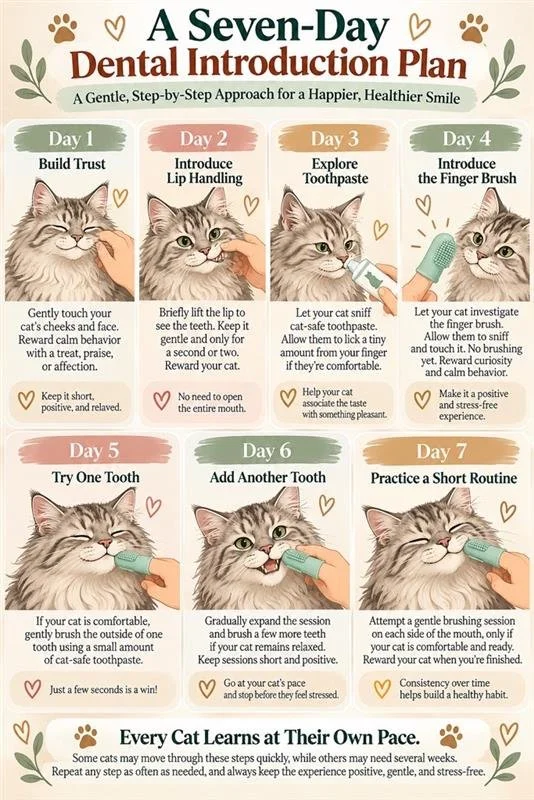
Every cat learns at their own pace, but this example can help you get started.
Day 1 — Build trust
Gently touch your cat’s cheeks and reward calm behavior.
Day 2 — Introduce lip handling
Briefly lift the lip, then reward your cat.
Day 3 — Explore toothpaste
Let your cat sniff or taste a tiny amount of cat-safe toothpaste.
Day 4 — Introduce the brushing tool
Allow your cat to investigate the finger brush or other appropriate tool without attempting to brush.
Day 5 — Try one tooth
If your cat is comfortable, gently brush the outside of one tooth.
Day 6 — Add another tooth
Gradually expand the session if your cat remains relaxed.
Day 7 — Practice a short routine
Attempt a few gentle strokes on each side of the mouth, only if your cat is ready.
Important!
This is an example, not a deadline.
Some cats may move through these steps quickly.
Others may need several weeks—or longer.
Repeat a step as often as necessary, and never rush a frightened or uncomfortable cat.
💛 What If Your Cat Absolutely Refuses Toothbrushing?
Not every cat will tolerate brushing, even with patience.
And that’s something owners should be prepared for.
If brushing remains difficult, speak with your veterinarian about other evidence-supported options.
These may include:
Veterinary Oral Health Council (VOHC)-accepted dental treats
Specially formulated dental diets
Certain dental gels or other oral care products
Veterinary dental examinations and professional cleaning when indicated
These alternatives can help support oral health, but they generally do not replace the plaque-removal benefits of effective daily brushing.
And none of them can treat a painful tooth fracture, advanced periodontal disease, or tooth resorption.
Never sacrifice your cat’s trust or safety just to complete a brushing session.
🩺 Don’t Forget Professional Dental Care
Even cats with excellent home routines still need veterinary dental examinations.
Your veterinarian can look for:
Gingivitis
Periodontal disease
Tooth resorption
Fractured teeth
Oral inflammation
Other abnormalities
Some dental problems develop beneath the gumline and cannot be identified through a simple visual inspection at home.
When indicated, professional dental procedures under anesthesia allow veterinarians to examine and clean the teeth thoroughly and obtain dental radiographs.
At-home brushing and professional veterinary care work together.
One does not completely replace the other.

✅ Your Cat’s Dental Care Checklist
Here’s a simple checklist you can use as part of your cat’s regular care routine.
Daily
[ ] Offer a brief, positive dental care interaction
[ ] Brush teeth if your cat is comfortable and your veterinarian has not advised against it
[ ] Notice any changes in eating or behavior
Weekly
[ ] Take a gentle look at the visible teeth and gums if your cat allows it
[ ] Check for persistent bad breath, redness, swelling, or visible tooth damage
[ ] Make sure dental supplies are clean and in good condition
During Routine Veterinary Visits
[ ] Ask your veterinarian to evaluate your cat’s oral health
[ ] Discuss whether professional dental care is recommended
[ ] Review your home dental routine and any concerns
If you notice significant pain, facial swelling, bleeding, or difficulty eating, don’t wait for a routine visit. Contact your veterinarian promptly.
🐾 The Biggest Lesson From Dental Health Week
If there’s one thing we hope you’ve learned from this week’s educational series, it’s this:
Dental care isn’t just about keeping teeth clean. It’s about protecting your cat’s comfort, health, and quality of life.
Throughout this week, we’ve explored:
Monday: Why your cat’s dental health matters.
Tuesday: How to brush your cat’s teeth.
Wednesday: Which dental products have evidence behind them.
Thursday: Common dental problems in Maine Coons.
Friday: How dental care changes from kittenhood through the senior years.
Saturday: How to turn that knowledge into a gentle, realistic routine.
Our hope is that these articles help families feel more confident about recognizing dental concerns, asking informed questions, and caring for their feline companions.
❤️ A Final Message From A Velvet Claw
When we look at our Maine Coons, we see so much more than their beautiful coats, magnificent ear tufts, and expressive personalities.
We see companions.
Family members.
Little personalities who bring extraordinary joy into everyday life.
And they depend on us.
They depend on us to recognize when something hurts.
To make thoughtful decisions about their health.
To be patient when something feels unfamiliar.
And to continue learning how to give them the best possible care.
At A Velvet Claw Maine Coon Cattery, education is part of that commitment.
We believe every cat deserves a lifetime of compassion, thoughtful care, and love.
And sometimes, making a meaningful difference begins with something as simple as a few gentle seconds of dental care.
Small habits. Healthy smiles. Extraordinary lives.
Thank you for joining us for Feline Dental Health Week!
💬 One Final Question for Our Community!
We’ve covered a lot of information this week!
What’s one thing you learned about feline dental health that you didn’t know before?
Tell us in the comments!
And if you found this series helpful, consider sharing it with another cat lover.
Together, we can help more families recognize the importance of lifelong dental care.
Extraordinary Cats. Brighter Tomorrows.
A Velvet Claw Maine Coon Cattery - Melina & Lexie
www.avelvetclaw.com
Educational Disclaimer: This article is intended for general educational purposes and does not replace professional veterinary advice, diagnosis, or treatment. Always consult your veterinarian regarding your cat’s individual oral health needs.