
Stripes, Swirls & Spots—Understanding the Beautiful Patterns Behind the Maine Coon
You’re looking at Maine Coon kittens. One has dramatic swirls along its sides. Another looks like a tiny tiger. And another seems almost solid from a distance—until you look closely and realize every individual hair seems to be doing something interesting.
Then you read the descriptions:
Classic tabby.
Mackerel tabby.
Ticked tabby.
And suddenly choosing a kitten feels like you need a degree in feline genetics. 😂 The good news? Once you know what you're looking for, the three primary tabby patterns are actually pretty easy to recognize. So grab your imaginary magnifying glass. 🔎🐾
We're going to talk stripes, swirls, ticking—and why two Maine Coons of the same color can look completely different.
First: Color and Pattern Aren't the Same Thing 🎨
This is one of the easiest things to confuse when you're learning about Maine Coon colors. Color describes the pigmentation of the coat. Pattern describes how that color is distributed.
For example, you might hear descriptions such as:
Brown classic tabby
Silver mackerel tabby
Red classic tabby
“Brown,” “silver” and “red” help describe the color. “Classic” and “mackerel” describe the tabby pattern. Think of it like this: Color = the paint. 🎨 Pattern = how the artist used it. 🖌️
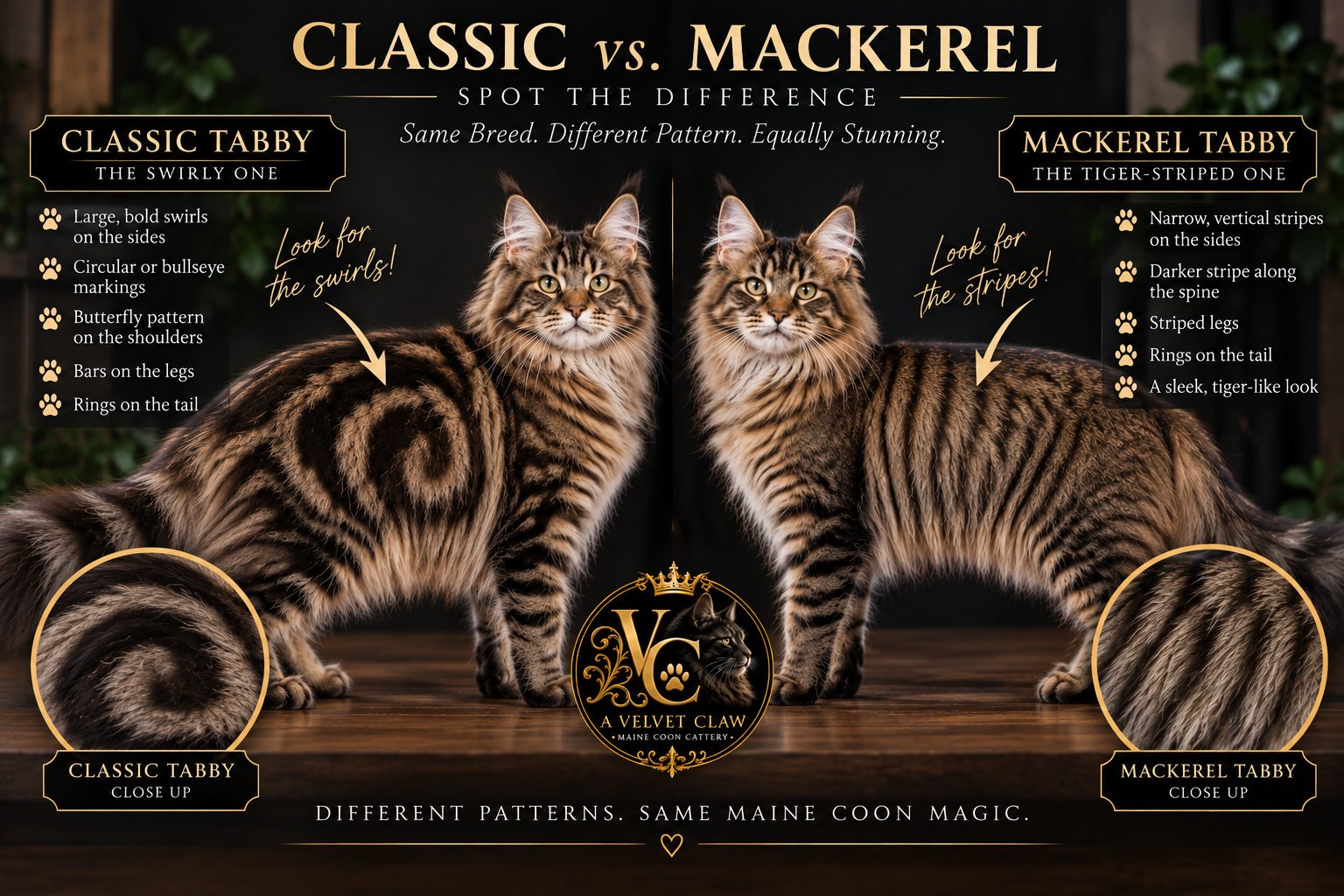
1. The Classic Tabby 🌀
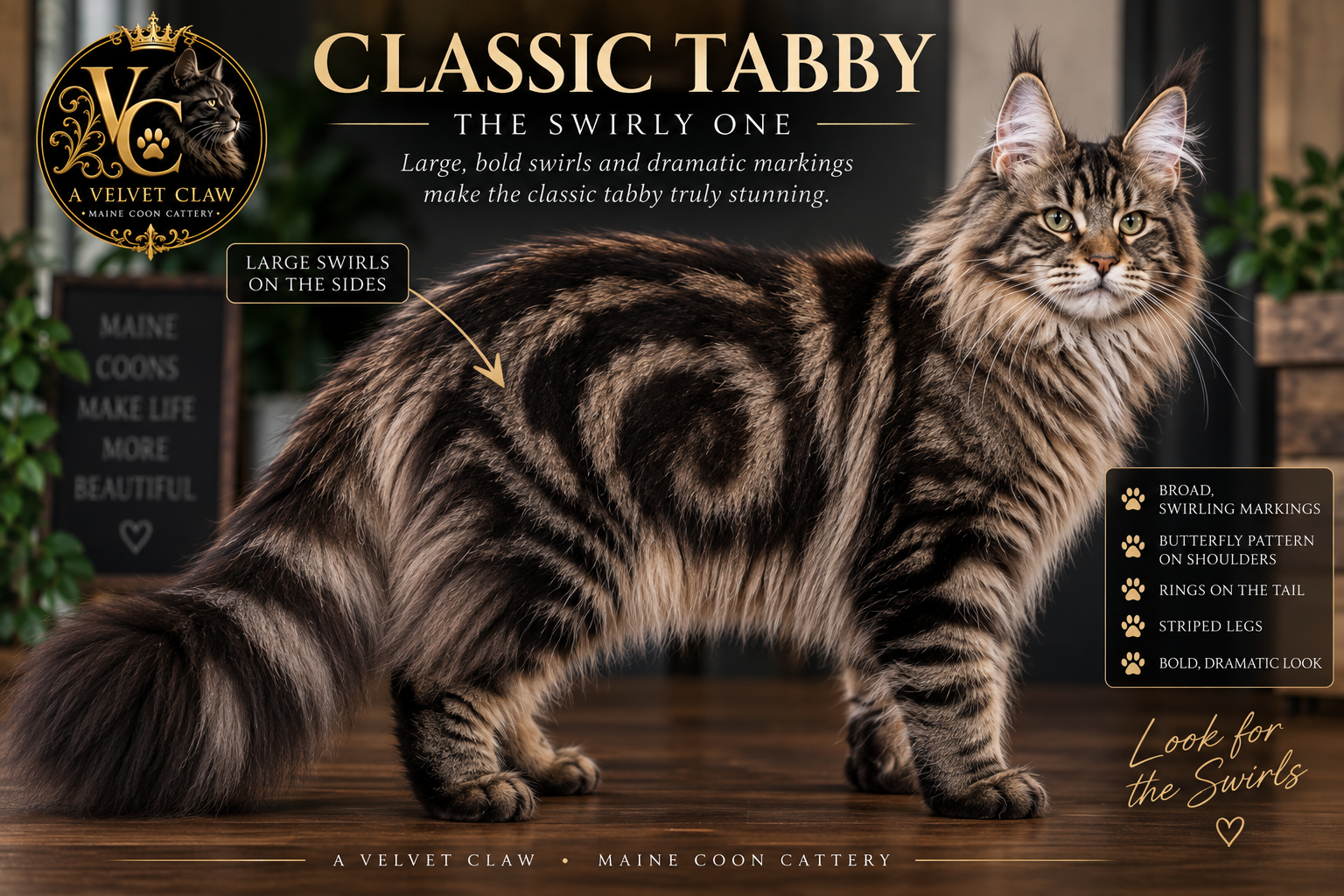
The Swirly One
If you've ever seen a Maine Coon with huge, dramatic swirls along its sides, you've probably been looking at a classic tabby. The classic pattern tends to create broader markings rather than lots of narrow vertical stripes.
You may see:
Large swirling patterns on the sides
Broad stripes
Circular or bull's-eye-like markings
A butterfly-like pattern across the shoulders
Rings around the tail
Bars on the legs
The pattern can look beautifully marbled. And on a long-haired Maine Coon? It can be spectacular. As the coat grows longer, those bold markings can flow through all that fur and create an almost painted appearance.
Basically: Someone spilled swirls all over the cat.
And we're keeping it. 😂🖤
2. The Mackerel Tabby 🐯
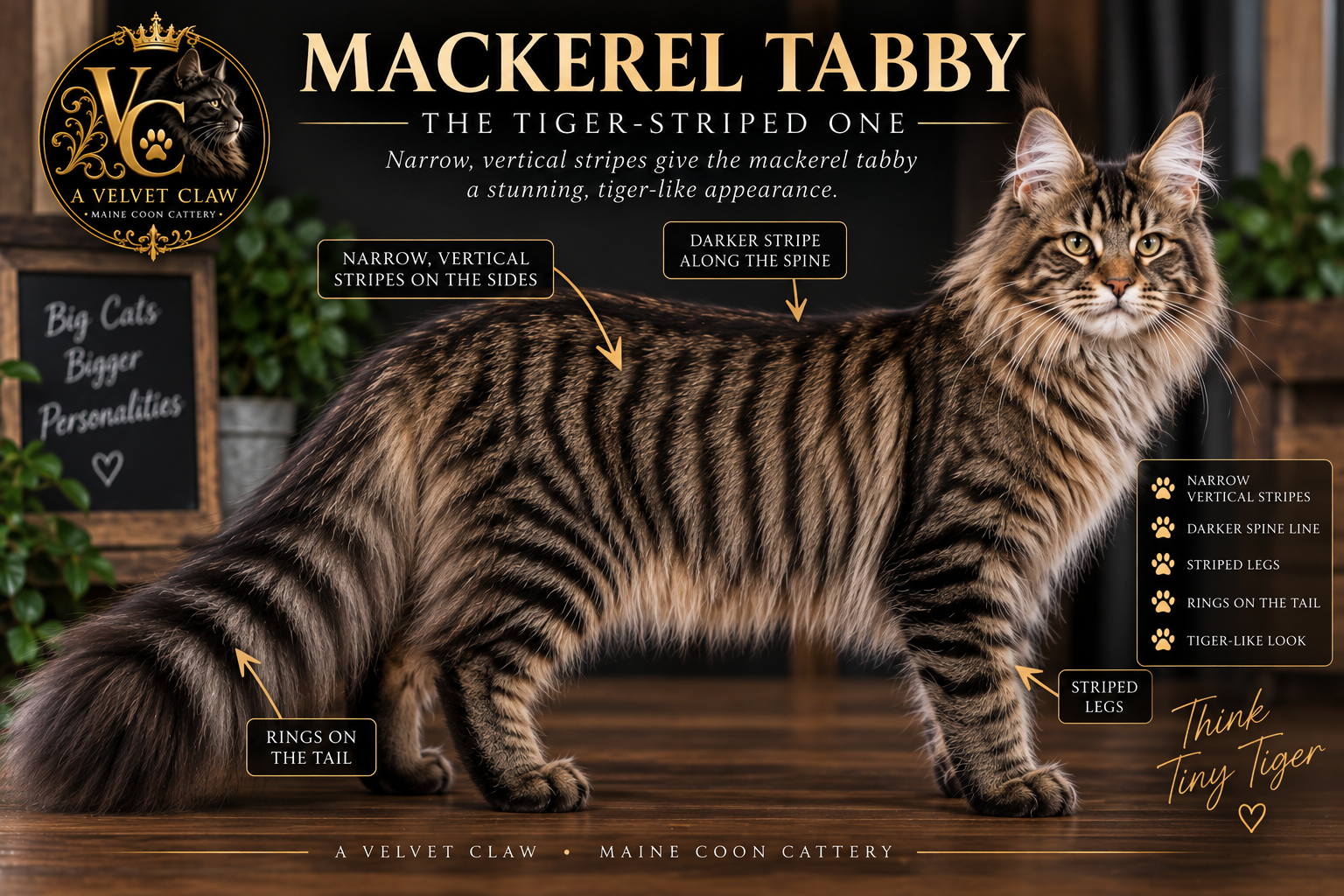
The Tiger-Striped One
The mackerel tabby has a very different look. Instead of broad swirls, mackerel tabbies typically have narrower stripes running down the sides of the body. There's usually a darker line along the spine, with stripes extending downward from it.
Think:
Tiny tiger.
You may notice:
Narrow vertical stripes along the sides
A darker stripe running along the back
Striped legs
Rings around the tail
More linear markings than a classic tabby
The name “mackerel” comes from the resemblance of the pattern to the bones of a fish skeleton.
Which is considerably less glamorous than saying: “My Maine Coon is dressed like a forest tiger.”
So we're going with forest tiger. 😂🐯
3. The Ticked Tabby ✨
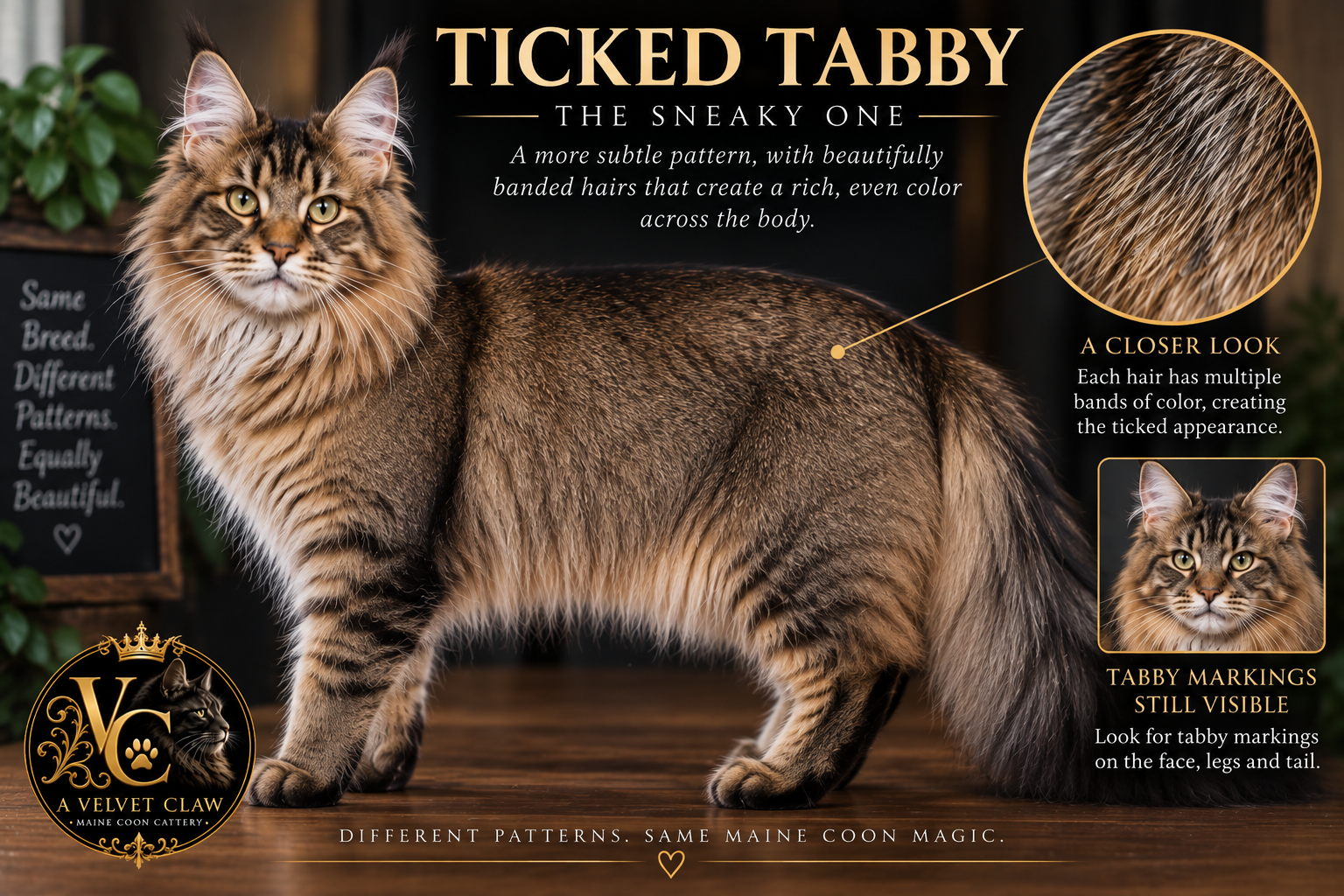
The Sneaky Tabby
Ticked tabbies can confuse people because they don't necessarily display the obvious body stripes we usually associate with the word tabby. Instead, much of the coat has agouti hairs—individual hairs with alternating bands of lighter and darker pigment. The result can be a more evenly textured or salt-and-pepper appearance across much of the body.
A ticked tabby may still show tabby markings around areas such as:
The face
Legs
Tail
Neck or chest
But the body itself may have far fewer obvious stripes or swirls. From across the room you might think: “That's not a tabby.” Then the cat turns around. Forehead markings. Facial lines. Striped legs. Surprise. Tabby. 😂
4. What About the Famous “M” on the Forehead? 👀
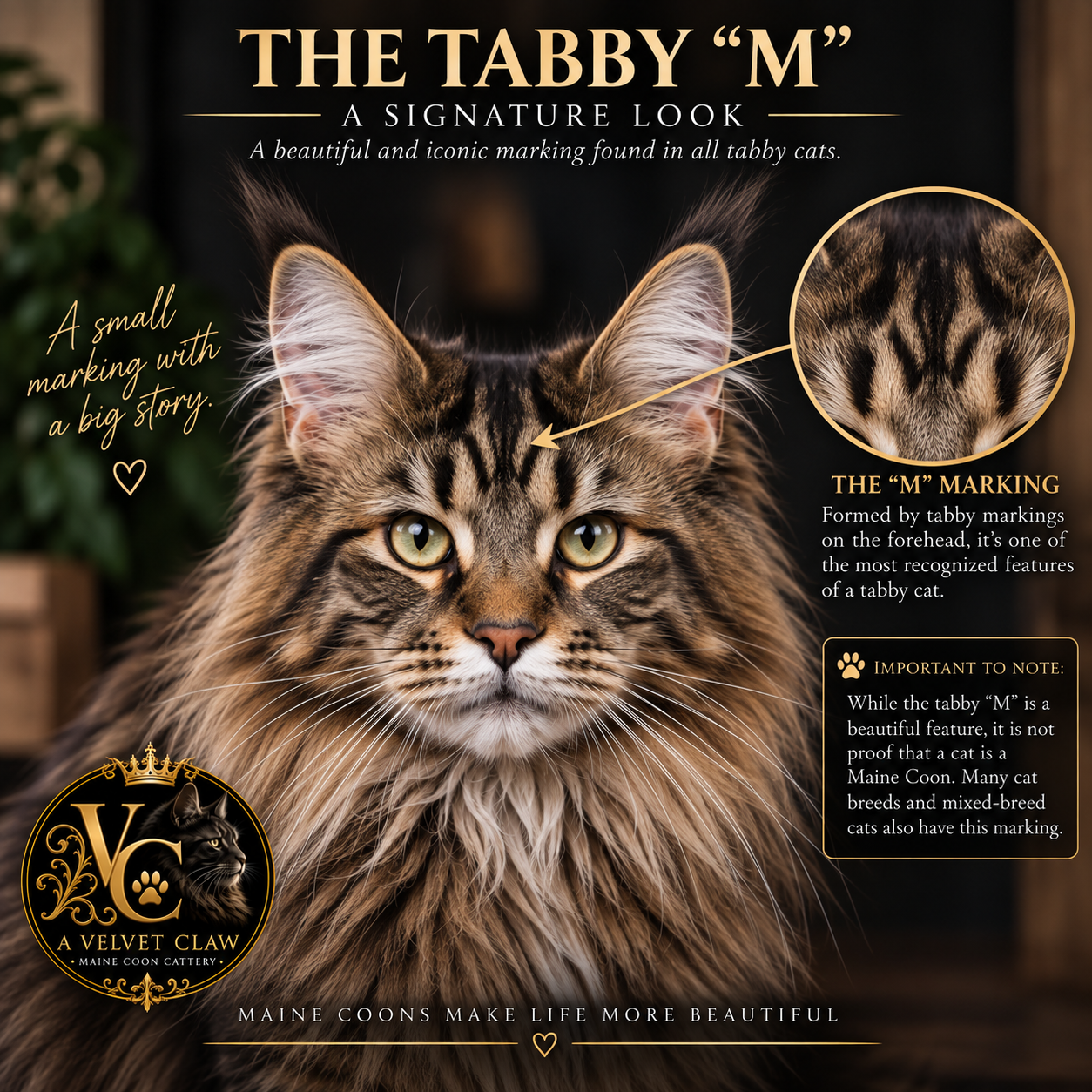
One of the most recognizable features associated with tabby cats is the marking that resembles an M on the forehead. You'll often see additional facial markings extending around the eyes and cheeks. And naturally, humans have created all kinds of charming legends explaining where the M came from. But scientifically, there's no mysterious Maine Coon stamp placed on their foreheads. 😂
It's simply part of the tabby patterning produced by genetics.
And importantly: The M does NOT mean the cat is a Maine Coon. Many tabby domestic cats have it. So while it's beautiful, it isn't proof of breed.
5. Classic vs. Mackerel: The Easiest Way to Tell 🔎
If you're trying to identify the pattern quickly, look at the sides of the cat's body.
Classic: Think SWIRLS. 🌀 Large, broad, curved or marbled markings.
Mackerel: Think STRIPES. 🐯 Narrower lines running down the sides.
Ticked: Think TEXTURE. ✨ Fewer obvious body stripes, with much of the visual pattern created by banded individual hairs.
So your cheat sheet is basically:
Classic = swirls
Mackerel = stripes
Ticked = ticking
Easy enough. 🖤
6. Why Can the Pattern Be Hard to See on a Maine Coon?
Because Maine Coons have an unfair amount of hair. 😂 A short-haired tabby's pattern may be relatively easy to identify. But Maine Coons have long, shaggy coats. As the coat develops, markings can appear softer, less sharply defined or visually different than they did when the cat was younger. Lighting can also make an enormous difference.
A pattern that looks subtle indoors may suddenly become obvious when sunlight hits the coat. And kittens are still developing their adult coats, so their overall appearance can change considerably as they mature. That's another reason photographs don't always tell the whole story.
7. Can Maine Coon Kittens' Patterns Change as They Grow? 🐾
The underlying genetically determined tabby pattern doesn't simply change from classic to mackerel because the kitten gets older.
A classic tabby doesn't wake up on its first birthday and decide: “I've had enough of these swirls. Tiger stripes from now on.” 😂
However, the appearance of the pattern can change.
As the kitten grows:
The body becomes larger
The coat becomes longer
Adult coat develops
Contrast may appear different
Seasonal coat changes can alter the overall appearance
So the same pattern can look surprisingly different on a little kitten compared with the mature Maine Coon.
8. Why Do Some Tabbies Have Spots?
Here's where things get interesting. Sometimes stripes can appear broken into spots or shorter segments. That can give the cat a spotted appearance rather than perfectly continuous lines. In some cat registries or breed standards, spotted tabby is recognized as its own pattern category. How patterns are named and classified can vary depending on the registry or standard being used.
So if you're looking at pedigrees, registrations or show terminology, use the terminology recognized by the appropriate registry rather than relying only on what the coat appears to resemble.
9. What Does “Agouti” Mean? 🧬
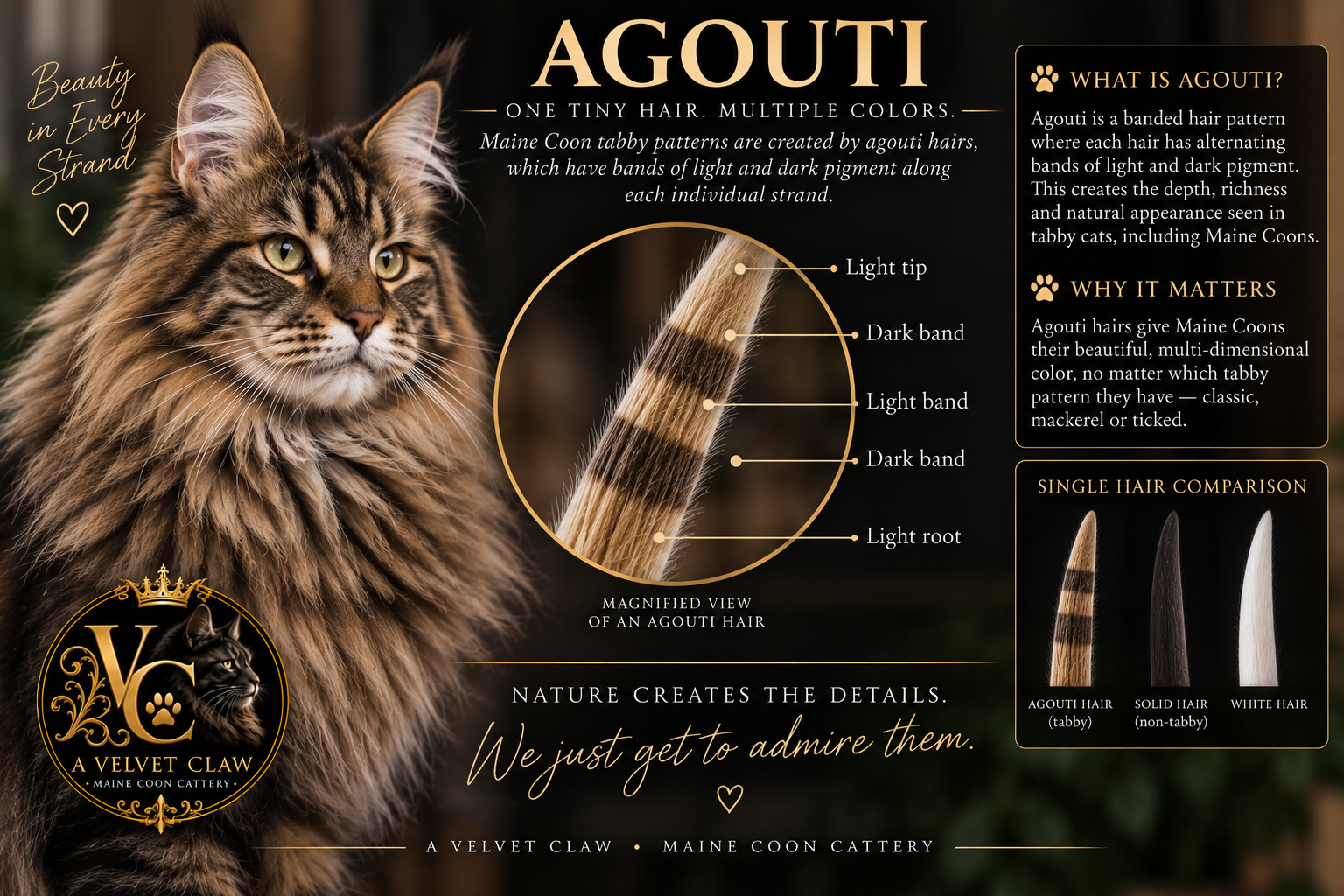
You'll hear this word frequently when learning about tabbies. Agouti refers to the banding of pigment on individual hairs. Instead of one hair being a single solid color from root to tip, an agouti hair contains bands of pigmentation. Those hairs contribute to the characteristic appearance of tabby coats.
It's one of those genetics terms that sounds intimidating until you realize: We're basically talking about striped hairs helping create a striped cat.
Genetics just likes fancy vocabulary. 😂
10. Tabby Pattern Is Genetic 🧬🐾
Your Maine Coon didn't personally select “Classic Swirl Package” before birth. Although I'm sure they would have if given the option. Tabby appearance is influenced by inherited genes that affect whether tabby patterning is expressed and what form that pattern takes. Breeders use pedigrees, knowledge of parent colors and patterns, and genetic principles to help understand what kittens may be produced from a pairing. But genetics can get complicated quickly.
Especially once you start adding:
Silver.
Smoke.
Dilution.
Tortoiseshell.
White spotting.
Sex-linked red.
And suddenly our cute little article about stripes has become a university course. 😂 We'll save those for another day.
11. Does One Tabby Pattern Make a Maine Coon “Better”?
No. This is important. Classic isn't better than mackerel. Mackerel isn't better than ticked. And having particularly dramatic markings doesn't make a cat healthier, better-tempered or inherently superior. Pattern is one part of the cat's appearance.
For responsible breeding, much bigger considerations include things like:
Health.
Temperament.
Structure.
Genetic diversity.
Pedigree.
Breed characteristics.
Overall quality of life.
A breathtaking coat is wonderful. But what's underneath that coat matters far more. 🖤
12. And Pattern Doesn't Determine Personality ❤️
Your classic tabby isn't going to be more affectionate because they have swirls. Your mackerel isn't automatically more adventurous because they look like a tiger. And your ticked tabby isn't secretly plotting something just because they managed to hide their stripes.
Okay... That last one is still possible. They're Maine Coons. We can't rule anything out. 😂
But coat pattern itself shouldn't be used as a reliable predictor of personality. Individual temperament is far more complicated than that.
🐾 Classic, Mackerel or Ticked—Which Is the Prettiest?
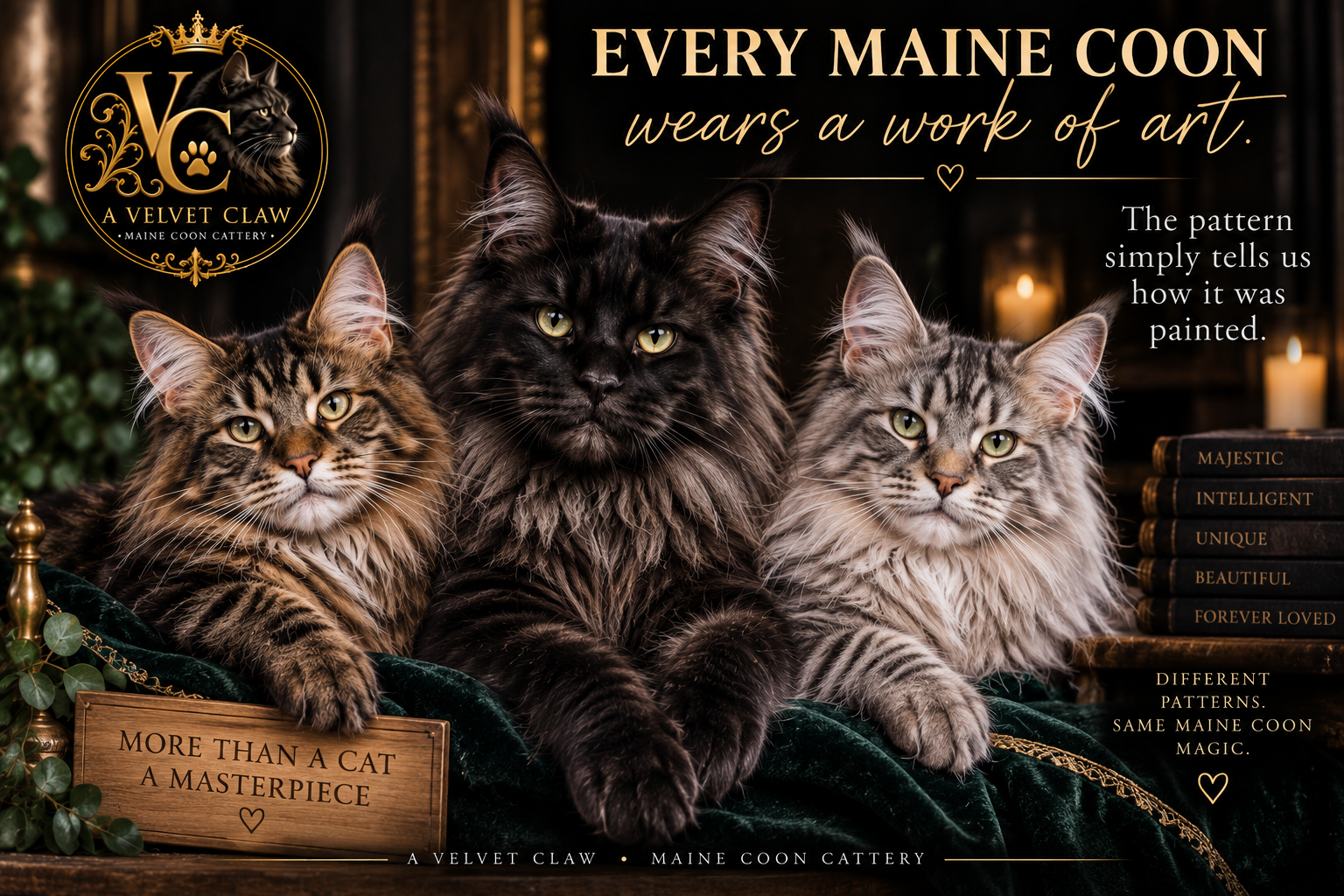
This is where we can finally provide the definitive scientific answer: Yes. 😂
Classic Maine Coons can have breathtaking swirls. Mackerels can look like enormous little woodland tigers. Ticked coats can have incredible depth and texture when you see them up close.
And the magic of Maine Coons is that color, pattern, coat length, expression and individual structure can combine in so many different ways.
Two Maine Coons can both be tabbies... and look nothing alike.
🖤 Learning to See What's in the Coat
Once you learn the difference between tabby patterns, something funny happens. You start seeing them everywhere.
Instead of: “That's a pretty striped cat.”
Suddenly you're standing there thinking: “Hmm... narrow vertical body stripes. Definitely looks mackerel.” 😂
But understanding coat terminology isn't only fun. For Maine Coon owners, prospective families and breeders, it helps make pedigree descriptions, registrations and conversations about genetics much easier to understand. So the next time you see a Maine Coon covered in gorgeous markings, look a little closer.
Are you seeing... Swirls? 🌀 Stripes? 🐯 Or ticking? ✨
Because every Maine Coon wears a work of art. The pattern simply tells us how it was painted. 🖤💛🐾
🖤 Keep Learning With A Velvet Claw
If you enjoyed learning about the beautiful patterns behind the Maine Coon coat, follow A Velvet Claw for more Maine Coon education, genetics, behavior, development, breeder insight—and, of course, plenty of gorgeous Maine Coons along the way. 🐾 We believe the more you understand this incredible breed, the more there is to love about them.
So follow along—there’s always something new to discover beneath all that floof. 🖤💛🐾
Fur - ever grateful: Lexie & Melina
Maine Coon tabby patterns • Classic tabby Maine Coon • Mackerel tabby Maine Coon
Ticked tabby Maine Coon • Maine Coon coat patterns • Classic vs mackerel Maine Coon