
🐾 Why Maine Coons Love High Places
The Instinct Behind Your Maine Coon’s Need to Climb, Perch & Supervise Everything
You walk into the kitchen and there they are. On top of the refrigerator. You turn around... Now they're on the back of the couch. Five minutes later, your Maine Coon is perched at the very top of the cat tree, staring down at the entire household like a tiny furry monarch surveying their kingdom. 👑
If you live with a Maine Coon, you've probably discovered something pretty quickly: These cats LOVE a good vantage point. And while their impressive size can make their climbing adventures especially noticeable, the desire to seek elevated spaces isn't simply a quirky Maine Coon habit.
It's deeply connected to normal feline behavior. So why does your Maine Coon want to be above everyone?
Let's climb into the science—and the silliness—behind it. 🖤💛
🌳 Cats Were Built to Think Vertically
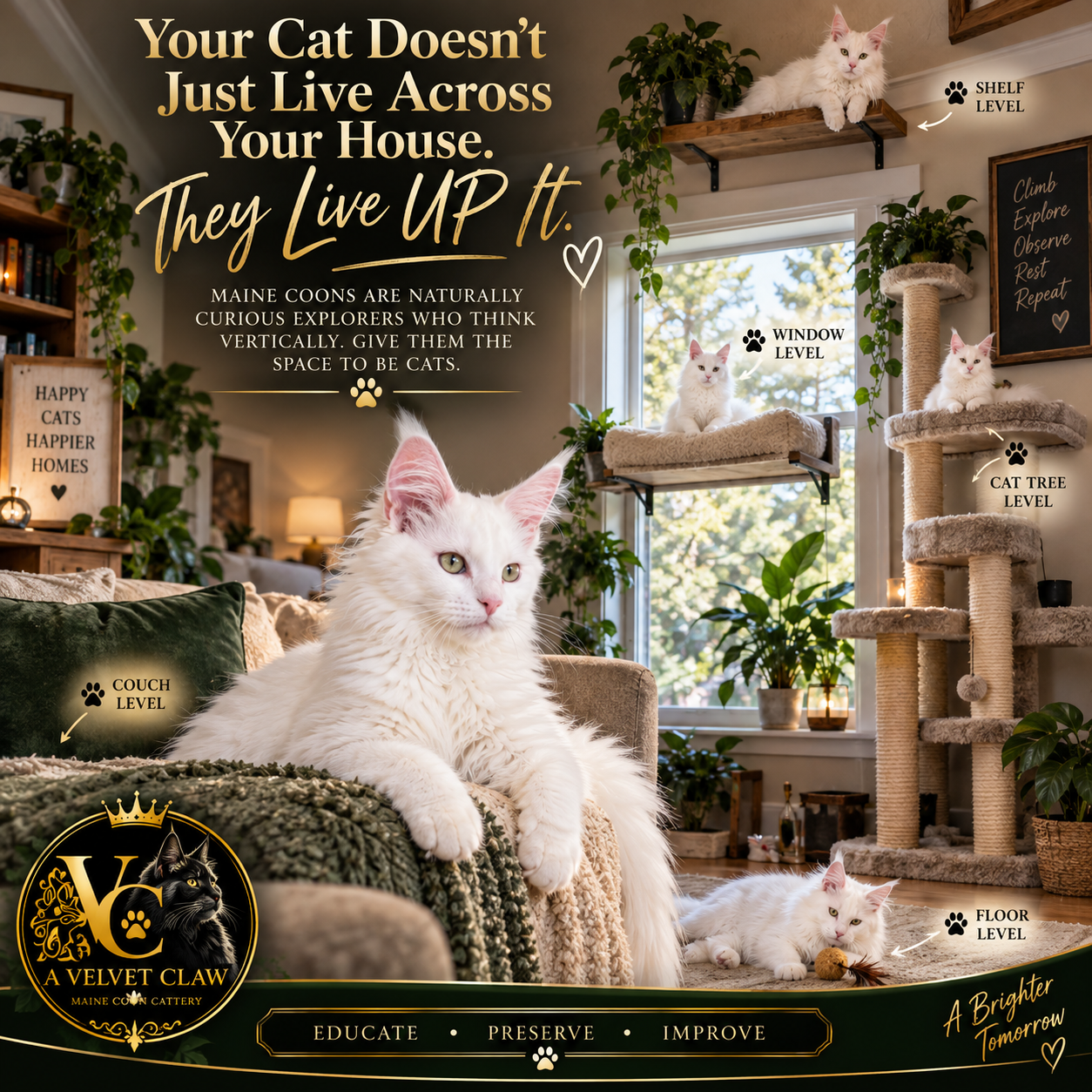
Humans tend to think about our homes in terms of floor space. Cats don't. To a cat, your home exists in three dimensions. The floor is territory. The couch is territory. The windowsill is territory. The bookshelf is territory. And yes... Apparently the top of your kitchen cabinets is also territory. 😂
Cats naturally use elevated areas for resting, observation and security. Feline environmental guidelines specifically recognize elevated resting areas and vertical space as important parts of a cat-friendly environment.
In other words: Your cat doesn't just live across your house.
They live up it, too.
👀 Height Gives Cats Information
Imagine standing in the middle of a crowded room. Now imagine standing on a balcony overlooking that same room. Suddenly, you can see everything. Your Maine Coon gets a similar advantage from an elevated perch.
From up high, a cat can observe:
🐾 People moving through the house
🐾 Other pets
🐾 Doors opening
🐾 Food preparation
🐾 Favorite humans
🐾 Interesting noises
🐾 Potential disturbances
🐾 And apparently every private thing you've ever attempted to do 😂
A high perch gives a cat an excellent observation point without requiring them to participate in everything happening below. And for an intelligent, curious breed like the Maine Coon, that can be especially appealing.
🛡️ High Places Can Feel Safe
There's another major reason cats seek elevation: Security.
An elevated resting spot can allow a cat to relax while still monitoring the environment. This can be particularly useful in a busy household. Maybe there are children. Maybe there are dogs. Maybe there are several cats. Or maybe your Maine Coon simply wants somewhere peaceful where nobody can accidentally step on their tail.
Environmental guidelines for cats recommend providing safe resting and hiding locations, including elevated options, because cats benefit from places where they can retreat and feel secure. Sometimes your Maine Coon isn't climbing because they want attention.
They may be climbing because they want a little space.
👑 Sometimes They Just Want to Supervise You
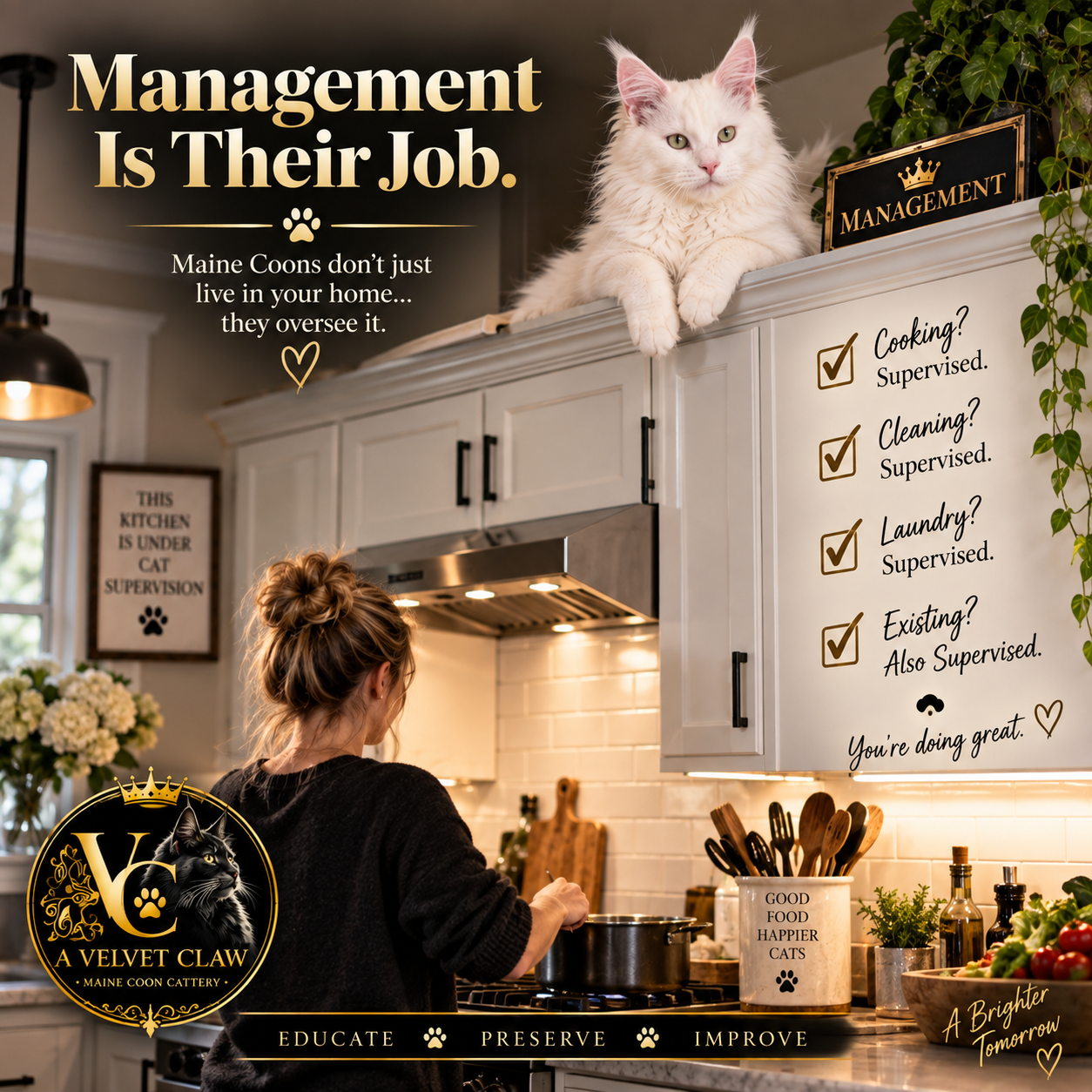
We can't discuss Maine Coons without acknowledging this. Some of them seem absolutely convinced that management is their job. Cooking dinner? Supervised. Folding laundry? Supervised. Cleaning the house? Definitely supervised. Working on your computer? Your performance review begins immediately. 😂
Maine Coons are often very socially involved with their families, so an elevated perch in a busy room can give them the best of both worlds: Close to their people—but not necessarily on top of their people. They can watch everything while maintaining their preferred amount of personal space.
It's basically the feline equivalent of an executive office overlooking the company floor.
🪟 Why Windows Are Especially Valuable
If you're deciding where to place a cat tree, don't underestimate the power of a window. A high window perch combines two things cats often enjoy: Elevation + entertainment.
Birds.
Squirrels.
Leaves.
People.
Cars.
Insects.
Neighborhood activity.
Your Maine Coon may sit there for ages watching the world outside. For an indoor cat, this kind of visual stimulation can be an important form of enrichment. Just make sure windows and screens are secure—especially with a large, powerful Maine Coon leaning against them.
🧠 Vertical Space Is Enrichment
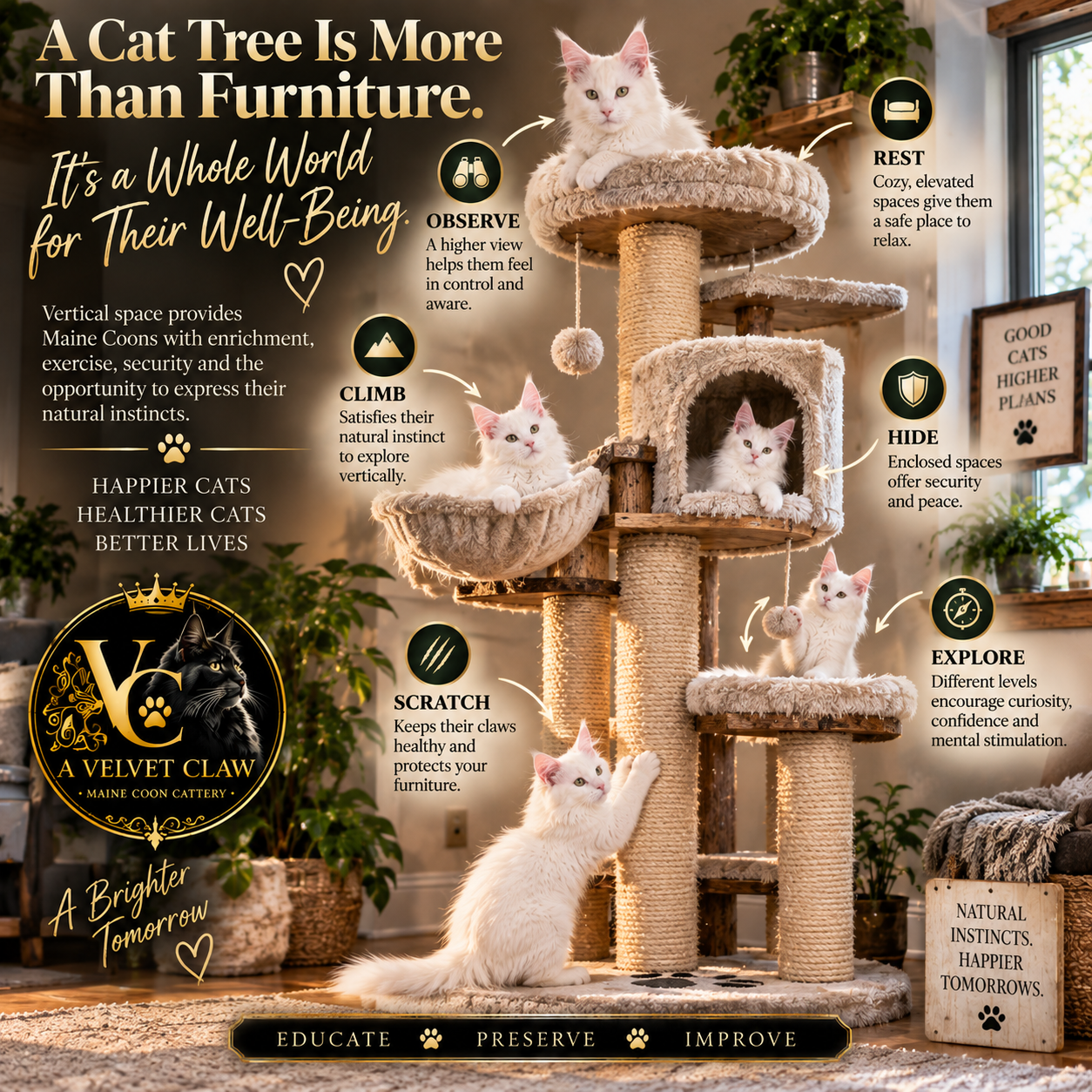
We often think enrichment means toys. And toys absolutely matter. But enrichment is much bigger than that. A cat-friendly environment gives cats opportunities to: Climb. Explore. Scratch. Observe. Hide. Rest. Hunt through play. Make choices.
Vertical territory provides several of those opportunities at once. A tall cat tree isn't merely furniture.
To your Maine Coon, it may function as:
🌳 A climbing structure
👀 An observation tower
😴 A sleeping area
🛡️ A safe retreat
🐾 A scratching station
🧠 A source of environmental enrichment
That's a lot of value from one piece of furniture.
🏠 Vertical Territory Can Make Your Home Feel Bigger
This becomes especially important in homes with multiple cats. Imagine two cats sharing one room. If they can only use the floor, they have a limited amount of territory available.
Now add:
A tall cat tree.
Window shelves.
A sturdy wall perch.
The back of a sofa.
Several resting levels.
You haven't added a single square foot to the house... But you've dramatically increased the usable space available to your cats.
Feline environmental guidance recognizes the importance of separated resources and safe places, particularly in multi-cat environments where competition and social tension can occur. Vertical space can give cats more choices about where they want to be and how close they want to be to one another.
And choice matters.
🐈 Maine Coon Size Changes the Equation
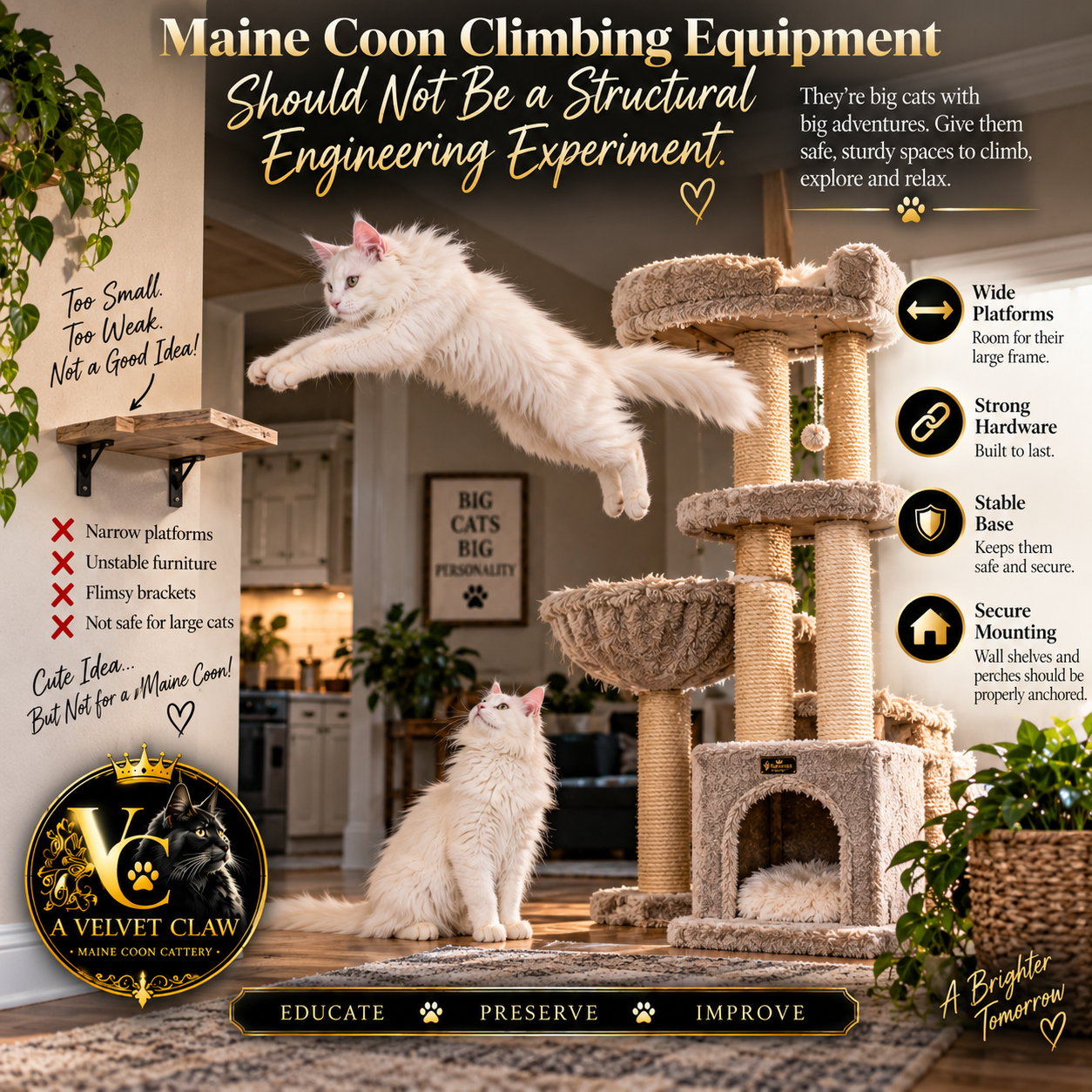
Here's where owning a Maine Coon becomes a little different. A small cat jumping onto a flimsy shelf is one thing. A fully grown Maine Coon launching onto it at speed is... A structural engineering experiment. 😂
Maine Coons are large, substantial cats. That means their climbing equipment needs to accommodate their body size—not just their weight.
Look for:
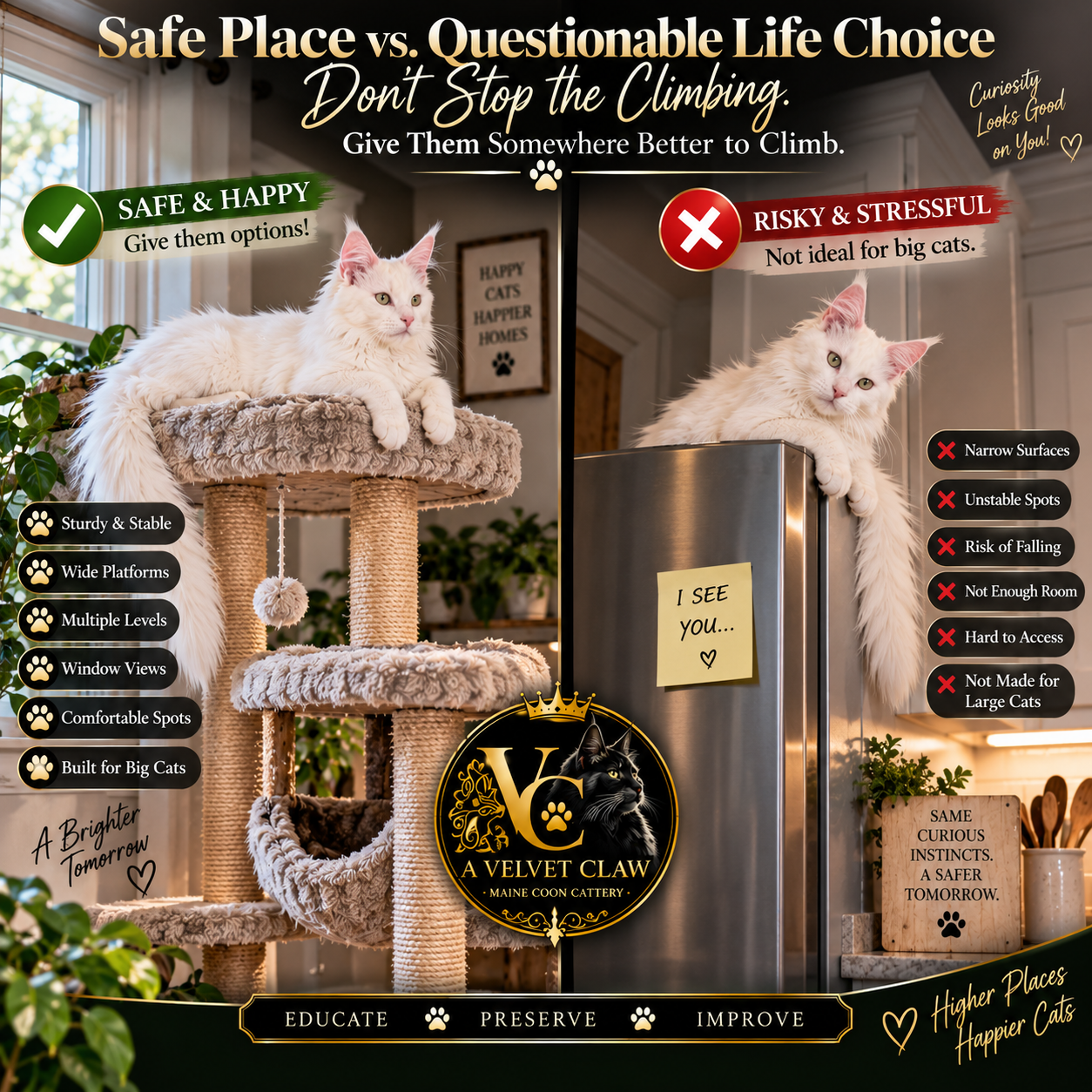
Wide platforms so the entire cat can rest comfortably.
Large sleeping areas where they aren't hanging halfway off.
A broad, stable base so the tree doesn't wobble.
Strong posts and hardware that can tolerate repeated jumping.
Secure wall mounting for shelves and climbing systems.
And don't forget that a Maine Coon kitten may eventually become much larger than they are today. That adorable little kitten-sized perch might not look quite as adorable when 18 pounds of adult Maine Coon attempts to occupy it. 😂
🚫 Not Every High Place Is a Good High Place
Your Maine Coon doesn't automatically know which elevated surfaces you've deemed safe. If the refrigerator is available... They're probably going to investigate the refrigerator. If there's a tall bookshelf... Challenge accepted. If there's a narrow ledge near something fragile... Obviously that's where the cat belongs. 😂
Instead of trying to eliminate climbing completely, it often makes more sense to provide better alternatives. Give your cat an approved high perch near the place they keep trying to reach. A cat tree beside the window may become more appealing than the bookshelf. A wall-mounted perch may beat the top of the entertainment center.
The goal isn't: “Never climb.” It's: “Here are safer places to climb.”
⚠️ Secure Tall Furniture
This one deserves its own section—especially with Maine Coons. Bookcases, shelving units, cat trees and other tall furniture should be stable and appropriately secured when necessary. A large cat jumping from one surface to another can generate considerably more force than their standing body weight might suggest. Also check climbing equipment regularly.
Look for:
🔩 Loose hardware
🪵 Cracked platforms
🧵 Damaged fabric or rope
📐 Wobbling structures
🧱 Loose wall anchors
Your cat tree is basically playground equipment. Playground equipment needs maintenance.
🐾 What About Kittens?
Maine Coon kittens can have an incredible combination of: Confidence + Curiosity + Questionable Judgment. 😂
They may discover that they can climb somewhere before figuring out how to get back down. Provide age-appropriate climbing opportunities and supervise access to potentially dangerous areas while they're learning.
Watch for:
Open stair railings.
Unsecured screens.
Tall unstable furniture.
Spaces behind appliances.
High ledges with dangerous landing areas.
And anything that allows a kitten to climb somewhere you can't safely retrieve them.
Their confidence occasionally develops faster than their coordination.
👵 Older Maine Coons Still Deserve the View
A Maine Coon may continue loving elevated resting spots even when jumping becomes more difficult. Older cats—or cats with mobility limitations—may benefit from having easier routes to their favorite locations.
Instead of expecting one huge jump, consider:
🐾 Pet stairs
🐾 Intermediate shelves
🐾 Lower platforms
🐾 Ramps
🐾 Furniture arranged as stepping points
The goal is to preserve access without requiring uncomfortable leaps. If your Maine Coon suddenly stops climbing, hesitates before jumping, misses jumps, seems stiff, or changes how they move, that's worth discussing with your veterinarian. Behavior changes can sometimes be one of the first clues that something physical has changed.
💤 Why Do They Sleep Up There?
Because apparently a $200 luxury cat bed on the floor cannot compete with the top of a cardboard box six feet in the air. That's just science. Okay... Maybe not that part. 😂 But elevated sleeping locations can combine several things cats value: Warmth. Security. Visibility. Privacy.
Your Maine Coon can sleep while still remaining aware of what's happening around them. And some cats simply develop favorite resting spots. Once your Maine Coon has claimed one... Good luck convincing them otherwise.
🐈⬛ Does the Highest Cat Mean the “Dominant” Cat?
Not necessarily. It's tempting to see a cat sitting above another and think: “Oh! That must be the dominant one.”
Cat social relationships are more complicated than a simple vertical hierarchy. Cats may choose elevated spaces because of comfort, temperature, security, access to people, preferred sleeping locations or the ability to avoid another animal. So don't automatically interpret height as a declaration of feline political power.
Sometimes the cat on top of the refrigerator... Just really likes the refrigerator.
🏡 Creating a Maine Coon-Friendly Vertical Environment
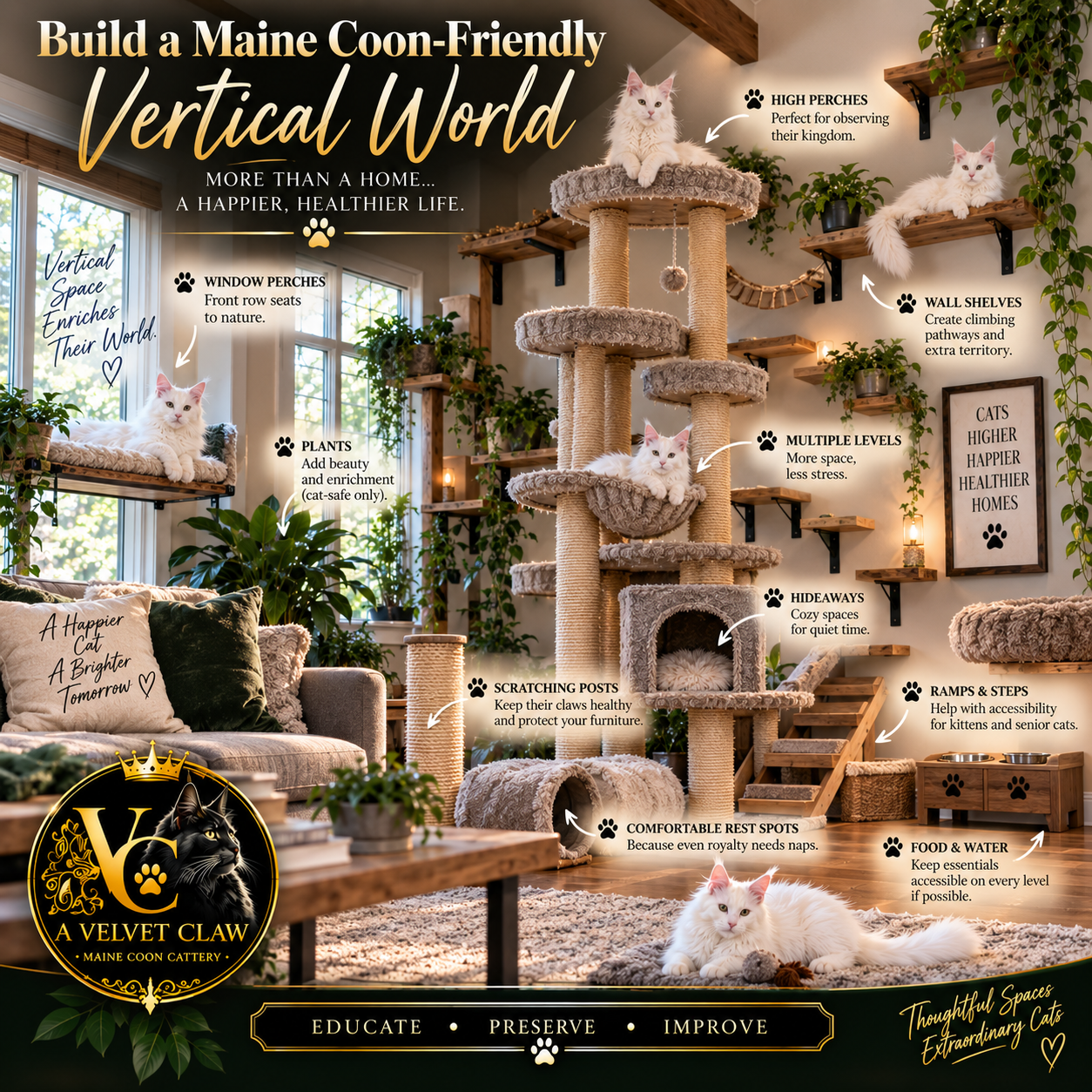
You don't need to turn your living room into an indoor jungle gym. Although... We fully support the aesthetic. 😂 Even a few thoughtful additions can make a big difference.
Consider providing a combination of:
A tall, sturdy cat tree
A window perch
Secure wall-mounted shelves
Large resting platforms
Scratching posts with height
Multiple levels in multi-cat areas
Easy-access options for older cats
Then pay attention to what your Maine Coon actually uses. Every cat has preferences. One may want the highest possible platform. Another may prefer being only slightly elevated but close to you. The best enrichment gives your cat choices.
👀 Watch What Your Maine Coon Is Telling You
Your cat's behavior can teach you a lot about what they need.
If your Maine Coon constantly climbs onto a particular bookshelf, ask:
What's special about that location?
Is it near a window?
Is it quiet?
Is it warm?
Can they see the whole room?
Does another pet leave them alone there?
Are they trying to stay close to you?
Instead of thinking: “How do I stop my cat from going there?” sometimes the better question is: “What is my cat getting from that location—and can I provide it somewhere safer?” That's enrichment through your cat's eyes.
🖤 The Whole House Looks Different From Up There
To us, a shelf is a shelf. A cabinet is a cabinet. A windowsill is a windowsill. But to your Maine Coon? They're lookout towers. Safe spaces. Nap locations. Observation posts.
And occasionally... Royal thrones. 👑😂
Providing safe vertical territory allows our cats to express natural behaviors while giving them more control over their environment. And when you're sharing your home with a giant, intelligent, curious Maine Coon, that's especially valuable.
🌟 The Bottom Line

Maine Coons don't seek high places simply because they're trying to cause trouble. Okay... Maybe occasionally. 😂 But climbing and seeking elevated resting spaces are normal feline behaviors.
Height can provide:
🐾 Security
👀 Visibility
🧠 Enrichment
😴 Comfortable resting areas
🏡 Additional usable territory
🐈 More choices in multi-cat homes
The goal isn't to stop your Maine Coon from climbing. Give them somewhere worth climbing to. Because if you don't choose the penthouse... Your Maine Coon probably will. 👑🐾
🐾 Keep Learning With A Velvet Claw
At A Velvet Claw Maine Coon Cattery, we believe understanding our cats means looking beyond how beautiful they are and learning why they behave the way they do. The more we understand their natural instincts, the better environments we can create for them.
And sometimes that means accepting one very important truth: Your house has two floor plans. The one you live in... and the one your Maine Coon discovered above it. 😂🖤💛
Fur - ever grateful: Lexie & Melina
Why Maine Coons love high places • Maine Coon climbing • Maine Coon behavior
Maine Coon vertical space • Maine Coon enrichment • Maine Coon cat tree