
🧬 Why Genetic Diversity Matters in Maine Coon Breeding
Why Responsible Breeding Is About More Than Producing Beautiful Kittens
Maine Coons are extraordinary cats. Their size, temperament, intelligence, beautiful coats and unmistakable appearance have made them one of the most recognizable cat breeds in the world. But preserving the Maine Coon isn't simply about producing kittens that look like Maine Coons.
Responsible breeders also have to think about something we can't see when we look at a beautiful cat: 🧬 Genetic diversity.
Every breeding decision influences more than one litter. The cats we choose today contribute genes to the Maine Coon population of tomorrow—and those decisions can continue echoing through pedigrees for generations. That's why understanding genetic diversity is such an important part of responsible breeding.
So what exactly does genetic diversity mean? And why should Maine Coon breeders—and kitten families—care about it?
Let's break it down. 🖤💛
🧬 What Is Genetic Diversity?
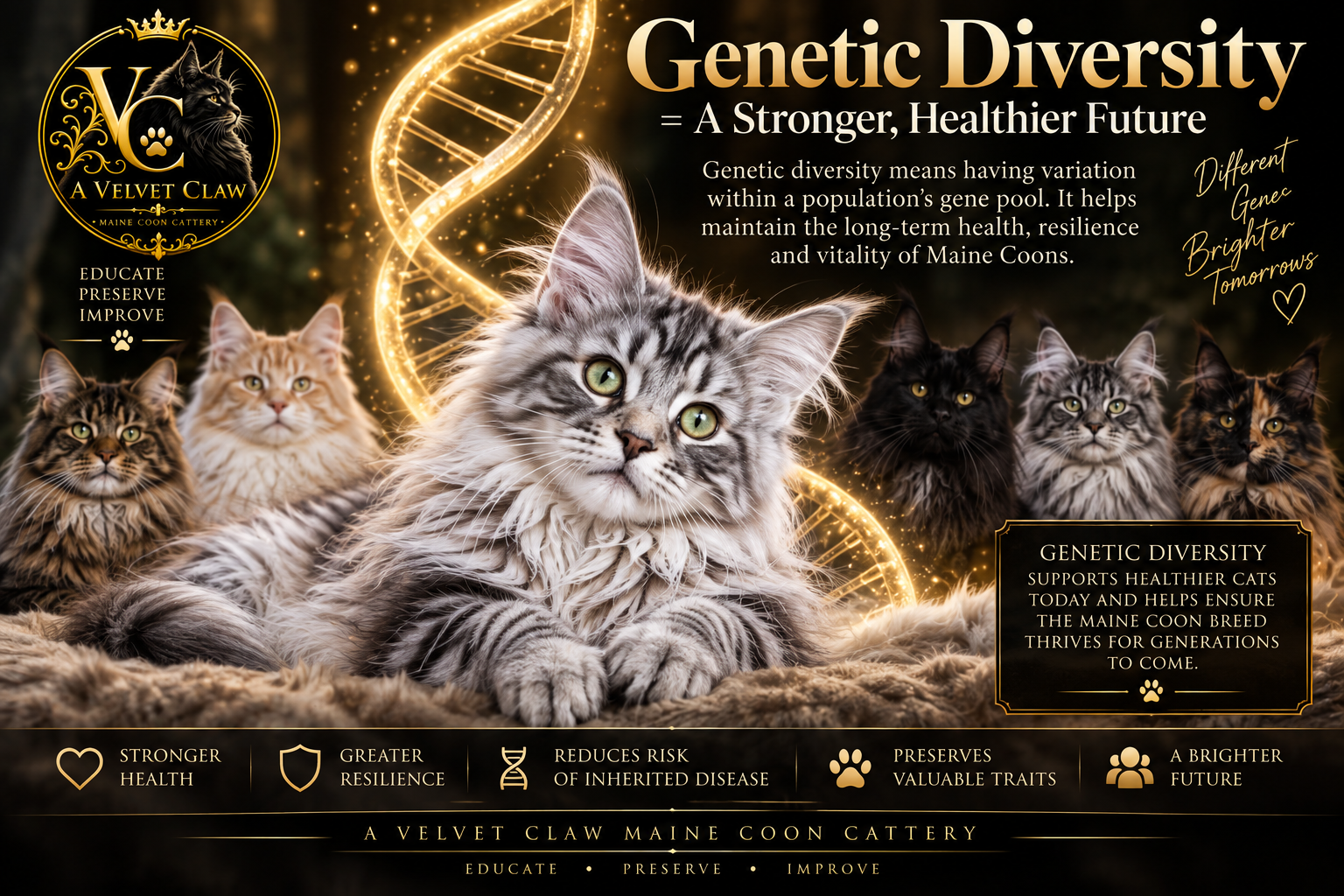
In simple terms, genetic diversity means having variation within a population's gene pool. Every cat inherits genetic material from both parents. Those genes influence countless characteristics—from visible traits such as coat color to biological processes we may never see. Within a breed, we naturally expect cats to share ancestry and many genetic characteristics. That's part of what creates a recognizable breed.
But we don't want every cat becoming genetically too similar.
Genomic research in domestic cats has demonstrated measurable differences in inbreeding and genetic relationships among breeds and populations, including geographically separated Maine Coon populations. Researchers emphasize breeding practices that maintain or increase diversity as one consideration in reducing risks associated with excessive inbreeding.
Think of genetic diversity as a library. 📚 A library with thousands of different books contains enormous amounts of information. Now imagine slowly replacing those books with additional copies of the same few titles.
The library may still contain thousands of books... But it contains much less variety. A gene pool can experience something similar.
🧩 Homozygous vs. Heterozygous: The Beginner Version
You'll sometimes hear these words when discussing genetic diversity. They're much easier to understand than they sound. For a particular genetic location, a cat generally inherits one version—an allele—from its mother and another from its father. If those two versions are the same, the cat is homozygous at that location.
If they're different, the cat is heterozygous. Neither word automatically means good or bad. Every healthy animal naturally has areas of both homozygosity and heterozygosity. The concern arises when breeding practices repeatedly increase genetic similarity across large portions of the genome or across a population.
Why? Because related cats are more likely to inherit genetic material originating from the same ancestors.
And that brings us back to something we've already discussed...
📊 Remember COI?
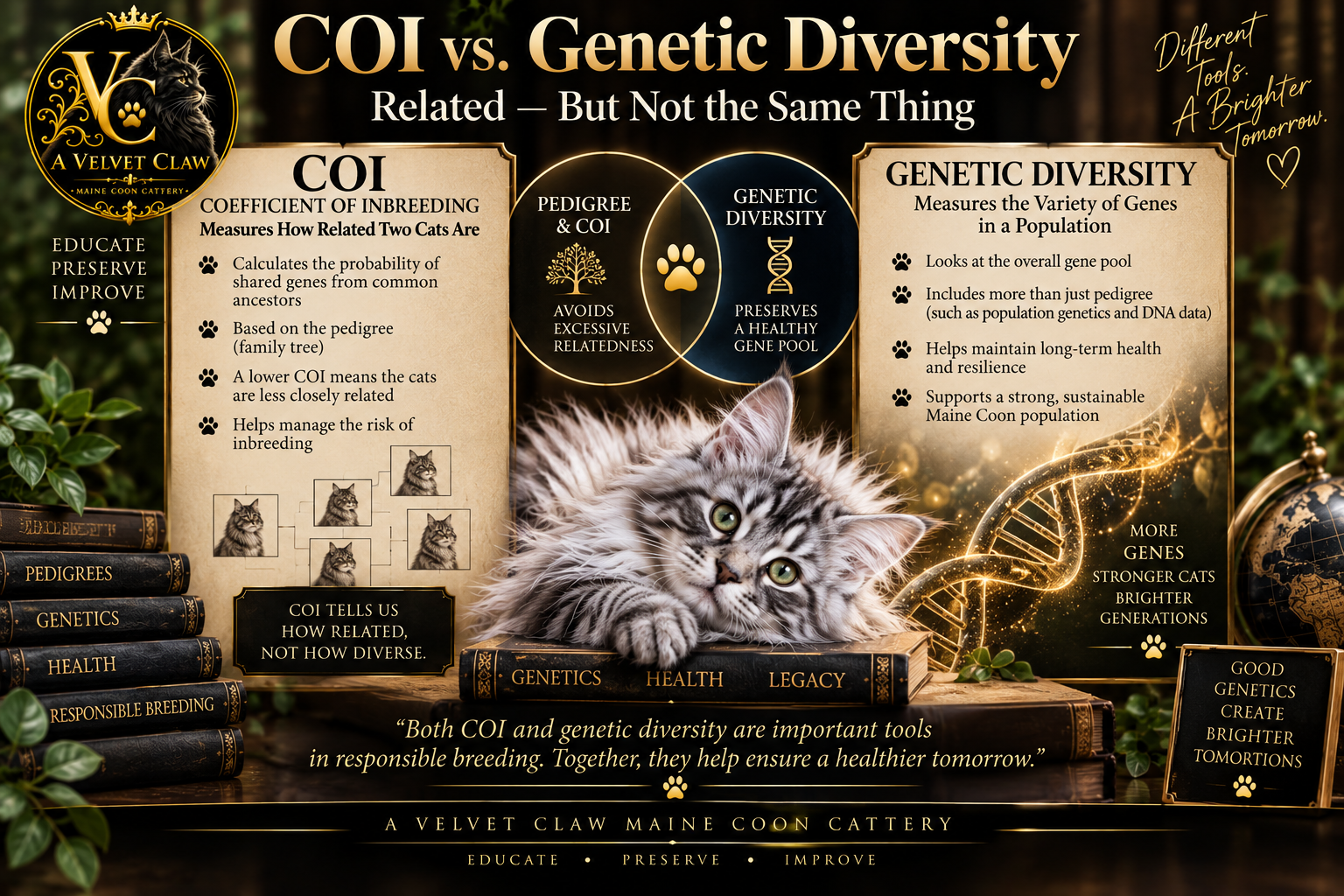
If you've read our article about Coefficient of Inbreeding (COI), this is where everything begins connecting. COI uses pedigree relationships to estimate the probability that the two copies of a gene at a location are identical by descent from a shared ancestor.
Generally speaking, closer or repeated relatedness increases that probability. But remember: COI and genetic diversity are related concepts—not interchangeable measurements.
Pedigree COI is calculated from documented ancestry. Genomic methods can instead examine DNA directly and estimate things such as homozygosity across the genome. Research comparing feline populations has used genomic measures such as runs of homozygosity to evaluate inbreeding rather than relying solely on pedigree calculations.
That's why one percentage should never become the entire breeding program.
🌳 Every Purebred Population Has Shared Ancestry
Here's something important to understand: Finding common ancestors in a Maine Coon pedigree is not automatically alarming. A recognized breed is a population descended from a finite number of cats, and generations of selective breeding naturally create shared ancestry. If you trace pedigrees far enough, ancestors will repeat.
In fact, some historical Maine Coon lines became extremely influential in the breed. Historical pedigree analyses maintained by PawPeds document how certain foundation cats and later descendants became heavily represented in Maine Coon pedigrees.
So the goal isn't: “Never have the same ancestor appear twice.” That's unrealistic. The more useful questions are: How closely related are these cats? How frequently are particular ancestors appearing? How concentrated are certain families within the pedigree? And what does this pairing contribute to the population going forward?
👑 The Popular Sire Effect
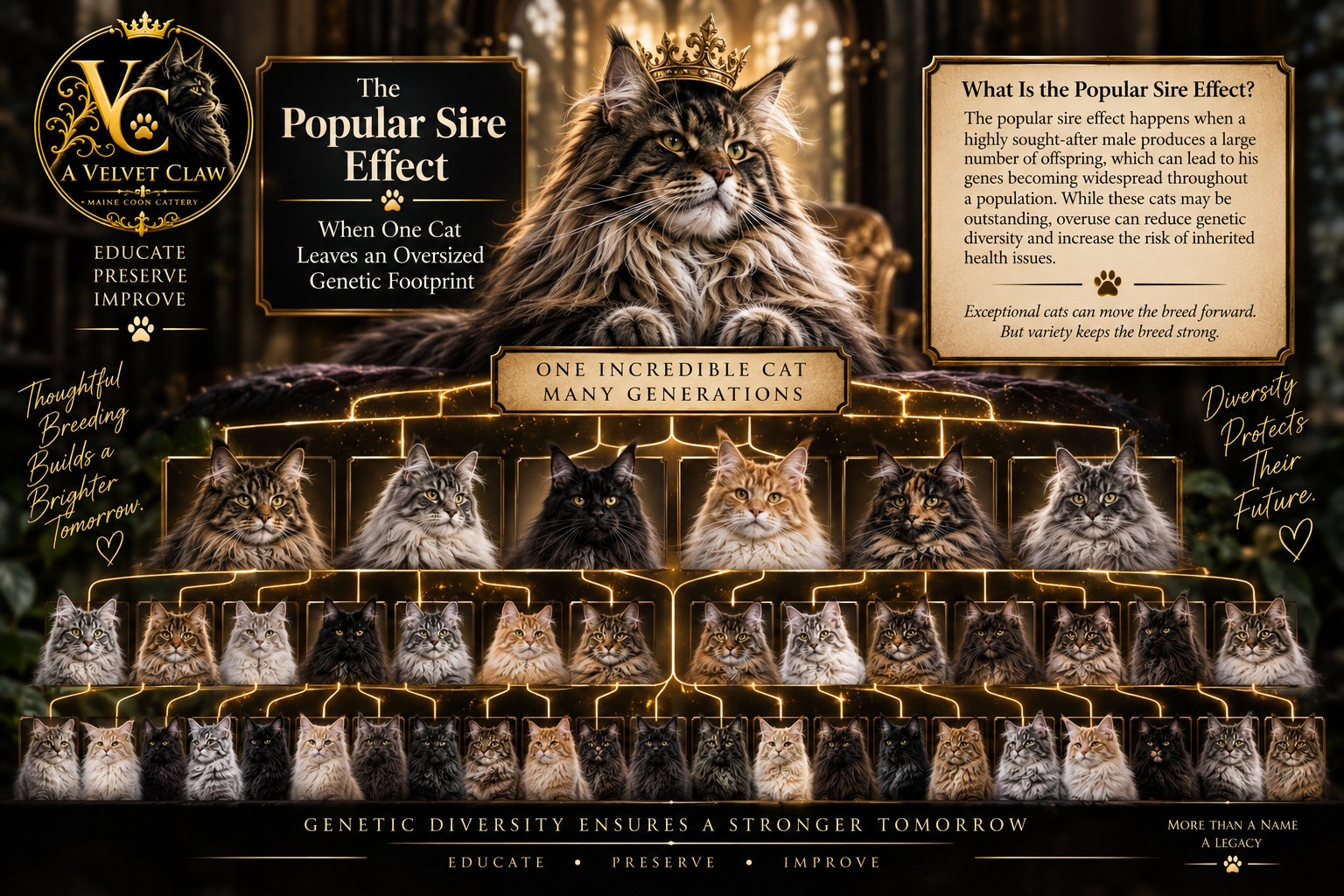
Imagine an exceptional male Maine Coon. He's healthy. Beautiful. Wonderful temperament. Excellent structure. Successful in the show ring. Naturally, breeders want kittens from him. So he produces kittens. Then more kittens. And more. His sons become breeding cats. His daughters become breeding cats. Their offspring enter additional programs. Eventually, that one outstanding male appears in pedigrees all over the population. This is where success can create an unintended problem.
When one animal contributes disproportionately to future generations, its genetic material can become extremely widespread. And that means you're spreading everything that cat carries—not only the characteristics everyone admired. Some genetic risks may not be recognized until years later. This general phenomenon is often called the popular sire effect. The lesson isn't that successful males shouldn't be bred.
It's that: No single cat should have to become the future of an entire breed. A healthy population needs many families contributing to future generations.
🧬 Why “Just Breed the Best Cats” Isn't Quite That Simple
It sounds perfectly reasonable: Test every cat and breed only the ones with perfect results. Unfortunately, genetics isn't that simple. Every animal carries genetic variants. And our genetic tests only identify the variants we currently know how to test and understand.
Modern feline genetic guidance warns that aggressively eliminating large numbers of cats carrying a common variant can create population bottlenecks and increase inbreeding, potentially allowing other problems to become more prevalent. Maine Coon HCM provides an especially useful historical example.
The breed-associated MYBPC3-A31P variant has been found at substantial frequencies in tested Maine Coon populations. Because removing every heterozygous cat immediately could significantly narrow the breeding population, breeding recommendations have emphasized carefully managing the variant rather than simply eliminating every carrier in a single generation.
That's population genetics in action. Sometimes responsible breeding means improving a population gradually and thoughtfully rather than trying to make everything genetically “perfect” overnight.
🚫 Genetic Diversity Does NOT Mean “Breed Two Completely Different Cats”
This misconception is worth clearing up. If two cats have very different colors, appearances or geographic origins, that doesn't automatically mean they're genetically diverse from one another. A red Maine Coon and a black silver Maine Coon could still share substantial ancestry. Likewise, bringing a Maine Coon from another country into a breeding program doesn't automatically make that cat unrelated to the cats already there.
Pedigrees can cross borders. Popular bloodlines can spread internationally. And genetic relatedness isn't visible simply by looking at two cats. Different-looking does not automatically mean genetically different.
That's why pedigree research matters.
🌎 Does Importing a Maine Coon Automatically Add Genetic Diversity?
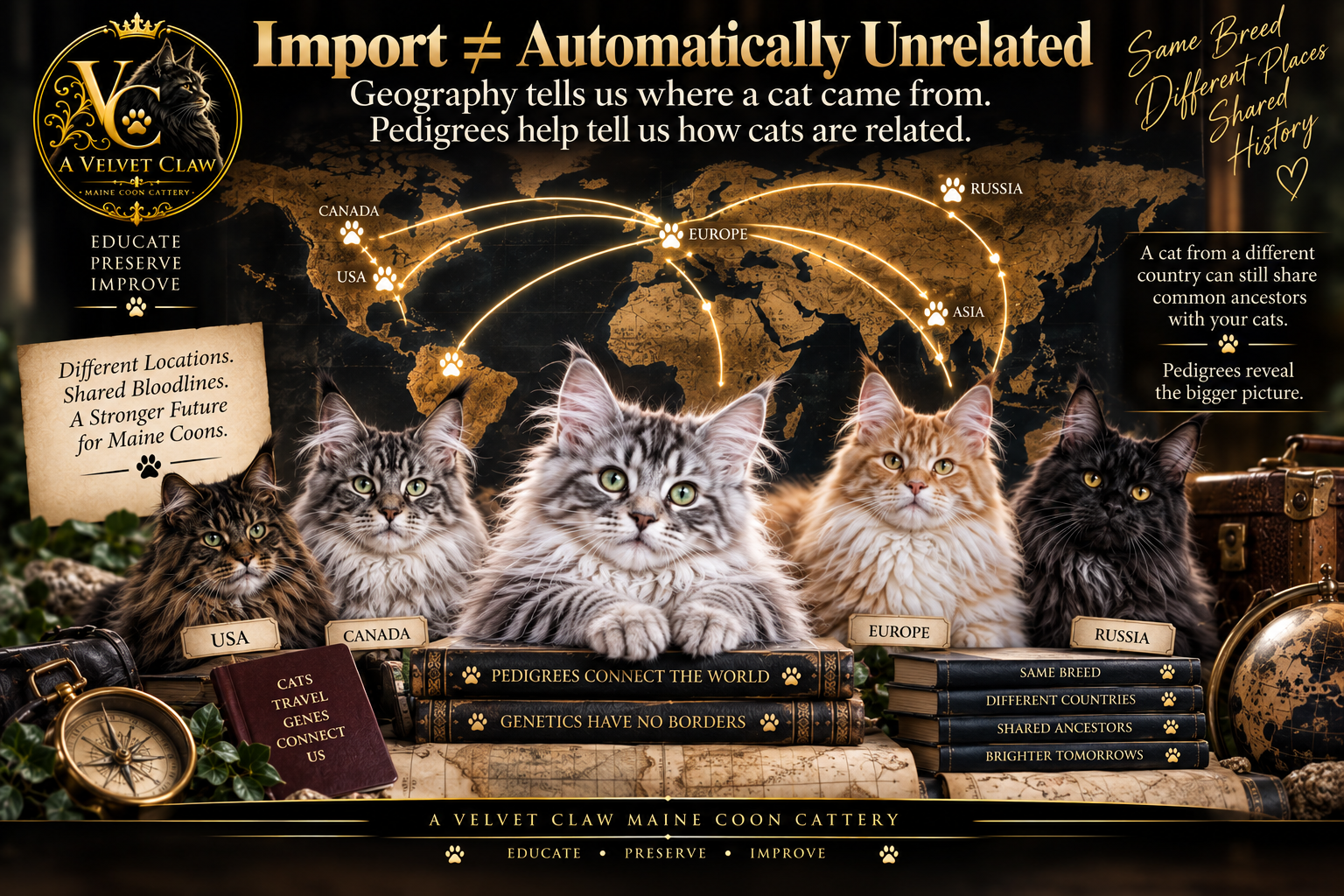
Not necessarily. An imported cat may introduce ancestry that is less represented in a particular breeding population. That can be valuable. But the word “import” itself tells us where a cat came from—not how genetically different that cat is from the breeding population it's entering.
An imported Maine Coon could potentially share many of the same ancestors already present in domestic pedigrees. So responsible breeders still need to study the pedigree.
Where a cat was born is geography. Genetic diversity is genetics.
🧬 Why Can't We Just Breed for the Lowest COI Possible?
Because COI is a tool. It isn't a contest. Imagine choosing between two hypothetical pairings. One produces a lower calculated COI but combines concerning family health histories, poor temperaments or structural weaknesses.
Another has a somewhat higher COI but has extensive health information, complementary structure and temperament, and a thoughtfully researched pedigree. Would the lowest number automatically make the first pairing better? No.
This is exactly why responsible breeding cannot be reduced to: “Lowest COI wins.” The entire pairing has to make sense.
❤️ Health and Genetic Diversity Have to Work Together
This is one of the hardest balancing acts in breeding. We want to reduce known genetic risks. We want healthy hearts. Healthy hips. Good temperament. Sound structure. Appropriate breed type. And we also want to avoid unnecessarily shrinking the available gene pool.
Those goals can occasionally pull breeders in different directions. That's why genetic test results should inform breeding decisions—not automatically make every decision by themselves.
A genetic test tells us something important about a particular variant. It doesn't tell us everything about the cat.
🧪 “Clear” Doesn't Mean Genetically Perfect
This is another misconception we've discussed before. A DNA panel may say a cat is clear for every condition included on that panel. That's wonderful information.
But it doesn't mean: “This cat has no genetic health risks.” It means the tested disease-associated variants were not detected according to that laboratory's test. There are thousands of genes. There are variants science hasn't identified yet. There are diseases influenced by multiple genes. And there are conditions influenced by genetics and environment.
For example, studies of Maine Coon HCM have found cats without the tested A31P variant that nevertheless had cardiac abnormalities, demonstrating why a single genetic result cannot account for every cause of HCM. Genetic testing is incredibly useful. But genetics is bigger than a test panel.
🐾 A Carrier Isn't Automatically a “Bad” Breeding Cat
This is especially important when discussing recessive conditions. For a straightforward autosomal recessive disease, a healthy carrier has one copy of a disease-associated variant. Depending on the disease, available testing and breeding recommendations, a carrier may sometimes be bred appropriately to a genetically clear mate so affected kittens aren't produced. Why would a breeder ever do that? Genetic diversity.
Immediately removing every carrier of every recessive variant can unnecessarily remove other valuable genetic variation along with it. The goal is not to collect cats with the greatest number of “clear” labels. The goal is to make informed pairings that reduce disease risk while maintaining a healthy breeding population.
And importantly, this logic is condition-specific. Dominant disorders, recessive disorders and variants with incomplete penetrance require different management strategies.
🌱 What Is a Genetic Bottleneck?
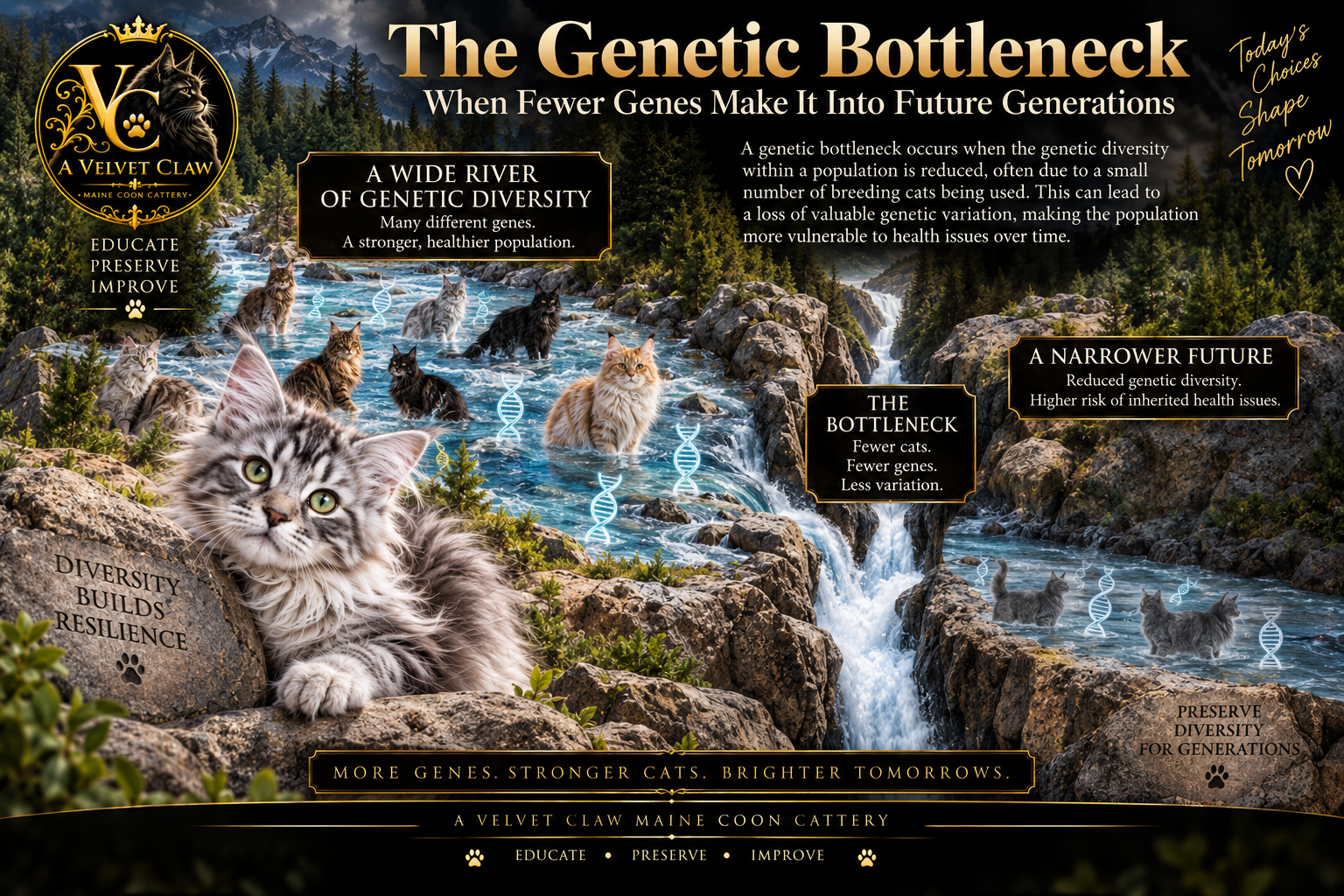
Imagine the breed's gene pool as a wide river. Now imagine forcing that entire river through a very narrow opening. Only a small portion of the original genetic variation makes it through. That's essentially the idea behind a population bottleneck.
If too few individuals contribute disproportionately to future generations—or large portions of a breeding population are removed very quickly—the amount of genetic variation available in later generations can decrease. This is one reason genetic management isn't simply about eliminating every undesirable allele as quickly as possible.
Sometimes aggressive selection can solve one problem while unintentionally increasing another.
🧬 Genetic Diversity Doesn't Mean Abandoning Breed Type
This is another important distinction. Responsible preservation breeding isn't about creating maximum genetic difference at any cost. Maine Coons should still remain recognizably Maine Coons. Breed standards, temperament, structure and defining characteristics matter.
The challenge is preserving those qualities while maintaining enough genetic variation for a sustainable population. That balance is part of what makes responsible breeding so complicated. Preserve the breed without unnecessarily narrowing the breed.
🔎 What Does a Responsible Breeder Actually Look At?
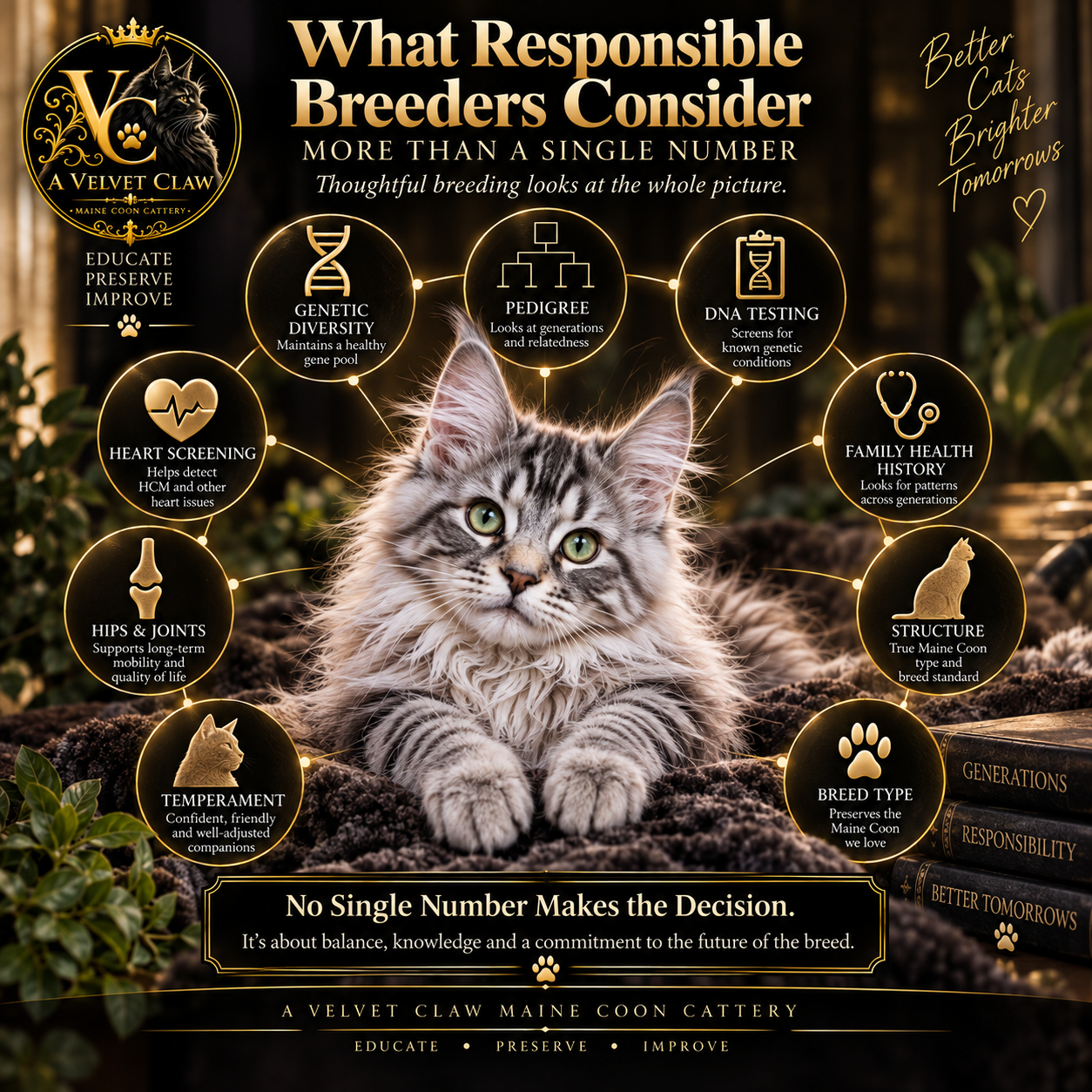
When planning a pairing, genetic diversity may be one part of a much larger evaluation.
A breeder may consider things like pedigree relationships, COI, known health history, DNA results, cardiac and orthopedic screening, temperament, structure, breed type, strengths and weaknesses of each cat, previous offspring, and how heavily certain ancestors or lines are already represented.
No responsible pairing can be summarized by one number. Not COI. Not a DNA result. Not a hip score. Not a show title. Not even a pedigree. The pieces have to be considered together.
👶 Why Does Any of This Matter to Someone Buying a Pet Kitten?
Because responsible breeding decisions don't stop affecting a kitten when that kitten leaves the breeder. The breeding decisions being made today influence the Maine Coon population that families may be choosing from years—or decades—from now. Kitten families don't need degrees in population genetics. But they can ask thoughtful questions.
Instead of asking only: “Are the parents DNA tested?” consider asking “How do you evaluate genetic diversity and pedigree relatedness when planning your pairings?”
That's a very different conversation.
🌳 We're Not Just Breeding Litters. We're Managing Generations.
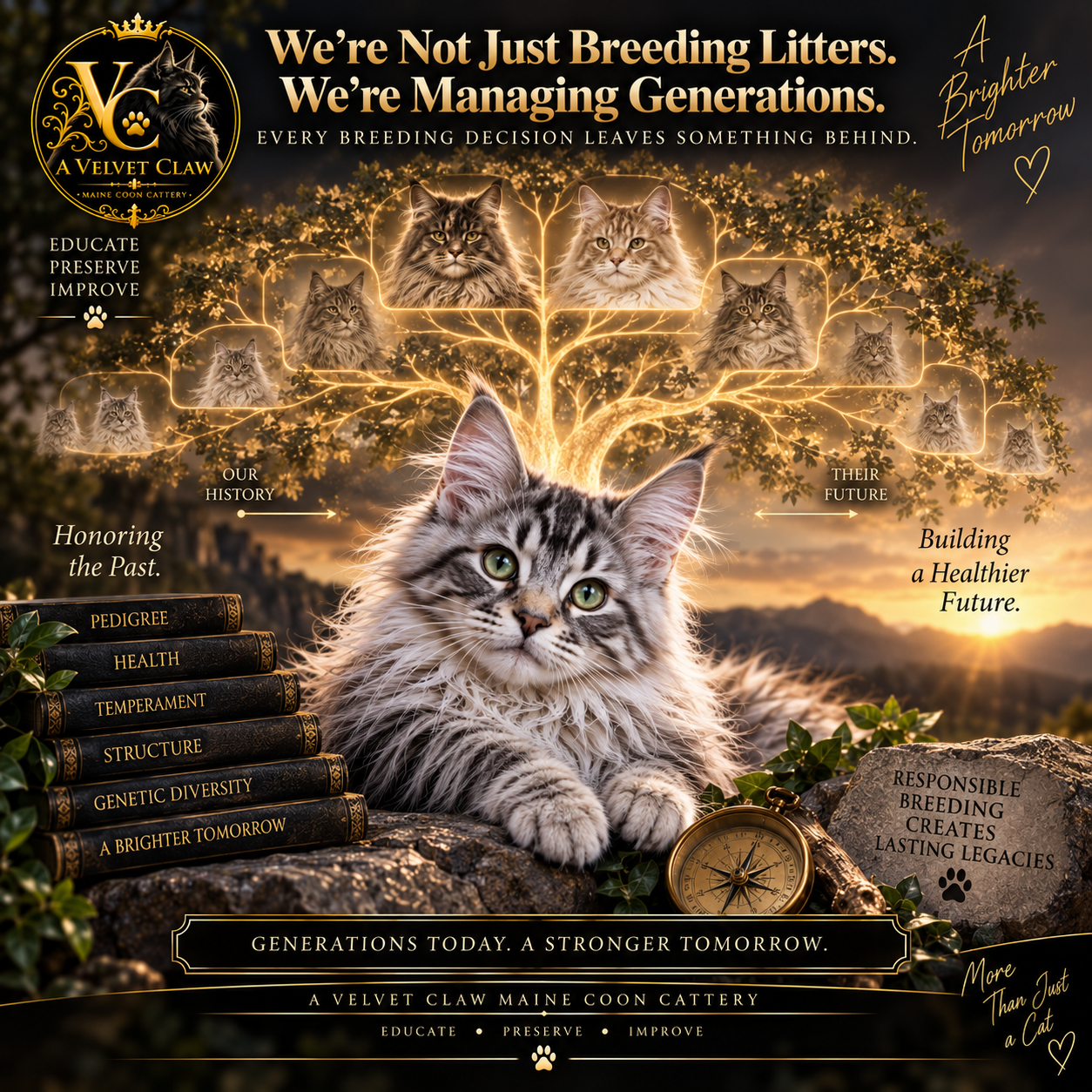
This might be the most important idea in this entire article. A breeding decision doesn't disappear after kittens go home. Some of those kittens may enter breeding programs. Their kittens may enter other programs. And generations later, genetics from today's breeding cats may still appear throughout pedigrees.
That's why responsible breeding requires thinking farther ahead than What will this litter look like? We should also be asking: What does this pairing leave behind?
🖤 The Whole Cat Still Matters
If you've followed our recent genetics series, you've probably noticed a theme. That's intentional. There is no single test that tells us whether a cat should be bred. There is no magical COI percentage. There is no perfect pedigree. There is no genetically flawless cat.
Instead, responsible breeding means gathering as much useful information as possible and making thoughtful decisions with it.
🧬 Genetics
❤️ Health
🌳 Pedigree
📊 COI
🐾 Temperament
🦴 Structure
👑 Breed type
🌱 Genetic diversity
📜 Family history
And finally: The individual cat standing in front of us.
🌟 The Bottom Line
Genetic diversity isn't about making Maine Coons less like Maine Coons. It's about helping ensure there is enough healthy genetic variation for the breed to continue thriving. It's not about chasing 0% COI. It's not about eliminating every carrier. It's not about importing a cat simply because it comes from far away. And it's definitely not about finding one “perfect” bloodline and using it everywhere. It's about balance. Research. Health. Pedigrees. Testing. And thinking beyond the next litter.
Because responsible breeders aren't only creating kittens. We're contributing to a gene pool. And every breeding decision leaves something behind.
🐾 Keep Learning With A Velvet Claw
At A Velvet Claw Maine Coon Cattery, we believe responsible breeding begins with education. The more we understand about genetics, pedigrees, health and diversity, the more thoughtfully we can approach the decisions that shape future generations. Because the goal isn't simply beautiful Maine Coons today. It's healthy, beautiful Maine Coons for generations to come. 🖤💛
Educate. Preserve. Improve. Better knowledge. Better decisions. Brighter generations.
Fur - ever grateful: Lexie & Melina
Maine Coon genetic diversity • Genetic diversity in Maine Coons • Maine Coon genetics
Responsible Maine Coon breeding • Maine Coon COI • Maine Coon pedigree