
How to Read a Maine Coon Pedigree: What All Those Names and Numbers Actually Mean
A Beginner-Friendly Guide to Understanding Your Maine Coon’s Family Tree
You finally get your Maine Coon's pedigree. You open it expecting a simple family tree... And suddenly you're staring at rows of long registered names, numbers, abbreviations, colors, titles and generations of cats you've never heard of. 😂 At first glance, a pedigree can look like a giant puzzle. But once you understand how it's organized, it starts telling a fascinating story.
A pedigree can show you who a cat's ancestors are, how different bloodlines connect, whether certain ancestors appear repeatedly, and how many generations of ancestry are documented. Official registries also use pedigree information such as registered names, registration numbers, and colors or color codes. And for breeders, a pedigree isn't simply a list of impressive names.
It's one piece of a much bigger picture involving health, genetics, diversity, structure, temperament and long-term breeding decisions. So let's learn how to read one. 🖤💛
🌳 First—What Is a Pedigree?
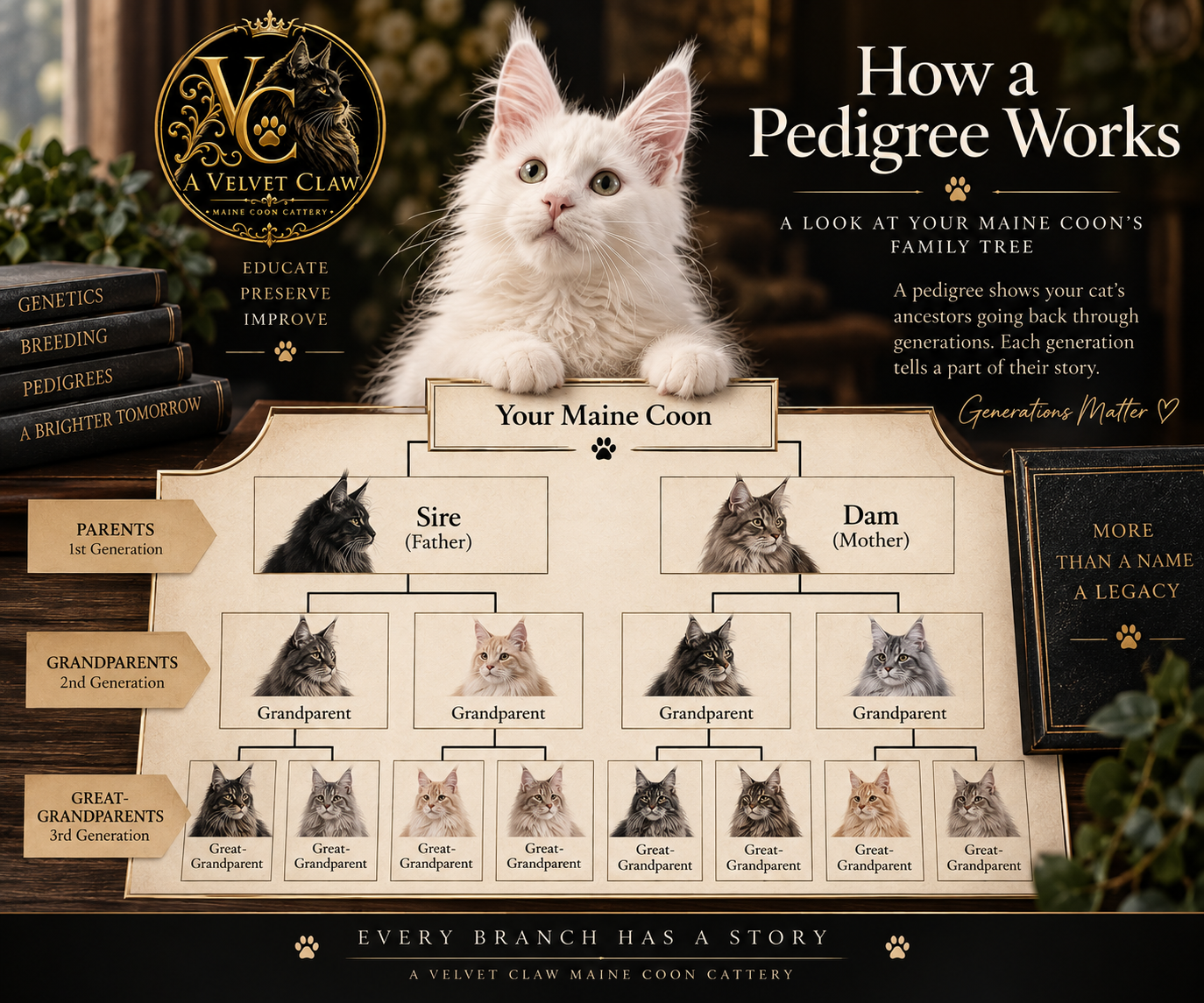
A pedigree is essentially your Maine Coon's documented family tree. At the beginning is your cat. From there, the pedigree branches backward through generations: Sire + Dam → Grandparents → Great-grandparents → Great-great-grandparents → and beyond.
One important detail: registries may describe generations differently depending on the document. For example, CFA states that on its certified pedigrees, the cat's parents are considered the first generation. So when comparing pedigrees, make sure you understand how that particular registry or database counts generations.
👑 Sire and Dam: Start Here
Two words you'll see constantly are: Sire = Father Dam = Mother That's it. 😂
It sounds much more complicated than it is. The sire's ancestry forms one side of the pedigree, while the dam's ancestry forms the other. Then each of their parents appears in the next generation.
Before long, your pedigree starts looking something like:
YOUR CAT
↙️ Sire | Dam ↘️
↙️ ↘️ | ↙️ ↘️
Grandparents
↓
Great-grandparents
↓
Great-great-grandparents
Every additional generation doubles the number of ancestral positions in the pedigree—although the number of unique cats can be smaller because the same ancestor may appear more than once. And that last part becomes very important.
🔁 Why Does the Same Cat Appear More Than Once?
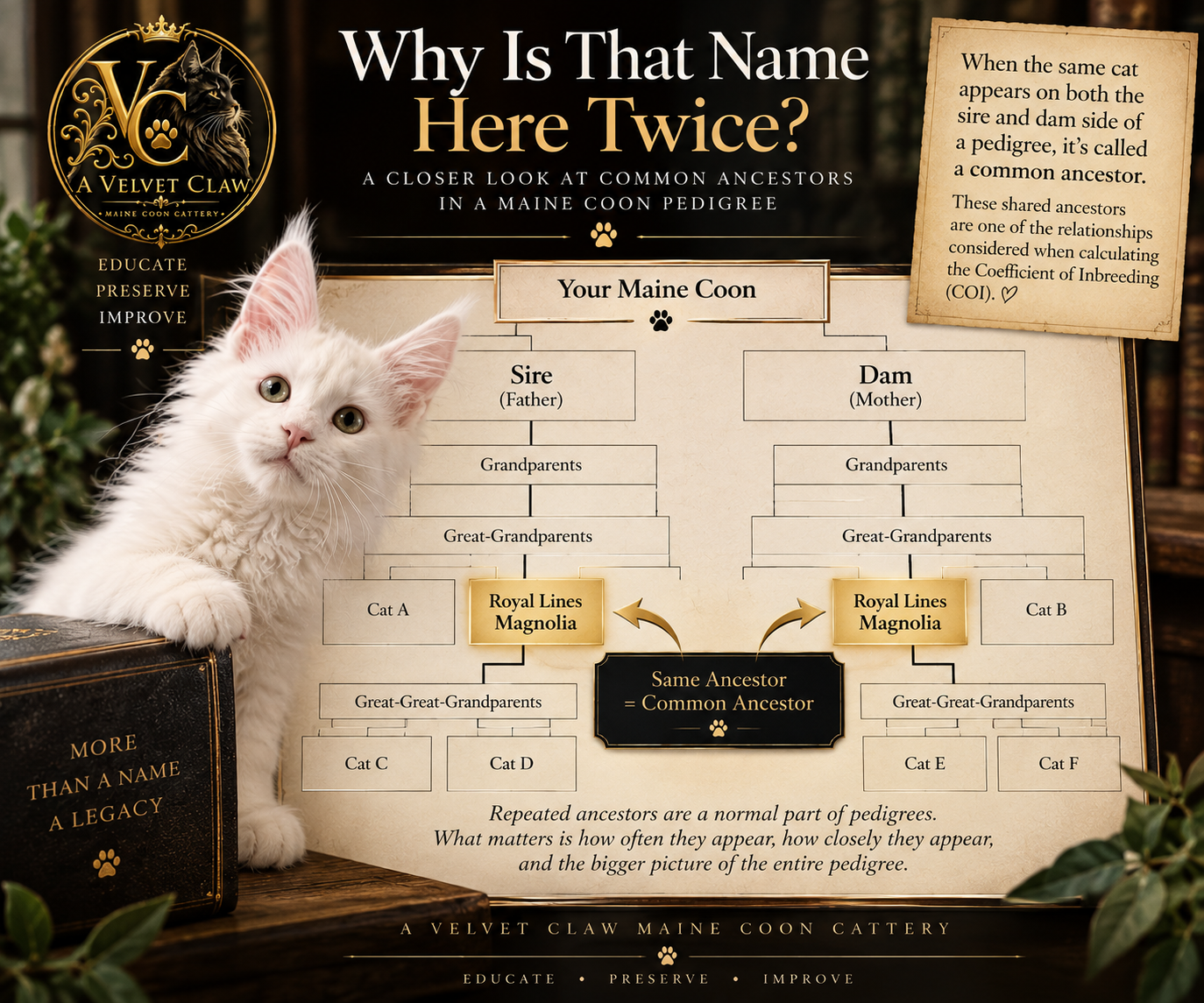
You might be reading a pedigree and suddenly think: Wait...didn't I already see that name? You probably did. When the same ancestor appears in multiple places, it means different branches of the pedigree eventually lead back to that same cat. This is called a common ancestor. And this connects directly to the COI article we just discussed.
Repeated ancestors and the paths connecting them contribute to pedigree relatedness and therefore can affect the Coefficient of Inbreeding (COI). A repeated name isn't automatically something frightening. What matters is how often the ancestor appears, how closely it appears, through which branches, and what the larger pedigree looks like. That's why breeders don't simply scan a pedigree looking for duplicates.
They study the relationships. 🧬 This Is Where COI Starts Making More Sense
Remember: COI = Coefficient of Inbreeding COI estimates pedigree relatedness based on shared ancestry.
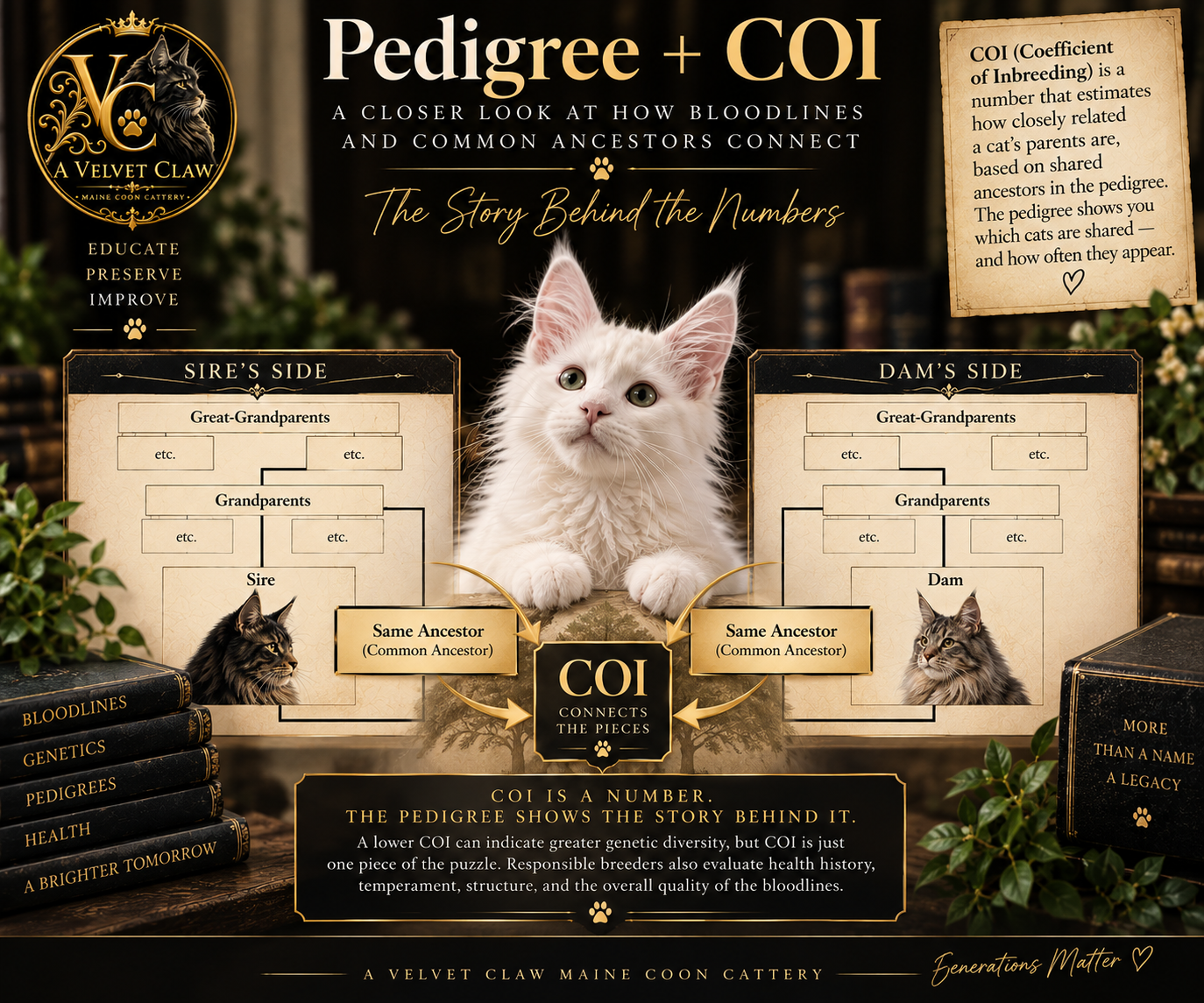
When the same ancestors appear on both sides of a pedigree, there are pathways through which genetic material from a common ancestor can reach a kitten through both parents. Pedigree databases can calculate COI from the ancestry they contain—but the depth and completeness of that ancestry matter. PawPeds specifically cautions that a COI calculation is only as complete as the pedigree information available and that comparisons should consider how many generations were included.
That's why understanding a pedigree makes understanding COI much easier. You're no longer just looking at: COI = 1.2% You're looking at the family tree behind the number.
📝 What Are Those Long Maine Coon Names?
Welcome to the wonderful world of registered cat names. 😂 A registered Maine Coon might have a name that looks considerably more elaborate than what everyone actually calls them at home.
Registered names can contain a cattery name identifying the breeder or breeding program associated with the cat, plus the cat's individual registered name. Depending on registry rules, an owner's cattery suffix may sometimes also be involved.
CFA, for example, has specific rules governing registered names, breeder cattery names and the addition of an owner's cattery suffix. Meanwhile, at home? That magnificent registered Maine Coon may answer to: Beans. 😂
The formal registered name helps identify the cat in pedigrees and registry records. The ridiculous nickname identifies who stole your pillow. Both are important.
🔢 What Is the Registration Number?
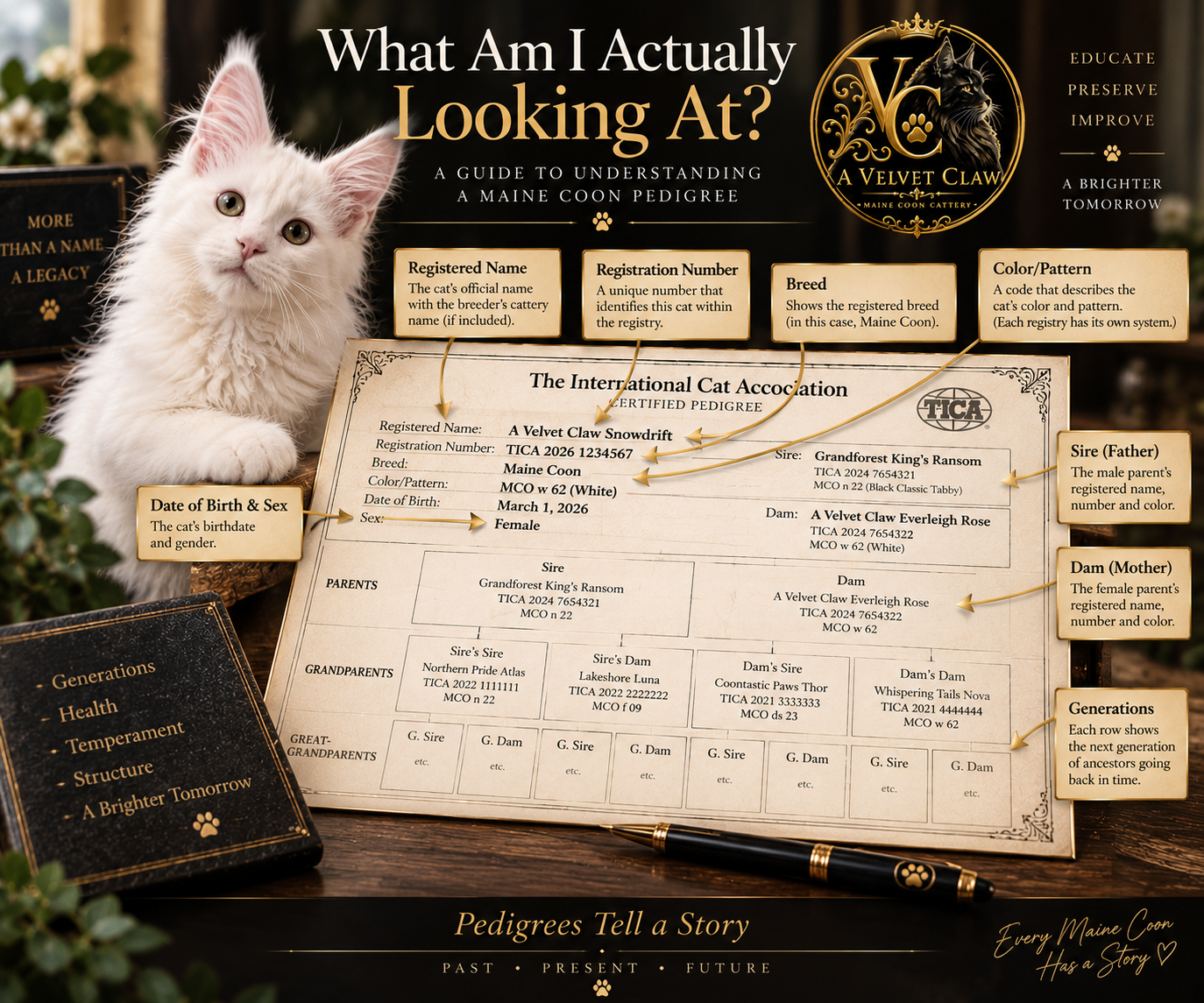
You'll often see a series of numbers or letters associated with each registered cat. That's the cat's registration identification within the applicable registry. It helps distinguish one registered cat from another—even when cats have similar names. Depending on the registry, the registration information can also encode or accompany additional information.
For example, CFA uses breed/color designation prefixes within registration numbers; its prefix chart incorporates breed, color and sex information, with additional pattern notation used for certain tabbies.
TICA pedigrees and registration documents have their own terminology and registration systems, so don't assume that a code from one registry means exactly the same thing in another. When decoding a pedigree, always identify which registry issued it first.
🎨 What Are All Those Color Codes?
This is one of the most confusing—and fun—parts. Instead of spelling out every coat description, pedigrees and registration systems may use standardized terminology or codes.
Those codes can describe things such as: Color • Pattern • Silver/smoke • White spotting • Sex or other registry-specific information depending on the system being used.
For example, official cat terminology may use:
Red instead of orange
Blue instead of gray
Cream instead of pale beige
And tabby is a pattern, not a color or breed. CFA describes coat identification using both color and pattern, while TICA likewise distinguishes official color terminology from everyday descriptions. So something that looks like mysterious alphabet soup may actually be telling an experienced reader: This ancestor was a particular color, pattern and white-marking combination.
Once you learn the system, those little codes become surprisingly informative.
🐾 Why Can Color Information Matter in a Pedigree?
Because kittens don't pull their colors out of a hat. They inherit genetic information from their parents. Looking at colors and patterns throughout a pedigree can sometimes help breeders understand what certain cats may carry genetically and what outcomes might be possible in future litters.
But pedigree color alone doesn't reveal every hidden genetic trait. A cat's appearance tells us its phenotype—what we can observe. Its underlying genetic makeup is its genotype.
Those aren't always identical stories. A cat can carry genetic information that isn't obvious just by looking at it.
Which is another reason modern genetic testing can complement pedigree research.
🏆 What Are the Letters Before or After a Cat's Name?
Those may be titles or awards, depending on the registry and pedigree. They can indicate achievements earned through cat shows or other registry programs.
But here's an important caution: Don't assume every abbreviation means the same thing everywhere.
Different registries have different title systems and rules. CFA also notes that titles and awards earned in other associations are not recorded on CFA records.
So if you see an unfamiliar abbreviation, identify the registry and look up that organization's title system rather than guessing.
👑 Does a Pedigree Full of Champions Mean Better Kittens?
Not automatically. Titles can provide useful information about a cat's success under a particular show standard.
But a pedigree filled with titled cats does not by itself guarantee:
❤️ Excellent health
🧬 Genetic diversity
🐾 Wonderful temperament
🦴 Healthy hips
❤️ A healthy heart
👶 Healthy kittens
And a cat without a wall full of titles isn't automatically a poor breeding prospect. Show accomplishments and responsible breeding decisions are related in some programs—but they're not interchangeable concepts.
A pedigree should be studied as a whole.
🔎 What Should a Breeder Actually Look For?
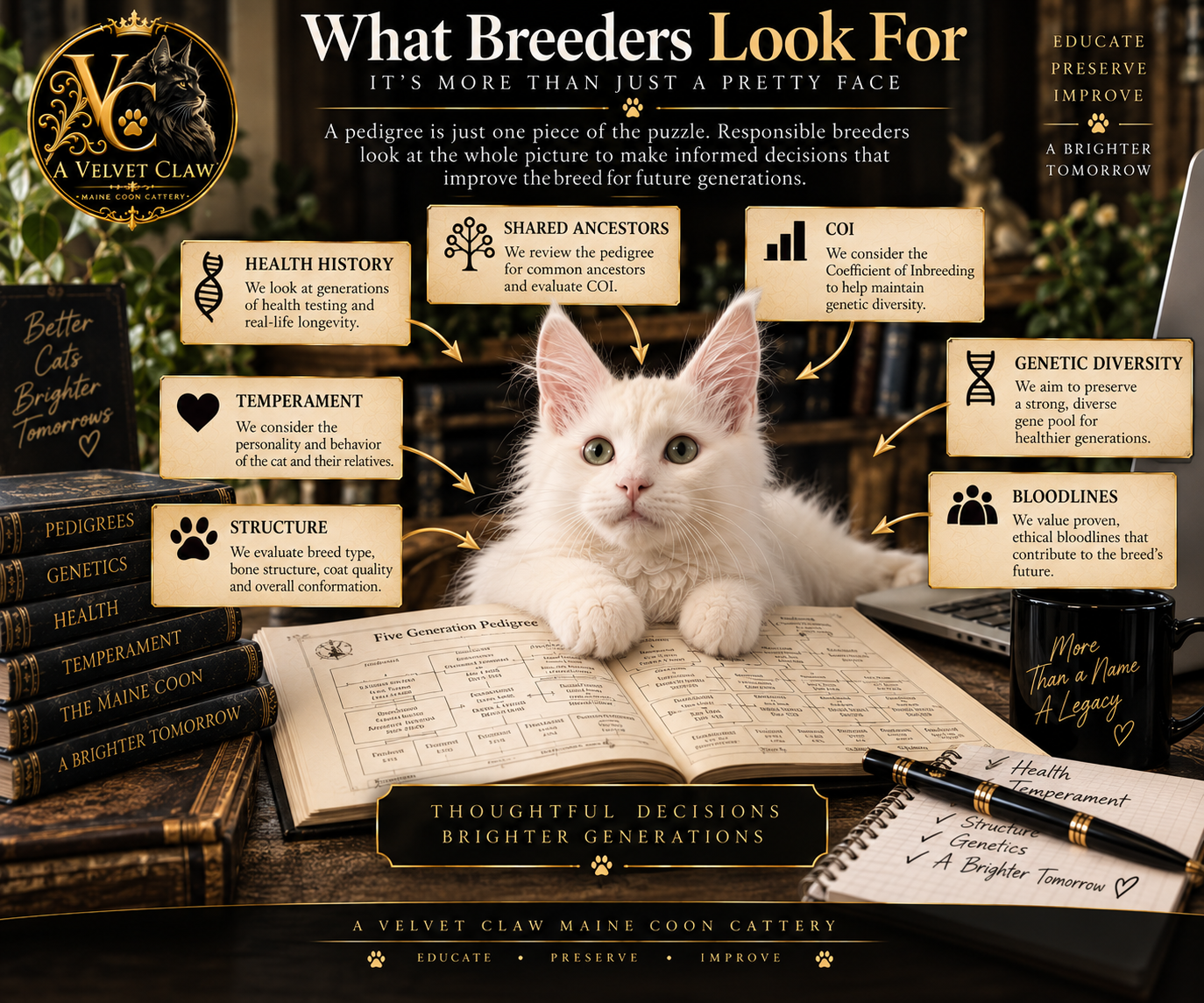
This is where pedigrees become much more interesting than simply collecting famous names.
A breeder may research questions such as:
Are the sire and dam related?
Which ancestors appear repeatedly?
How far back do those shared ancestors occur?
Are certain lines heavily represented?
What do we know about health within those families?
What traits have appeared across generations?
What might this pairing contribute to genetic diversity?
Are there health, temperament or structural concerns documented within related cats?
A pedigree gives us the map. Research tells us what happened along the roads.
❤️ A Pedigree Is Not a Health Certificate
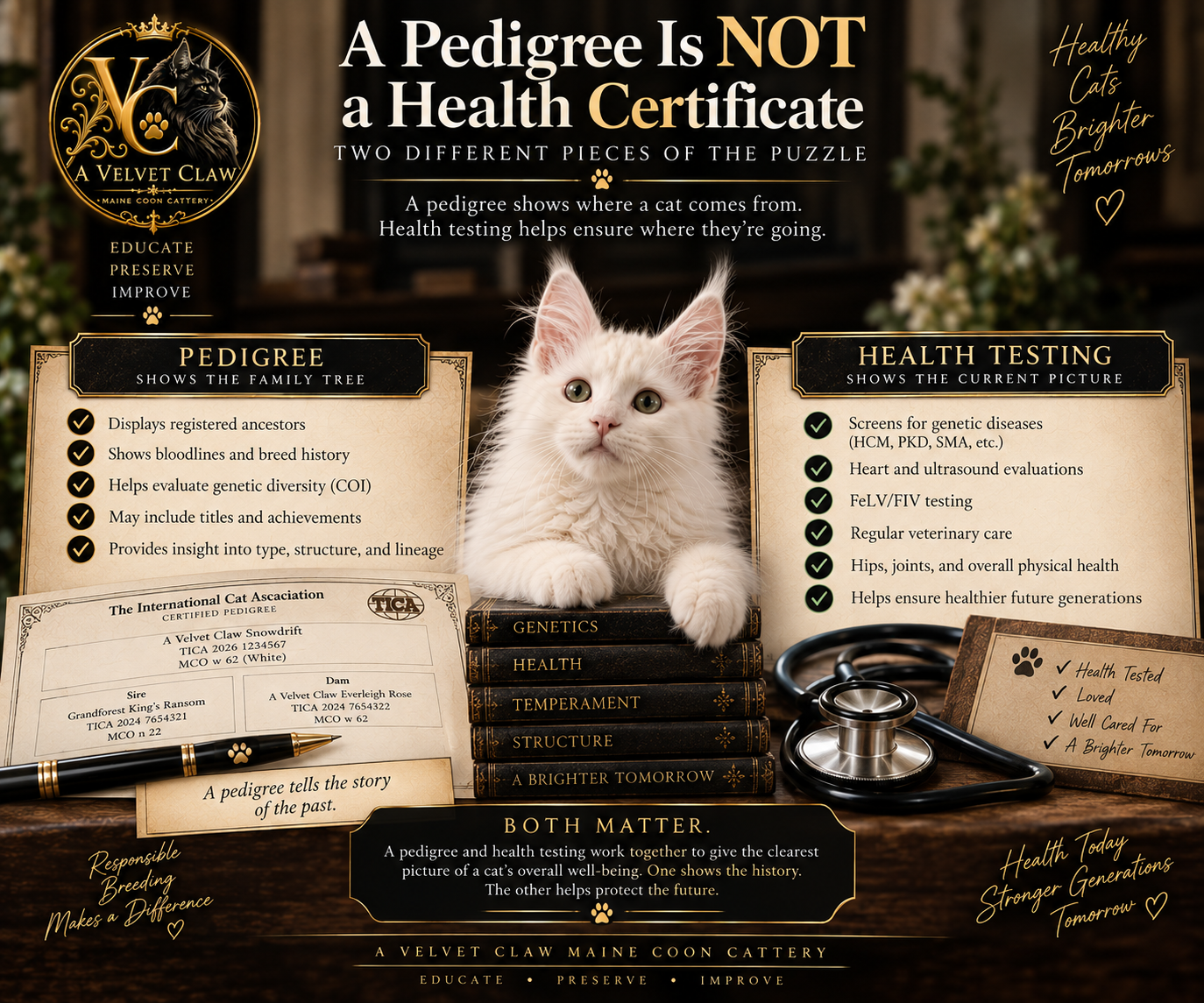
This distinction deserves its own section. A beautiful five-generation pedigree does not prove a cat is healthy. And a pedigree containing famous cats doesn't replace health screening. A pedigree cannot substitute for appropriate veterinary care or health evaluation.
For Maine Coons, responsible health evaluation can involve multiple tools depending on the issue being assessed. TICA, for example, specifically discusses both genetic testing and periodic echocardiographic evaluation for HCM in responsible Maine Coon breeding.
Think of pedigree research as another layer of information. Not the entire answer.
🧬 Health Tests Tell Us About a Cat. Family History Can Tell Us More.
Imagine a breeding cat receives favorable results on every test performed today. Wonderful. But what if multiple close relatives developed the same health problem later in life? That's information worth knowing.
This is why responsible breeders don't necessarily stop at: “My cat tested clear.”
They may also ask: “What happened to this cat's parents, siblings, grandparents and offspring?”
No pedigree can tell you all of that by itself. But the pedigree tells you who those relatives are, allowing breeders to research further.
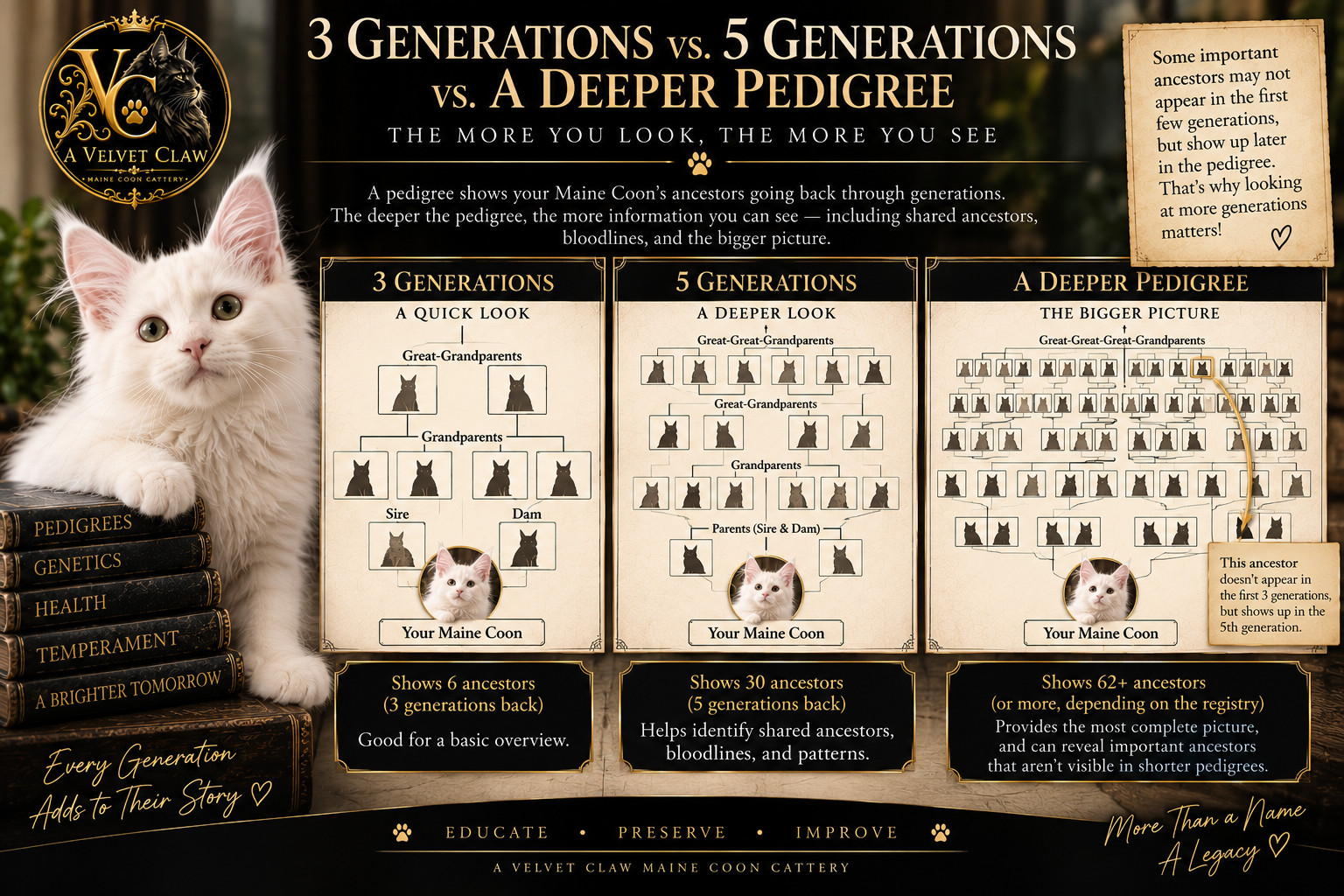
🌳 Why Pedigree Depth Matters
A three-generation pedigree can be useful. A five-generation pedigree reveals more. A much deeper pedigree can reveal relationships that weren't visible in the first few generations. This is especially important when evaluating relatedness. As we discussed in our COI article, two cats might appear unrelated within a short pedigree while common ancestors become visible farther back.
PawPeds warns specifically that animals with different amounts of known pedigree information can appear misleadingly different in their calculated inbreeding, which is why pedigree completeness and calculation depth matter.= So more generations don't necessarily mean a better cat. They mean more ancestry available to study.
🧩 What If Some Ancestors Are Missing?
This matters too. A pedigree calculation can only use information that's actually available. If ancestors are unknown or missing from a database, the absence of a relationship on the screen doesn't prove that relationship never existed.
It may simply mean: We don't have the information. This becomes especially important when interpreting COI.
PawPeds explicitly notes that even a calculation extending as far back as its database allows is no more complete than the pedigree data contained in the database.
Unknown isn't the same as unrelated.
📜 Official Pedigree vs. Online Pedigree Database
These aren't necessarily the same thing. An official/certified pedigree is issued by a registry based on its records. CFA, for example, offers certified pedigrees in multiple generation depths and requires registered names, registration numbers and color information in pedigree documentation used for registration purposes.
An online pedigree database can be an incredibly useful research tool, especially for exploring deeper ancestry and relationships. But it should be understood as a research resource, not automatically treated as the cat's official registry document. Both can be valuable for different reasons.
🔍 Don't Pedigree Shop by Famous Names
This is something I think deserves more attention. When people become familiar with Maine Coon bloodlines, it's easy to start searching for certain famous cats or catteries.
But: A famous ancestor doesn't make a perfect kitten. A pedigree should not become a celebrity list. Every cat contributes genetics. Every generation matters. And concentrating heavily on popular lines can have population-level consequences even when the individual cats involved are excellent.
The question shouldn't simply be: “Who famous is in this pedigree?”
A better question is: “What does this pedigree tell us about this family?”
🖤 The Whole Cat Still Matters
This has become a recurring theme throughout our health and genetics series because it's important. A pedigree is valuable. COI is valuable. DNA testing is valuable. Cardiac screening is valuable. Hip evaluation is valuable. Family health history is valuable.
But none should be treated as the single number, document or test that defines a Maine Coon.
Responsible breeding requires putting all of those pieces together.
Health.
Temperament.
Structure.
Genetic diversity.
Pedigree.
Family history.
Breed type.
And the individual cat standing in front of us.
🐾 What Should a Kitten Family Ask?
You don't need to understand every code on a five-generation pedigree before bringing home a Maine Coon. But you can ask thoughtful questions.
Instead of only asking: “Does my kitten come with a pedigree?”
try: “Can you help me understand my kitten's pedigree and family history?”
You might also ask about the parents, health screening, known family health history, and how the breeder evaluates potential pairings. A responsible conversation about pedigree should be educational—not intimidating.
📜 The Bottom Line
At first, a Maine Coon pedigree may look like nothing more than: Names. Numbers. Letters. Codes.
But once you learn to read it, you begin seeing something completely different.
You see generations.
You see mothers and fathers.
You see families connecting.
You see ancestors appearing again.
You see the history behind the cat sitting beside you.
And for breeders, that information can help guide decisions about health, relatedness, genetic diversity and future generations. A pedigree isn't a trophy It isn't a health guarantee. And it isn't simply proof that a cat is “purebred.” It's information.
And the more thoughtfully we understand that information, the better decisions we can make for the Maine Coons who come next. 🖤💛
🐾 Keep Learning With A Velvet Claw
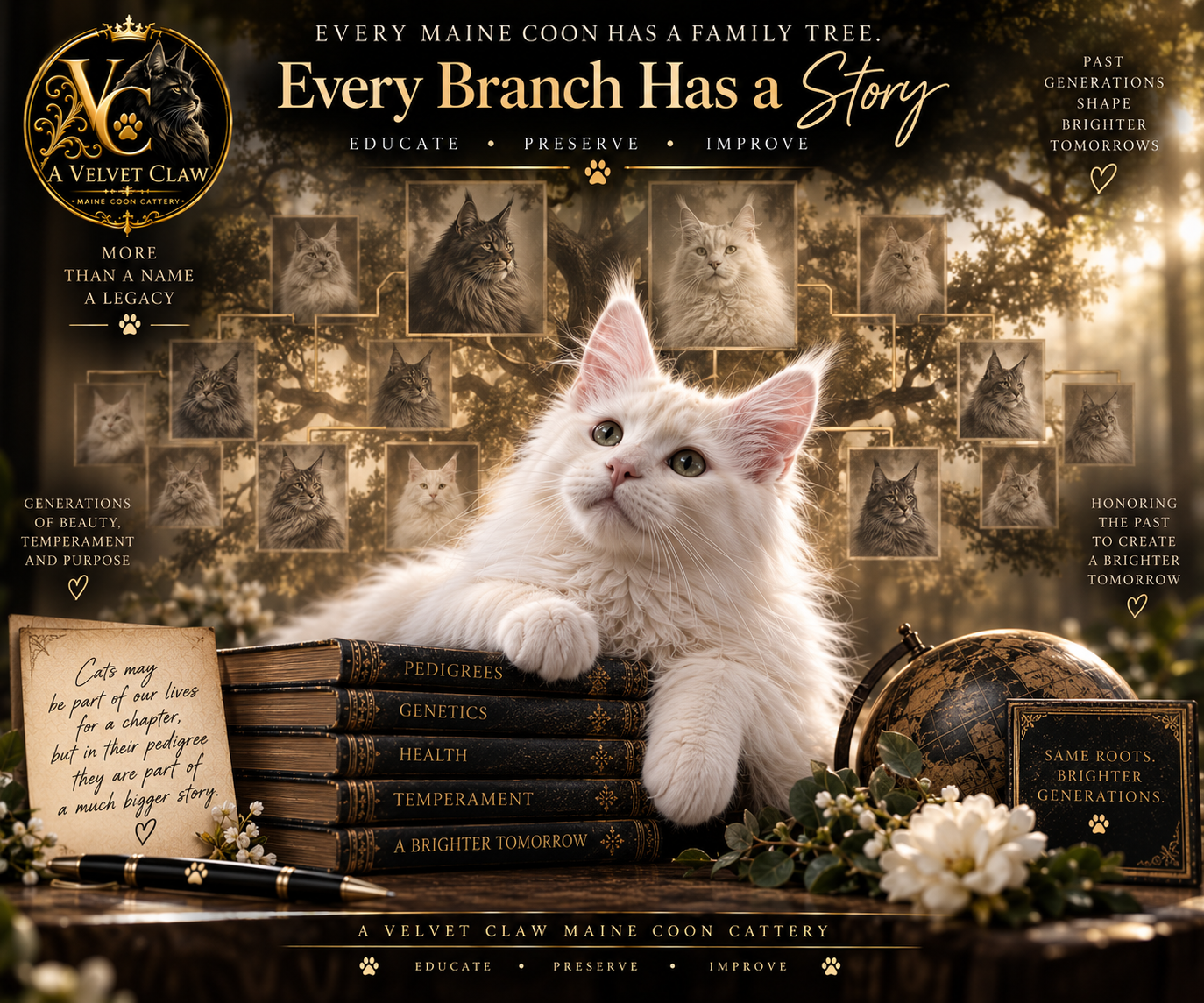
At A Velvet Claw Maine Coon Cattery, we believe responsible breeding begins long before a litter is born It begins with learning, researching and understanding the cats behind every pairing. Because every Maine Coon has a family tree. And every branch has a story. 🌳🐾
Educate. Preserve. Improve. Better knowledge. Better decisions. Brighter generations. 🖤💛
Fur - ever grateful: Lexie & Melina
Maine Coon pedigree • How to read a Maine Coon pedigree • Maine Coon pedigree explained
Maine Coon bloodlines • Maine Coon ancestry • Maine Coon family tree