
🧬 What Is COI in Maine Coons—and Why Does It Matter?
Understanding Coefficient of Inbreeding, Genetic Diversity and Responsible Maine Coon Breeding
When people hear the word inbreeding, they sometimes immediately imagine a brother being bred to a sister or a parent being bred to an offspring. But in pedigreed cats, genetic relationships are much more complicated than that. Two Maine Coons can have completely different parents, grandparents and even great-grandparents—and still share ancestors farther back in their pedigrees.
That is where COI, or the Coefficient of Inbreeding, becomes useful. COI gives breeders a way to examine how genetically related the parents of a potential litter are through shared ancestry. It is one tool that can help breeders think beyond appearance, color, size and even individual health-test results when planning a pairing.
And just like the health tests we've discussed before, COI isn't a crystal ball. It is information. The important part is understanding what that information actually means.
🧬 First—What Exactly Is COI?
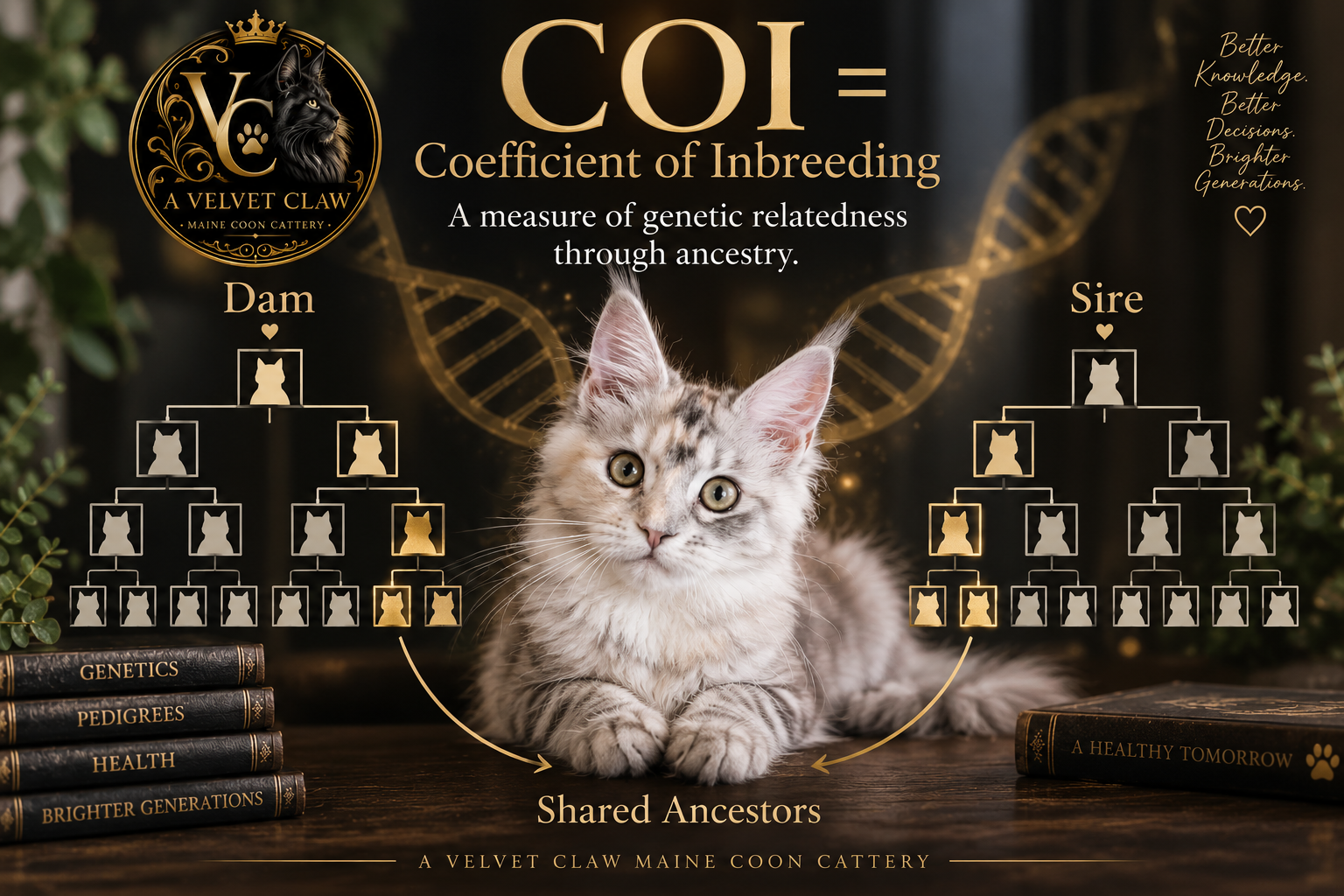
COI stands for Coefficient of Inbreeding. It is expressed as a percentage and estimates the probability that an individual inherited two copies of an allele that are identical by descent—meaning those copies trace back to the same ancestral source through both sides of the pedigree. That sounds complicated, so let's make it much easier.
Imagine a kitten's pedigree as two enormous family trees: Mom's family tree 🌳 + Dad's family tree 🌳 If the same ancestors appear on both sides, there are paths through which the kitten can inherit genetic material originating from the same ancestor.
COI mathematically accounts for those relationships. Generally, the more closely related the parents are through their pedigrees, the higher the expected COI of their offspring.
📊 What Do COI Percentages Actually Mean?
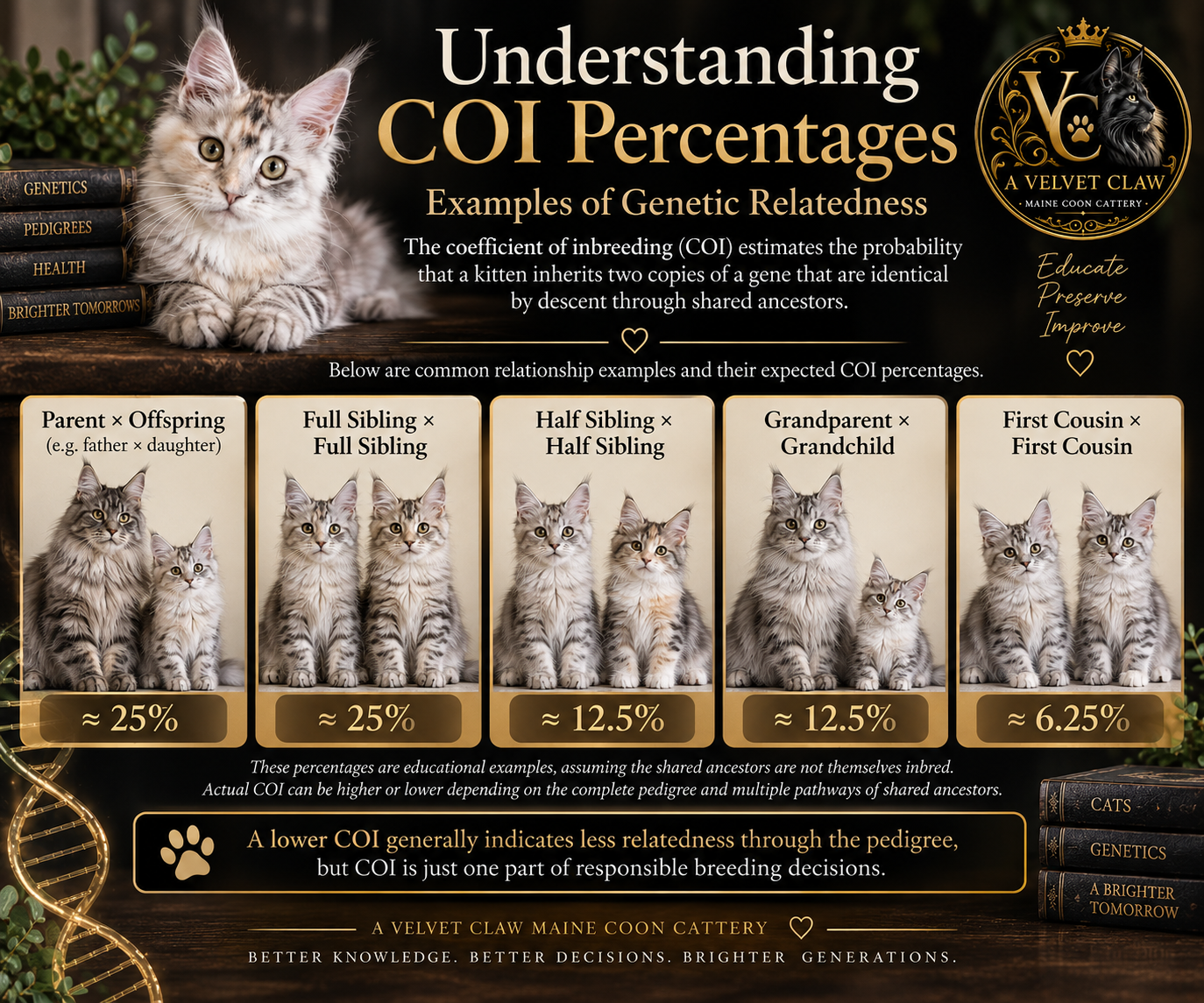
Some simple relationships help demonstrate how the mathematics work.
For example, assuming the shared ancestors themselves are not inbred, classic pedigree calculations give approximately:
Parent × offspring → 25%
Full sibling × full sibling → 25%
Half sibling × half sibling → 12.5%
Grandparent × grandchild → 12.5%
First cousin × first cousin → 6.25%
These examples are educational reference points—not breeding recommendations. Actual pedigrees can be considerably more complicated because the same ancestors may appear through multiple pathways and may themselves already be related.
🐾 Why Does COI Matter in Maine Coons?
Selective breeding creates breeds. Generations of breeders selecting for recognizable characteristics helped create the Maine Coon we know today—the structure, coat, temperament and distinctive breed type people love. But every closed or relatively limited breeding population faces another challenge: preserving enough genetic diversity for the future.
When the same individuals or closely related lines are used repeatedly, more of the population can become genetically similar over generations. That doesn't mean every related pairing produces unhealthy kittens. It does mean breeders need to understand the cumulative effects of breeding decisions.
UC Davis feline genetics materials note that inbreeding increases homozygosity. That can help make desirable inherited traits more consistent, but it can also increase the chance that undesirable recessive traits are expressed. That's one reason COI matters.
🧬 Higher COI Does NOT Mean “This Cat Is Sick”
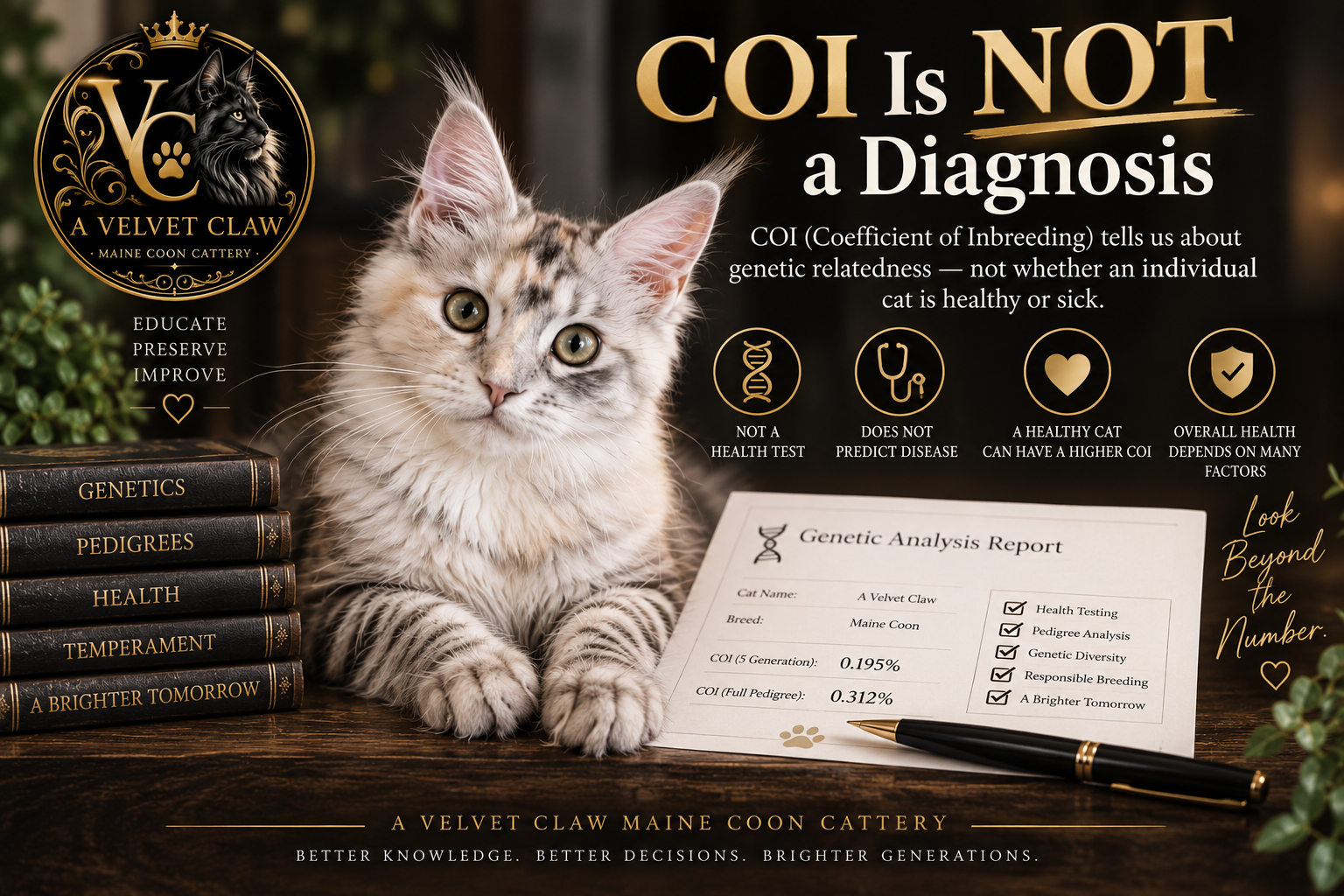
This distinction is extremely important. A COI number is not a diagnosis. A Maine Coon with a higher COI isn't automatically unhealthy. Likewise, a Maine Coon with a lower COI isn't automatically healthy.
COI tells us something about pedigree relatedness. It does not tell us whether a cat has HCM, hip dysplasia, an infectious disease, a particular temperament or any other individual health condition.
Think about it similarly to the other tools we've discussed:
DNA testing gives us certain genetic information.
An echocardiogram evaluates the heart at that point in time.
Hip radiographs evaluate hip structure.
A pedigree provides family-history information.
COI provides information about ancestral relatedness.
None tells the entire story alone.
🔎 Is a Lower COI Always Better?
This is where COI conversations can become oversimplified. It is tempting to say: “The lowest COI is always the best breeding.”
But responsible breeding decisions aren't made from one number. Imagine two potential breeding cats. One combination produces an extremely low calculated COI but has significant concerns elsewhere in the pedigree.
Another combination produces a somewhat higher COI but has extensively documented health history, complementary traits and other characteristics important to the breeding program. The COI is important information—but it doesn't make the decision by itself.
Breeders must consider the entire pairing. That can include health screening, pedigree, family history, temperament, structure, genetic diversity and the strengths and weaknesses of both cats.
⚠️ A 0% COI Can Be Misleading
This is one of the most important things for kitten families—and new breeders—to understand.
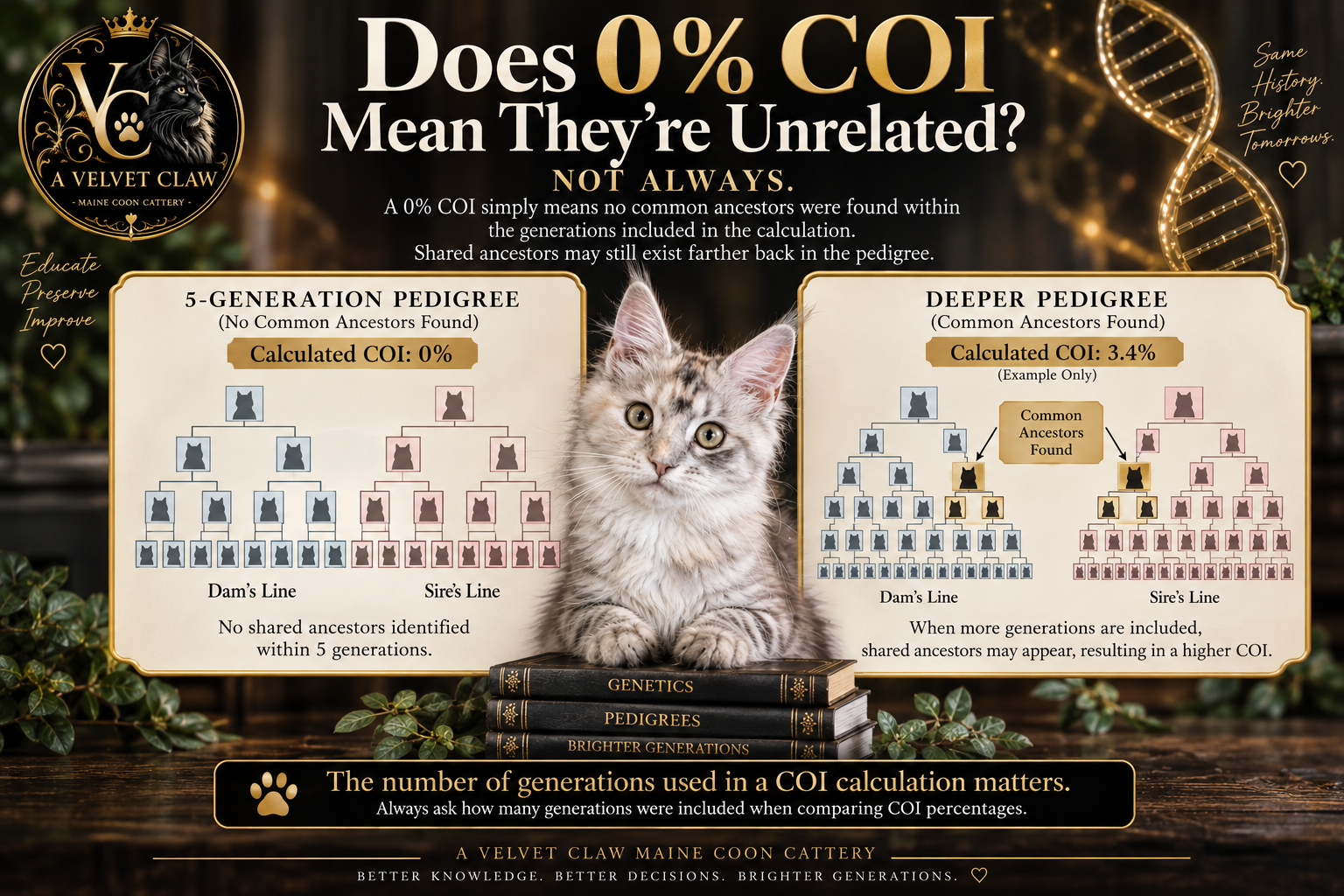
You might see: 5-Generation COI: 0% and naturally think: “These cats aren't related at all!” Not necessarily. It means no shared ancestry was identified within the pedigree information used for that particular calculation. Shared ancestors may exist farther back.
Research and feline-genetics references specifically caution that calculations using only four or five generations can produce a lower COI than calculations extending farther into the pedigree. So whenever someone gives you a COI percentage, an important question is: Calculated over how many generations?
Without that information, two percentages may not be directly comparable.
🌳 Five Generations vs. Complete Pedigree
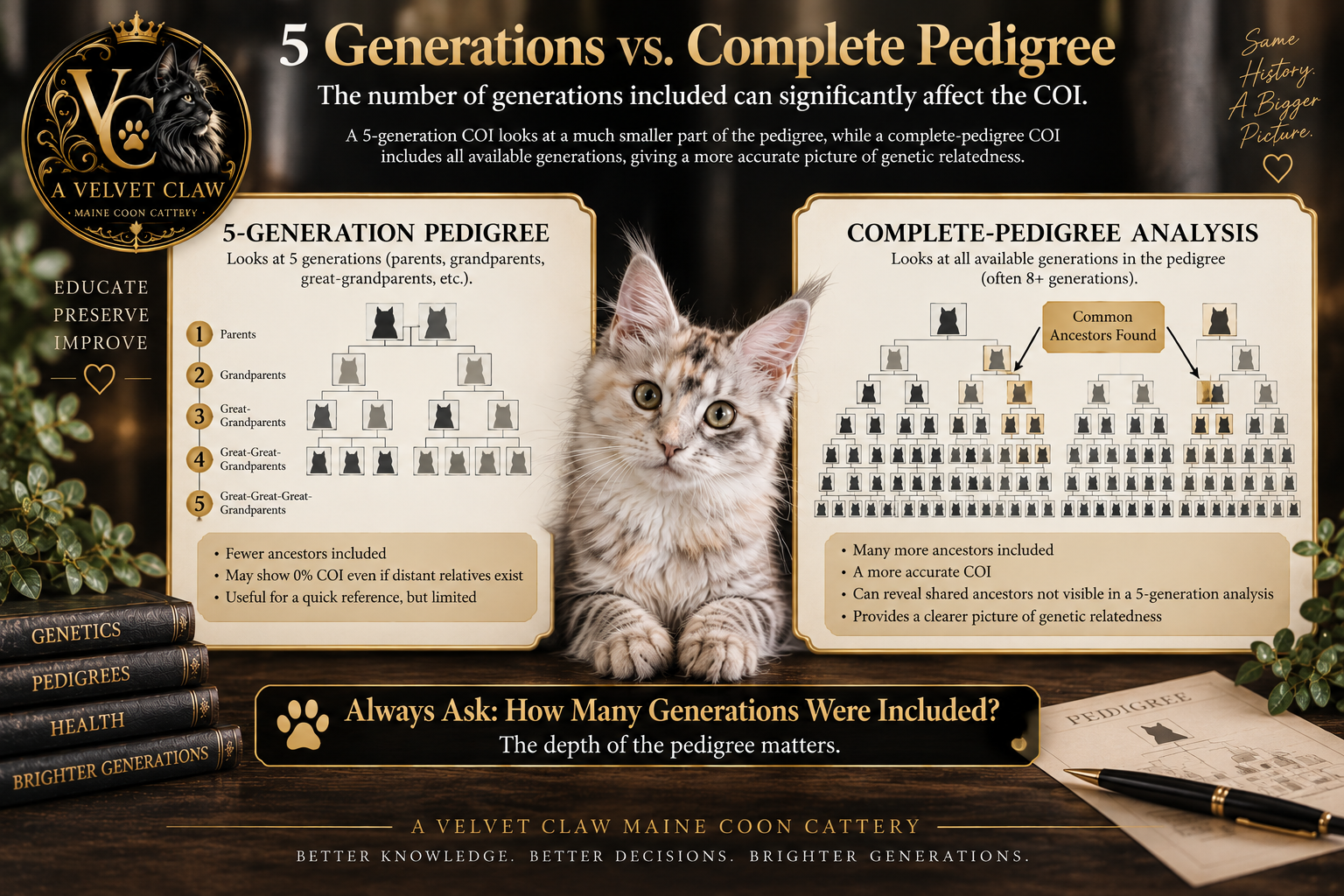
Let's imagine a hypothetical pairing. The first five generations contain no repeated ancestors. A program might calculate: 5-generation COI: 0% But extend that pedigree another five, ten or more generations and shared ancestors may begin appearing.
The complete-pedigree calculation could therefore be higher. Neither number is necessarily “wrong.” They are measuring different amounts of pedigree information.
This is why breeders using pedigree databases such as PawPeds may look beyond only a short pedigree when researching potential pairings. PawPeds specifically describes using pedigree information to calculate COI and provides extensive Maine Coon pedigree resources.
🐈 Maine Coons Have Shared Foundation Ancestors
Every established breed has a history. Modern Maine Coons ultimately descend from a finite foundation population, and some historical cats became particularly influential in the breed. Certain Maine Coon foundation cats and later descendants appear repeatedly throughout pedigrees because particular lines were used extensively. PawPeds' historical Maine Coon material documents several especially influential foundation cats and the heavy historical use of certain descendants.
That means finding common ancestors far back in two Maine Coon pedigrees isn't inherently surprising. The question isn't simply:“Are these cats related somewhere?”
A more useful question is: How closely related are they, through how many pathways, and what does the complete pedigree tell us?
🧬 Why Genetic Diversity Matters
Every individual carries genetic variation. A healthy breeding population benefits from maintaining diversity rather than allowing a relatively small number of animals to contribute disproportionately to future generations. This concept is sometimes discussed as effective population size.
A breed can contain thousands of registered cats but still lose genetic diversity if a relatively small number of breeding animals—particularly popular sires—produce a disproportionately large share of future generations. PawPeds' genetics education discusses this exact problem: population size alone doesn't necessarily equal a large effective gene pool.
This is why breeders shouldn't only ask: “Is this individual cat healthy?” They should also think about: “What does this breeding contribute to the population that comes after it?”
🧬 What Is Inbreeding Depression?
As inbreeding accumulates across a population, increased homozygosity can expose harmful recessive variants and reduce genetic diversity. The broader phenomenon known as inbreeding depression refers to reductions in biological fitness associated with increased inbreeding.
In breeding populations, concerns can include reproductive performance, survival and other aspects of fitness. Veterinary literature recommends considering pedigree information and COI when evaluating breeding programs and reproductive concerns.
That doesn't mean: High COI = sick kitten. Genetics doesn't work that neatly. Instead, COI helps breeders evaluate population-level and pairing-level genetic risk.
❤️ COI Is About Generations, Not Just One Litter
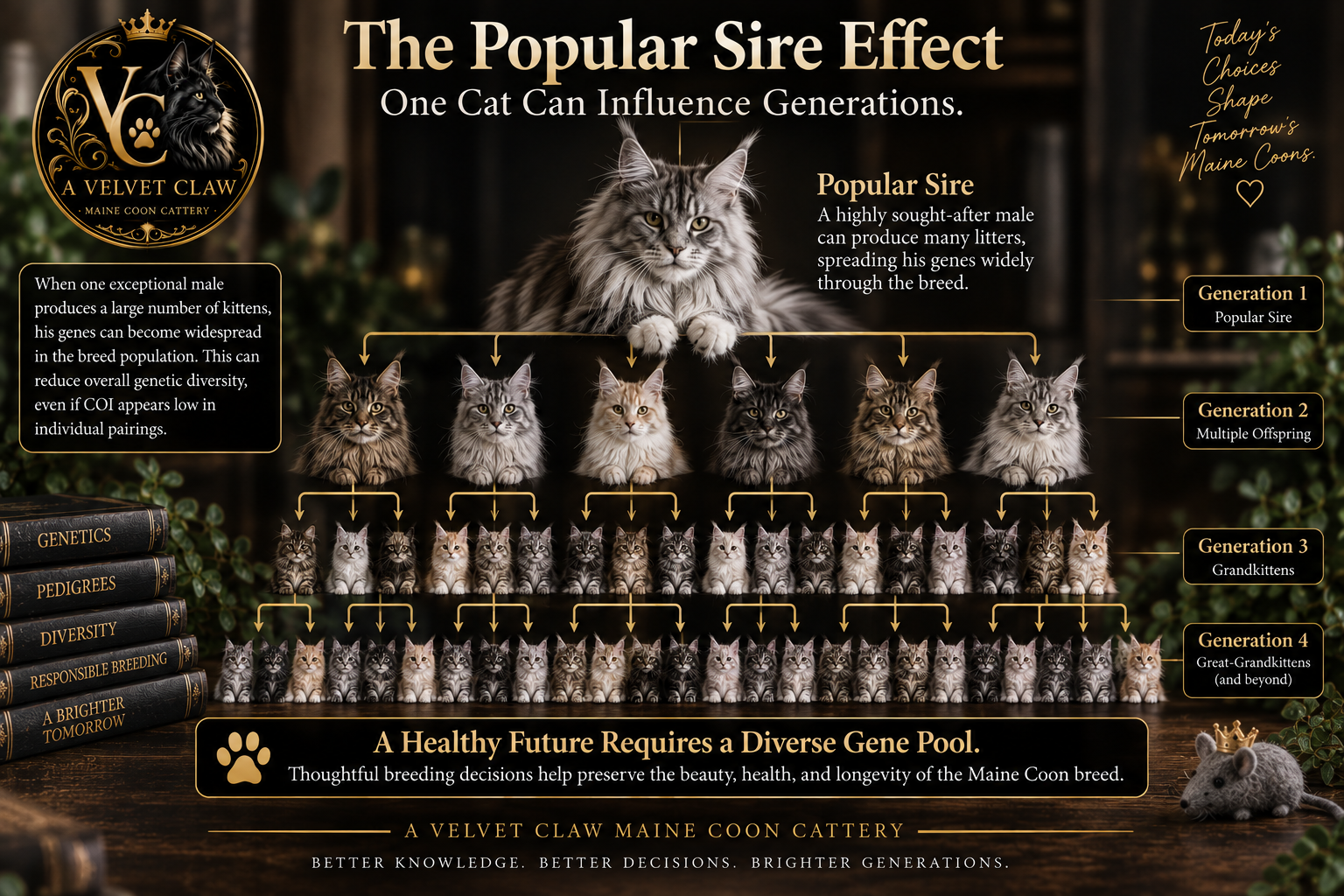
This may be my favorite way to think about COI. A breeder isn't only creating today's kittens. Every breeding decision potentially influences: the next generation… then their offspring… then the generations after them. A pairing that seems perfectly reasonable when looking only at the immediate litter may have a different significance when considered as part of a long-term breeding program.
Responsible breeding therefore requires thinking beyond: “Can these two cats produce beautiful kittens?” and asking: “What are we contributing to the future of the breed?”
🧬 Can DNA Testing Tell Us a Cat's COI?
This requires an important distinction. The traditional pedigree COI is calculated from documented ancestry. Modern genomic testing can also estimate inbreeding or homozygosity directly from DNA markers.
Those are related concepts, but they aren't necessarily the same measurement and shouldn't automatically be treated as interchangeable numbers. Research comparing pedigree-based and genomic measures in cats demonstrates that different methods can produce different information about inbreeding.
So when someone says: “This cat's COI is X%,” it's worth knowing how that number was calculated.
🐾 Does COI Replace Health Testing?
Absolutely not.
A low COI doesn't replace:
❤️ cardiac screening
🦴 appropriate hip evaluation
🧬 relevant genetic testing
🩺 routine veterinary care
📜 pedigree and family-health research
And excellent health-test results don't make COI irrelevant either. These tools answer different questions.
That's becoming a recurring theme in our health-education series for a reason: Responsible breeding is rarely about one test, one number or one piece of paper.
It's about putting information together.
🔎 What Should Kitten Families Ask?
You don't need a degree in genetics to have a thoughtful conversation with a breeder. Instead of asking only: “What's the COI?” try asking: “Do you evaluate pedigree relatedness and genetic diversity when planning your pairings?” A breeder should be able to explain the reasoning behind a pairing in language you can understand.
And remember: a COI percentage without context—especially without knowing how many generations were included—doesn't tell you very much by itself.
🖤 A Number Should Never Replace the Whole Cat
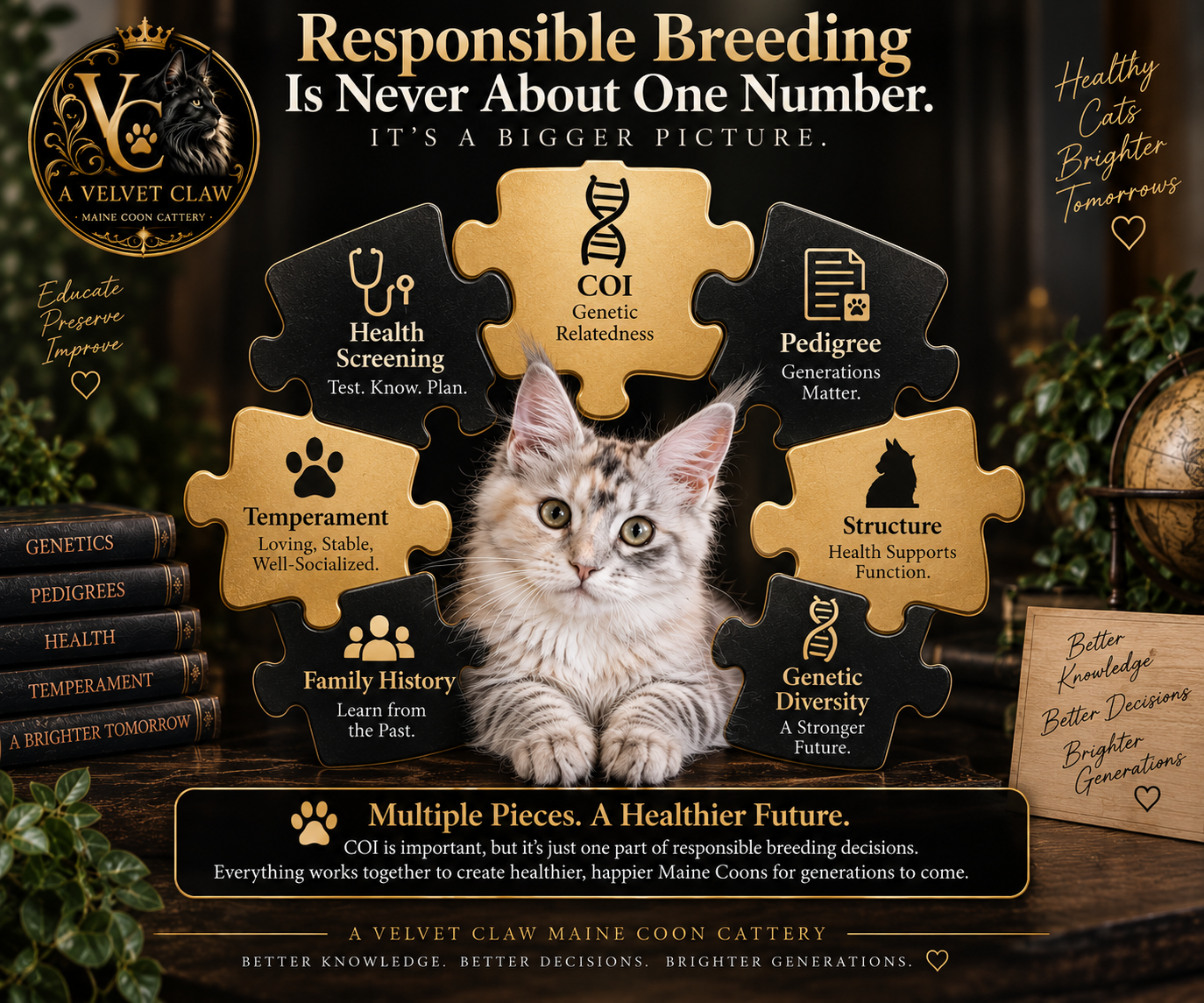
Breeding isn't a spreadsheet. COI is incredibly useful, but Maine Coons are more than percentages.
Responsible decisions consider the entire animal:
Health.
Temperament.
Structure.
Pedigree.
Family history.
Genetic diversity.
Breed type.
And what that individual may contribute to future generations.
The goal isn't to chase one magical number. The goal is to use the information available to make increasingly thoughtful decisions.
🧬 The Bottom Line
COI—Coefficient of Inbreeding—is a tool used to evaluate genetic relatedness through ancestry. A higher COI generally reflects more shared ancestry between the parents. A lower COI reflects less shared ancestry within the pedigree depth being examined. But COI isn't a health guarantee. It isn't a diagnosis. And it isn't a number that should be interpreted without knowing how it was calculated.
A five-generation COI and a complete-pedigree COI may tell very different stories. Responsible Maine Coon breeding means looking beyond a single number and considering health, pedigree, genetic diversity and the long-term future of the breed together. Because we're not only planning the kittens standing in front of us today. We're helping shape the Maine Coons that come after them. 🖤💛
🐾 Keep Learning With A Velvet Claw
At A Velvet Claw Maine Coon Cattery, we believe education is part of responsible breeding. The more we understand about genetics, health and pedigrees, the better equipped we are to make thoughtful decisions for the cats we love—and the generations still to come.Educate. Preserve. Improve.
Better knowledge. Better decisions. Brighter generations. 🧬🐾🖤
Fur - ever grateful: Lexie & Melina
Maine Coon COI • COI in Maine Coons • Maine Coon coefficient of inbreeding
Maine Coon genetic diversity • Maine Coon pedigree • Maine Coon breeding genetics