
❤️ HCM in Maine Coons: Why a DNA Test Isn’t Enough
What Responsible Breeders—and Maine Coon Families—Should Understand About Genetic Testing and Heart Screening
You send off your Maine Coon's DNA sample. The results come back. You scroll through the report and see: HCM — Negative. ✅
Wonderful news. So that means your Maine Coon can never develop hypertrophic cardiomyopathy… right?
Unfortunately, no.
A negative result for a known HCM-associated genetic variant is valuable information, but it doesn't guarantee that a Maine Coon will never develop HCM. And this distinction is incredibly important—especially when we're making decisions about breeding cats. DNA testing and cardiac screening aren't competing tests.
They're different tools answering different questions.
Let's talk about why responsible Maine Coon health screening often involves both. 🧬❤️
1. First—What Is HCM? ❤️
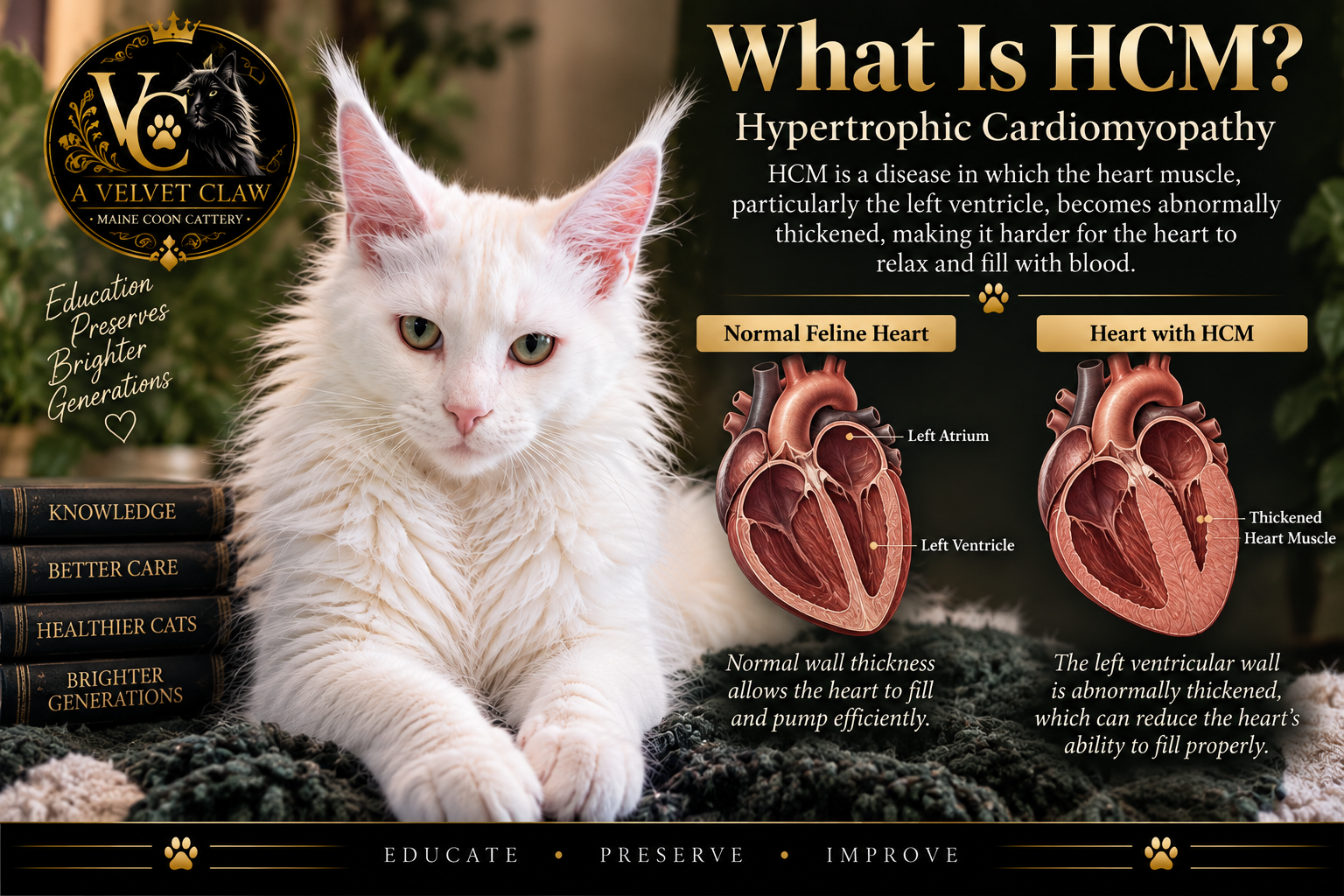
Hypertrophic cardiomyopathy, usually shortened to HCM, is a disease in which the muscular walls of the heart—particularly the left ventricle—become abnormally thickened. That thickening can interfere with the heart's ability to relax and fill normally. Some cats with HCM remain stable for years. Others can develop serious complications, including congestive heart failure, blood clots and abnormal heart rhythms.
In some cases, sudden death can occur. The course of HCM can vary considerably between individual cats. And one of the most important things to understand is:
A cat with HCM may initially look completely healthy.
2. Why Do We Talk About HCM So Much in Maine Coons? 🐾
HCM can occur in many cats, including mixed-breed cats. However, Maine Coons are one of the breeds in which a hereditary component of HCM has been identified.
Researchers discovered a variant in a gene called: MYBPC3 The gene helps produce cardiac myosin-binding protein C, a protein involved in normal heart-muscle function. A particular MYBPC3 variant has been associated with HCM in Maine Coons.
That discovery gave breeders something incredibly useful: A DNA test. But it didn't give us a crystal ball.
3. What Does the Maine Coon HCM DNA Test Actually Tell Us? 🧬
A DNA test looks for a specific genetic variant. Depending on the laboratory, results may be described using terms such as negative, heterozygous or homozygous—or with genotype notation.
The important concept is this: The test tells us whether the tested genetic variant was detected. That's extremely useful information. But notice what it doesn't say.
It doesn't say: “This cat will never develop HCM.” Those are two very different statements.
4. Negative DNA Test ≠ HCM-Free for Life
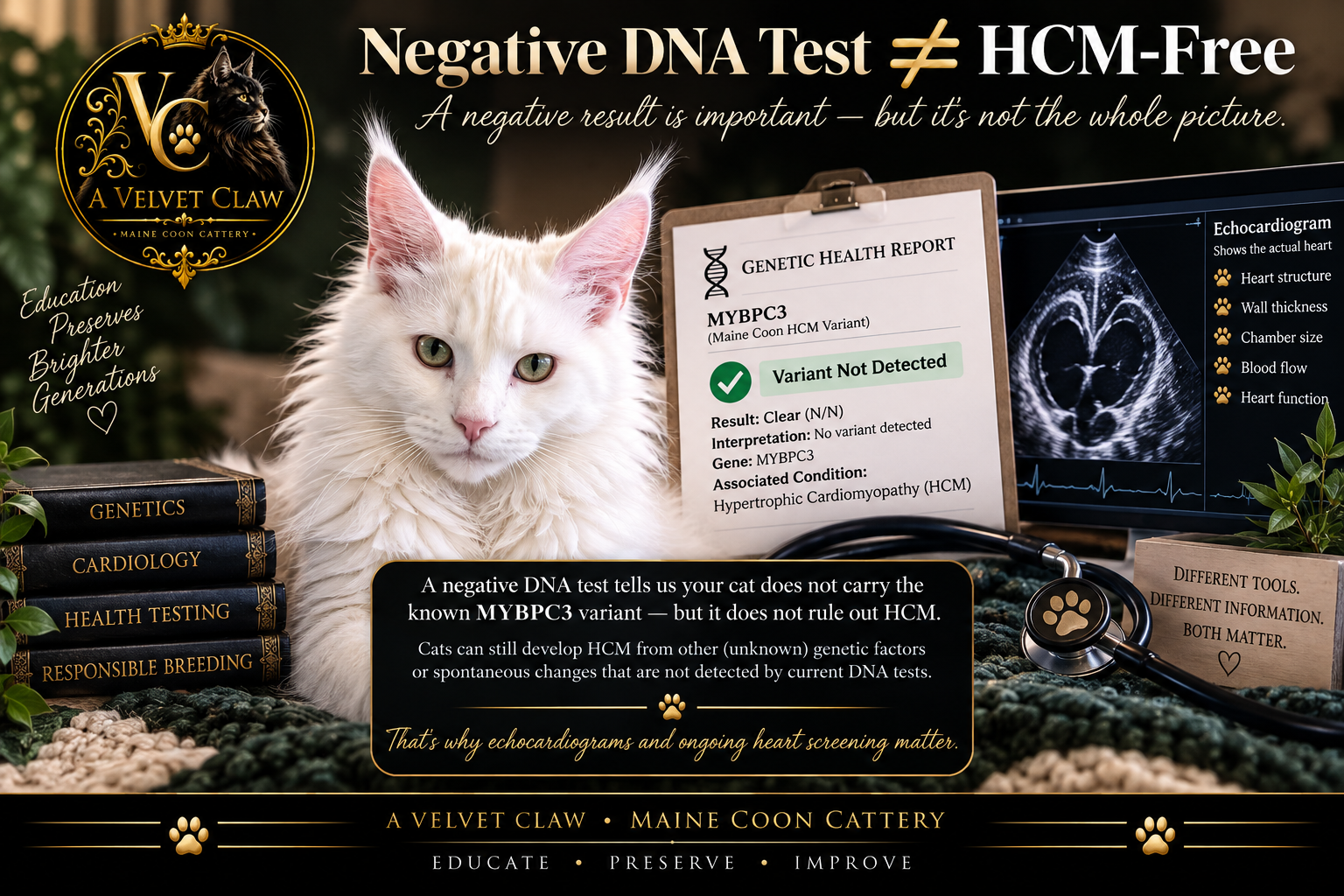
This may be the single most important takeaway from this article. A Maine Coon can test negative for the known breed-associated MYBPC3 HCM variant and still develop HCM. Why? Because HCM is genetically complex. The currently available DNA test does not identify every possible genetic cause of HCM in every Maine Coon. There may be other genetic influences that aren't included in the test, and not every case of feline HCM is explained by the known Maine Coon MYBPC3 variant.
So when a report says the tested variant wasn't detected, the appropriate interpretation is: “This particular tested variant was not detected.”
Not: “This cat can never develop HCM.” That's a very important difference.
5. What About a Maine Coon That Tests Positive? 🧬❤️
The opposite misunderstanding can happen too. Finding an HCM-associated variant doesn't necessarily tell us exactly what will happen to that individual cat. Genetics aren't always perfectly predictable. A concept called penetrance helps explain why. Penetrance describes how often individuals carrying a disease-associated genetic variant actually develop the associated condition.
With the Maine Coon MYBPC3 variant, disease expression can vary. That means genetic status provides information about risk—but doesn't function like a countdown clock telling us exactly if or when a particular cat will develop detectable heart disease. This is another reason we shouldn't interpret a DNA result in isolation.
6. So How Do We Actually Look at the Heart? 🩺
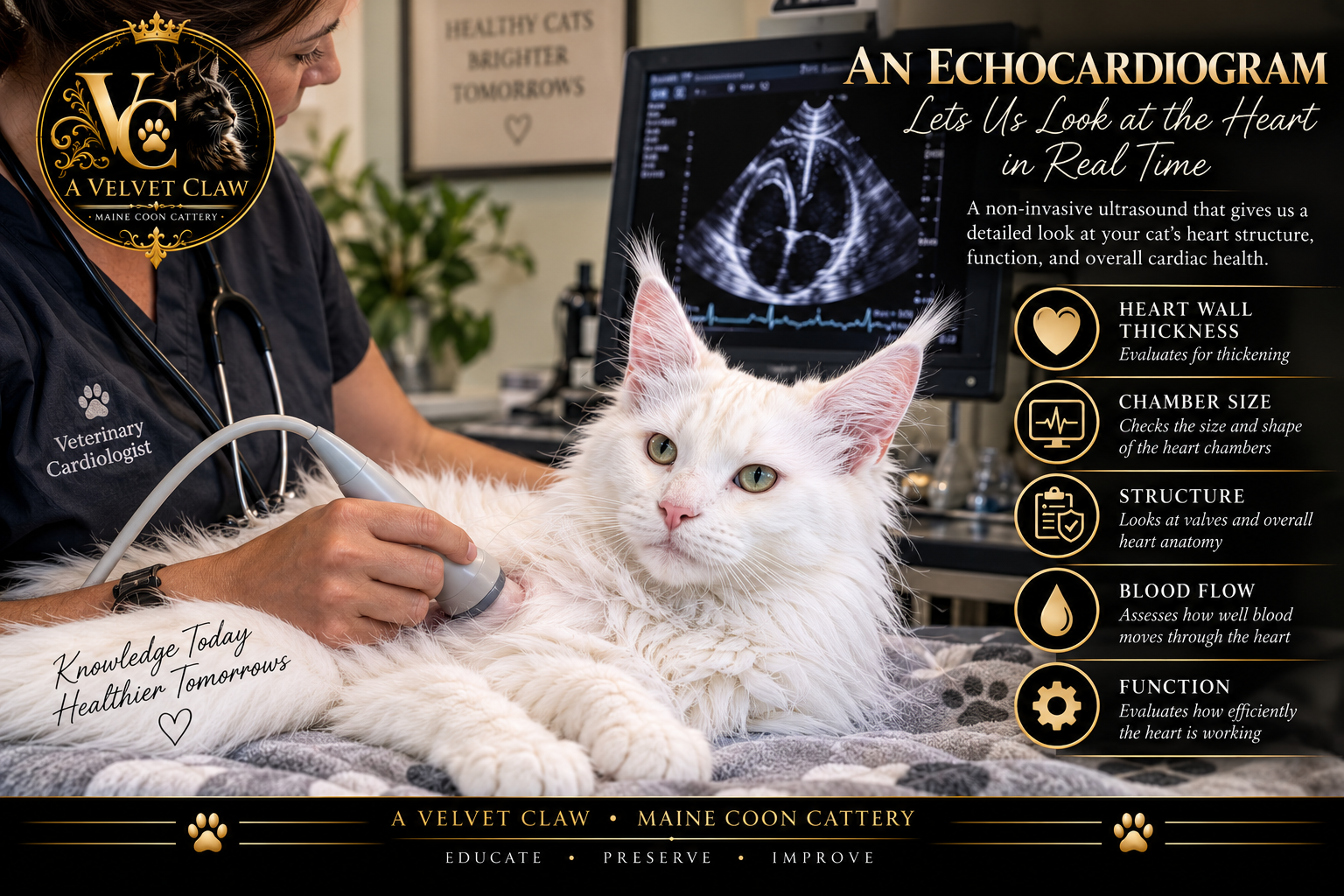
This is where an echocardiogram comes in. An echocardiogram is an ultrasound examination of the heart. Instead of examining DNA, it allows a veterinarian—ideally someone with advanced training in cardiology—to evaluate the heart itself.
They can assess things such as:
Heart-wall thickness
Chamber size
Heart structure
Valve movement
Blood flow
Heart function
In other words: 🧬 DNA testing asks: “Does this cat have the genetic variant we're testing for?”
❤️ Echocardiography asks: “What does this cat's heart look like right now?” Now you can see why one can't completely replace the other.
7. DNA Testing vs. Echocardiogram: The Simplest Explanation
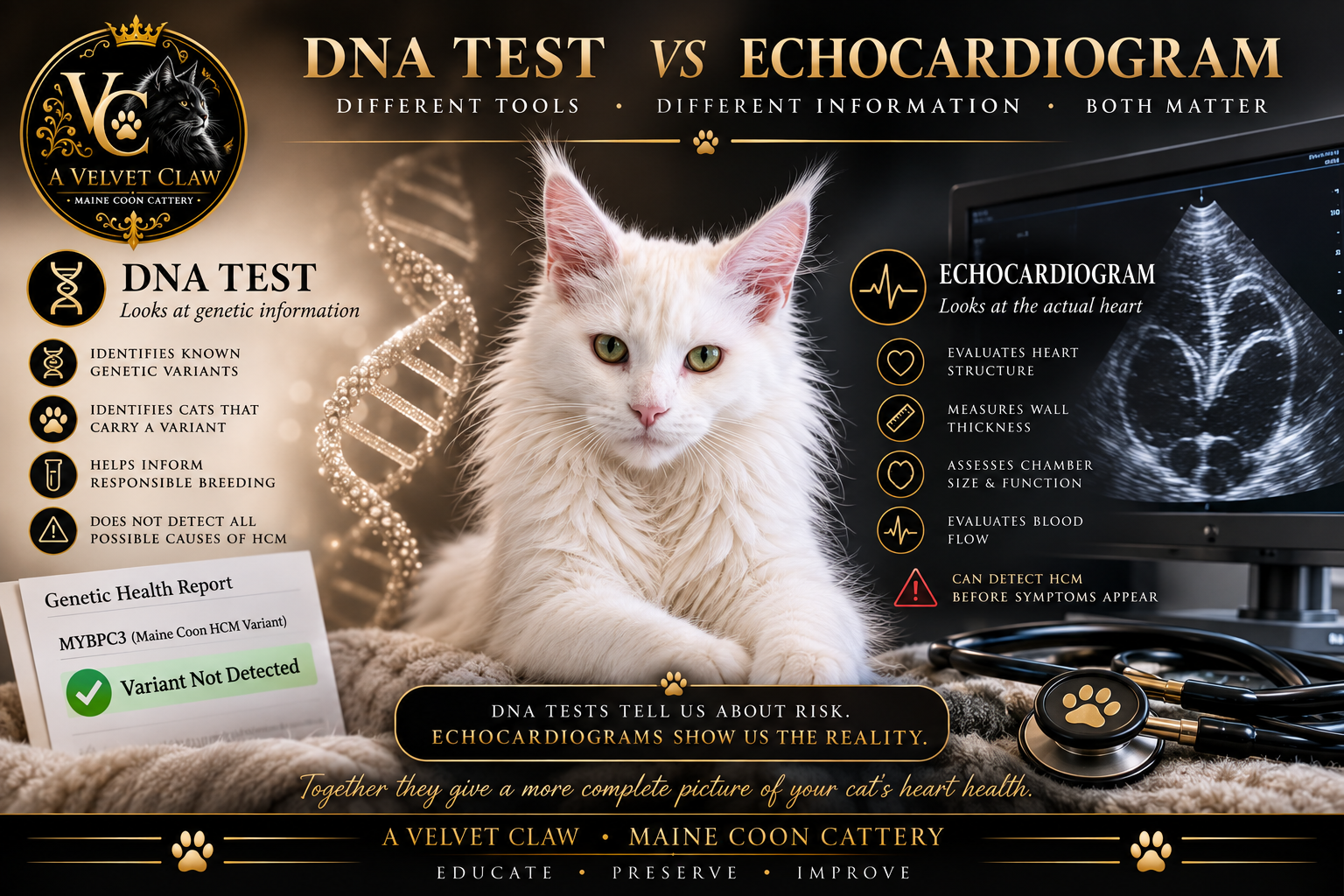
Think about it this way. 🧬 DNA TEST Looks at genetic information It can identify certain known inherited variants associated with disease risk. ❤️ ECHOCARDIOGRAM
Looks at the actual heart It can identify physical changes consistent with HCM at the time of the examination. One evaluates genotype. The other evaluates phenotype. And responsible health screening benefits from understanding both.
8. “But My Veterinarian Listened to the Heart and Said It Sounds Great.” 🩺
That's wonderful. Routine veterinary examinations are extremely important. Listening to the heart with a stethoscope can reveal abnormalities such as a murmur or an irregular rhythm.
But here's another important distinction: A normal-sounding heart doesn't completely rule out HCM. Some cats with HCM don't have an obvious heart murmur. Likewise, not every heart murmur means a cat has HCM.
A stethoscope provides valuable information. An echocardiogram provides different and much more detailed information about the heart's structure. Again, different tools answer different questions.
9. Why a Veterinary Cardiologist Matters ❤️🩺
Measuring a cat's heart isn't always straightforward. Heart-wall measurements are small, and interpretation can involve more than simply deciding whether one number is above or below a cutoff. Age, body size, hydration status, blood pressure and other medical conditions may need to be considered. Some illnesses can also cause heart-wall thickening that may resemble HCM.
That's why evaluation by a board-certified veterinary cardiologist can be particularly valuable for breeding cats and cats with suspected cardiac disease. They're trained specifically in diagnosing and managing diseases of the cardiovascular system. For a breeding program, that expertise gives us better information for making important decisions.
10. Why Isn't One Normal Echocardiogram Enough Forever? 📅
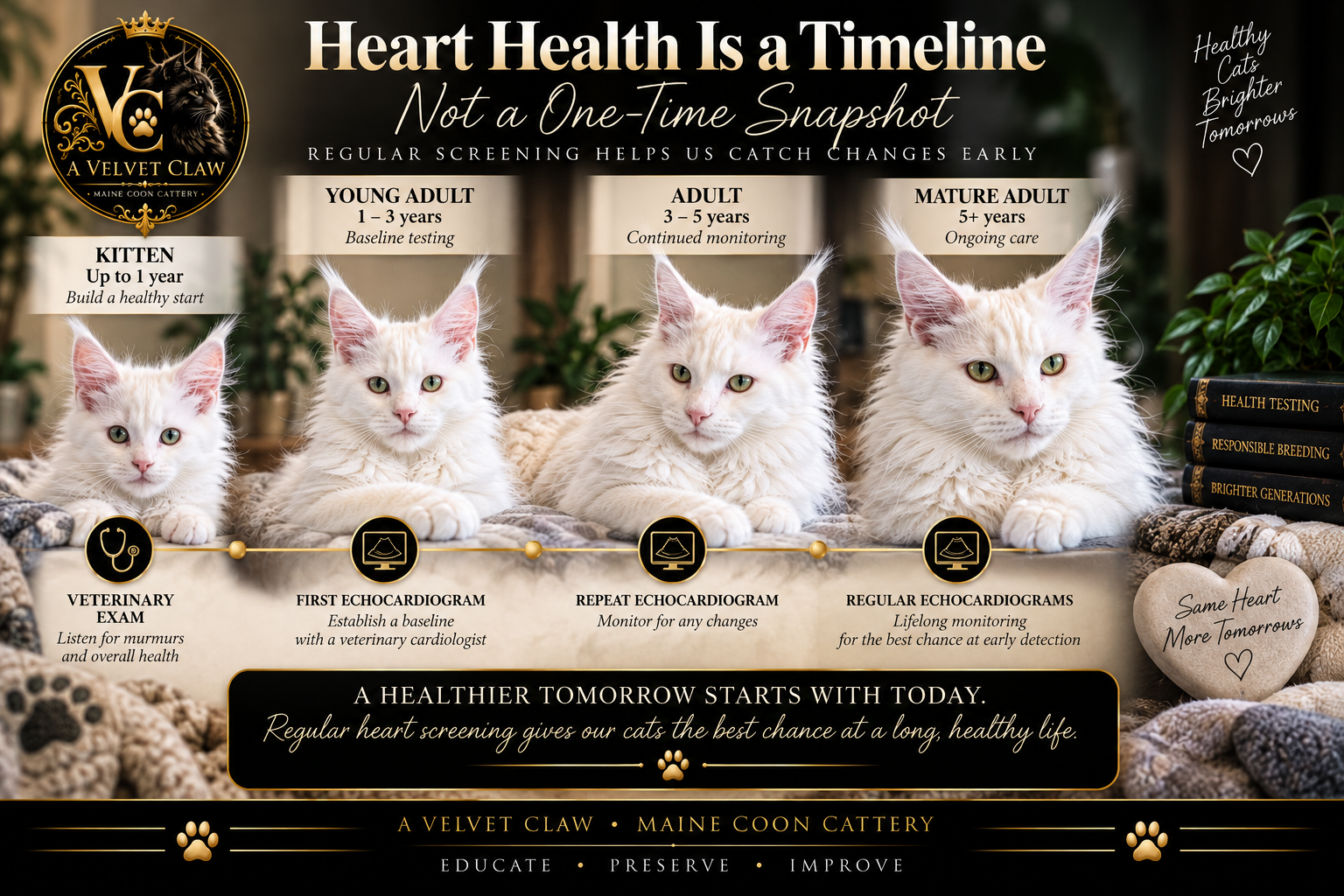
Here's another common misunderstanding. Suppose a young breeding Maine Coon receives an echocardiogram. Everything looks normal. Fantastic. Does that mean HCM can never appear later? No. HCM can develop over time. A normal echocardiogram tells us that the cardiologist did not identify evidence of HCM at that examination. That's valuable information.
But it isn't a lifetime guarantee. This is why cardiac screening in breeding programs may be repeated periodically, rather than performed once and forgotten. The appropriate screening schedule should be determined with the breeder's veterinarian or veterinary cardiologist based on the individual cat, age, family history and breeding program.
11. Why Family History Matters Too 📜❤️
This is one reason pedigrees are much more than fancy papers filled with registered names. Imagine a breeding cat that: Has a negative DNA test for the known HCM-associated variant. Has a normal echocardiogram. But has multiple close relatives that developed HCM.
Would that information matter? Absolutely.
Health information from parents, siblings, offspring and other relatives can provide valuable context that one individual test can't. This is why responsible breeders pay attention to lines, not just individual cats. DNA testing. Cardiac screening. Pedigree research. Family history. They're different pieces of the same puzzle.
12. What If a Breeding Cat Develops HCM? 💔
This is where responsible breeding sometimes requires difficult decisions. A cat can be beautiful. Have an incredible temperament. Have wonderful breed type. Be deeply loved. And still develop a condition that changes the breeding plan. A diagnosis of HCM is significant information that must be taken seriously in breeding decisions.
The cat's veterinary care becomes the priority, and the breeder should work closely with veterinary professionals regarding treatment, monitoring and the implications for related cats and offspring. Responsible breeding sometimes means changing plans we were emotionally invested in. That's part of the responsibility we accept when we choose to breed animals.
13. Health Testing Doesn't Make a Cat Disposable 🖤
This deserves to be said. When a breeding cat develops a health problem, that cat hasn't “failed.” They're still the same animal. They're still loved. They're still family. Health screening exists so breeders can gather information and make responsible decisions—not so animals become nothing more than test results.
Sometimes the greatest act of responsible breeding is deciding: “Your job now is simply to be loved.”
And that's a pretty wonderful retirement plan. 🖤🐾
14. Can HCM Be Completely Eliminated Through DNA Testing? 🧬
Not with the testing currently available. If every case of Maine Coon HCM were caused by one single known genetic variant, the problem would be much simpler. But biology rarely cooperates that nicely. The known MYBPC3 variant gives breeders valuable information. It can help inform breeding decisions and reduce risk associated with that particular variant.
But focusing exclusively on one DNA result while ignoring echocardiography, pedigree information and family history would leave important information out of the picture. Responsible breeding requires looking beyond one test.
15. Does a Normal Echocardiogram Guarantee Healthy Kittens? ❤️
No. Just like favorable hip evaluations don't guarantee every kitten will have perfect hips. And clear genetic testing doesn't guarantee a kitten will never develop disease. Health screening isn't about making impossible promises. It's about risk reduction. We collect information. We study pedigrees. We evaluate breeding cats. We make thoughtful pairings. We follow offspring. We adjust future decisions when new information becomes available.
That's how responsible breeding works.
16. What Should Kitten Families Ask a Breeder? 🔎
Instead of asking only: “Have the parents been DNA tested?”
Ask: “What HCM screening do you perform on your breeding cats?” Then ask whether you can see the results.
You can also ask about:
DNA testing
Echocardiograms
Family history
The age of the parents when screened
Whether cardiac screening is repeated
You don't need a veterinary degree to ask good questions. And a responsible breeder should be willing to explain what their testing means—including its limitations.
17. This Is Why “Health Tested” Can Mean Very Different Things 📋
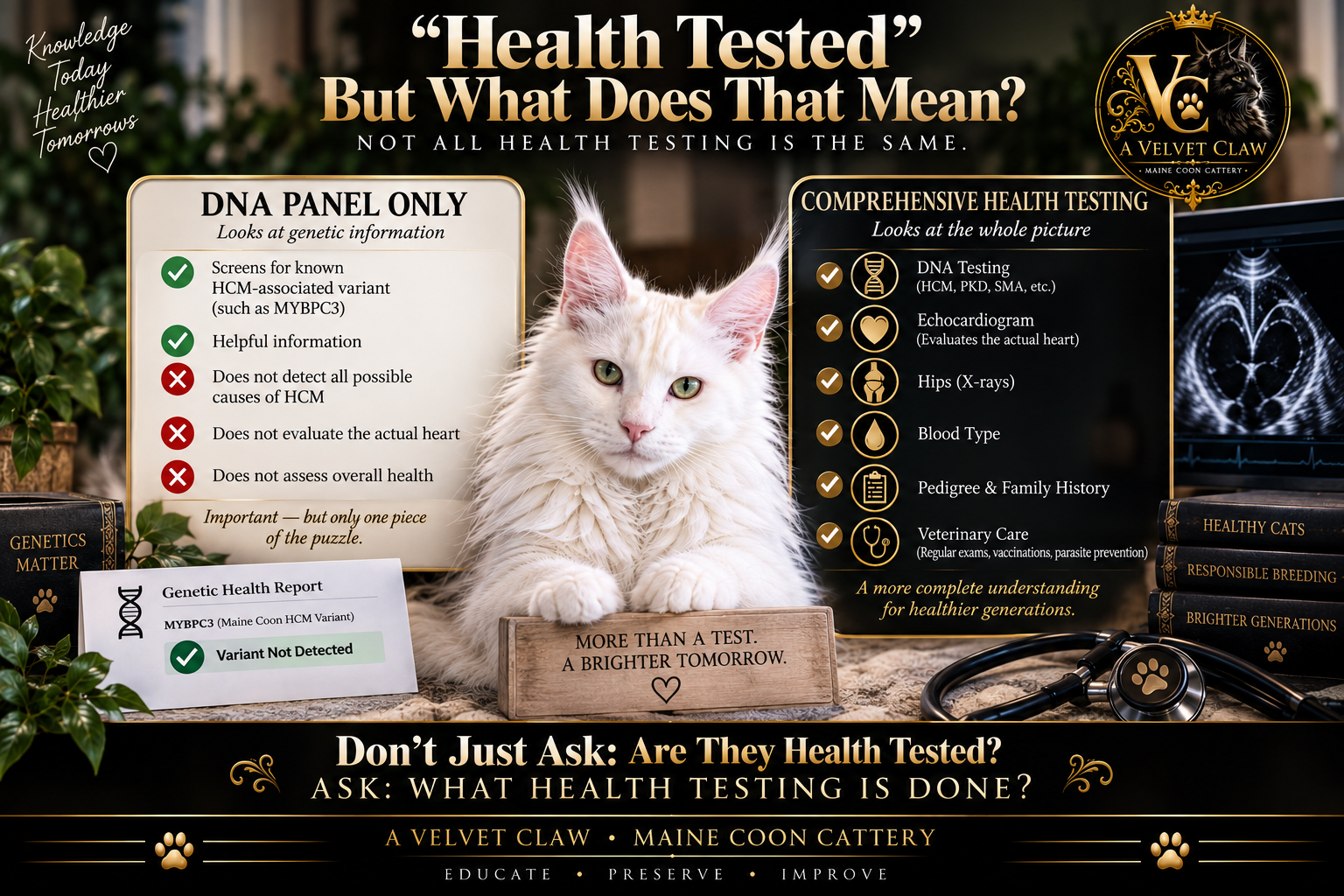
You'll often see breeders advertise: “All of our cats are health tested.” But what does that actually mean?
One breeder may mean: “We ran a DNA panel.” Another may mean: DNA testing + cardiac screening + hip evaluation + blood typing + infectious disease screening + routine veterinary care + pedigree research.
Those aren't necessarily equivalent. So rather than stopping at: “Are your cats health tested?”
Ask: “What health testing do you perform?” Then look at the actual results. That question tells you much more.
18. DNA Testing Is Valuable—It Just Isn't the Whole Story 🧬❤️
None of this means DNA testing isn't important. It absolutely is. The discovery of disease-associated genetic variants gives breeders tools previous generations simply didn't have. That's extraordinary. But responsible breeding means understanding both the power and limitations of every tool we use. DNA tells us something. An echocardiogram tells us something else. A pedigree adds another layer.
Family history adds another. And following cats throughout their lives adds information that couldn't possibly have been available when they were kittens. The more pieces we have, the clearer the picture becomes.
❤️ The Heart Deserves More Than a Checkmark
A beautiful DNA report filled with green checkmarks feels reassuring. We understand why. But responsible breeding isn't about collecting green checkmarks. It's about understanding what those results actually mean. For HCM, a negative result for a known genetic variant is good information. It isn't the same thing as looking at the heart.
That's why DNA testing and echocardiography shouldn't be viewed as competitors. They're partners. One helps us understand genetic risk. The other lets us evaluate what's happening inside the heart. Together with pedigree research, family history, veterinary care and long-term follow-up, they give breeders a much better foundation for making responsible decisions.
Because when we're making decisions that may influence generations of Maine Coons… Their hearts deserve more than assumptions. ❤️🐾
🖤 Keep Learning With A Velvet Claw
At A Velvet Claw, we believe responsible breeding starts with education—not perfection. Understanding what health tests can tell us—and what they can't—helps breeders and kitten families make better-informed decisions.
Follow along for more Maine Coon genetics, health screening, pedigrees, development and responsible breeding education. 🖤💛🐾
Educate. Preserve. Improve. Better knowledge. Better decisions. Brighter generations.
Fur - ever grateful: Lexie & Melina
Maine Coon HCM • HCM in Maine Coons • Maine Coon HCM testing
Maine Coon HCM DNA test • Maine Coon echocardiogram • Maine Coon heart screening