
Why Blood Type Matters in Maine Coon Breeding 🩸🐾
The Tiny Detail That Can Make a Life-or-Death Difference for Newborn Kittens
When most people think about responsible Maine Coon breeding, they think about things like genetic testing, HCM screening, hip evaluations, pedigrees and temperament. But there's another piece of information responsible breeders need to understand:
Blood type.
It sounds simple. After all, why would a perfectly healthy queen and a perfectly healthy tom having different blood types matter? Because under certain circumstances, their kittens can be born looking completely healthy—and then become critically ill after nursing from their mother.
The condition is called feline neonatal isoerythrolysis, or NI.
It's one of those behind-the-scenes breeding considerations most kitten families never hear about, but it's a perfect example of why responsible breeding involves so much more than simply putting two beautiful cats together. 🖤
1. Cats Have Blood Types Too 🩸
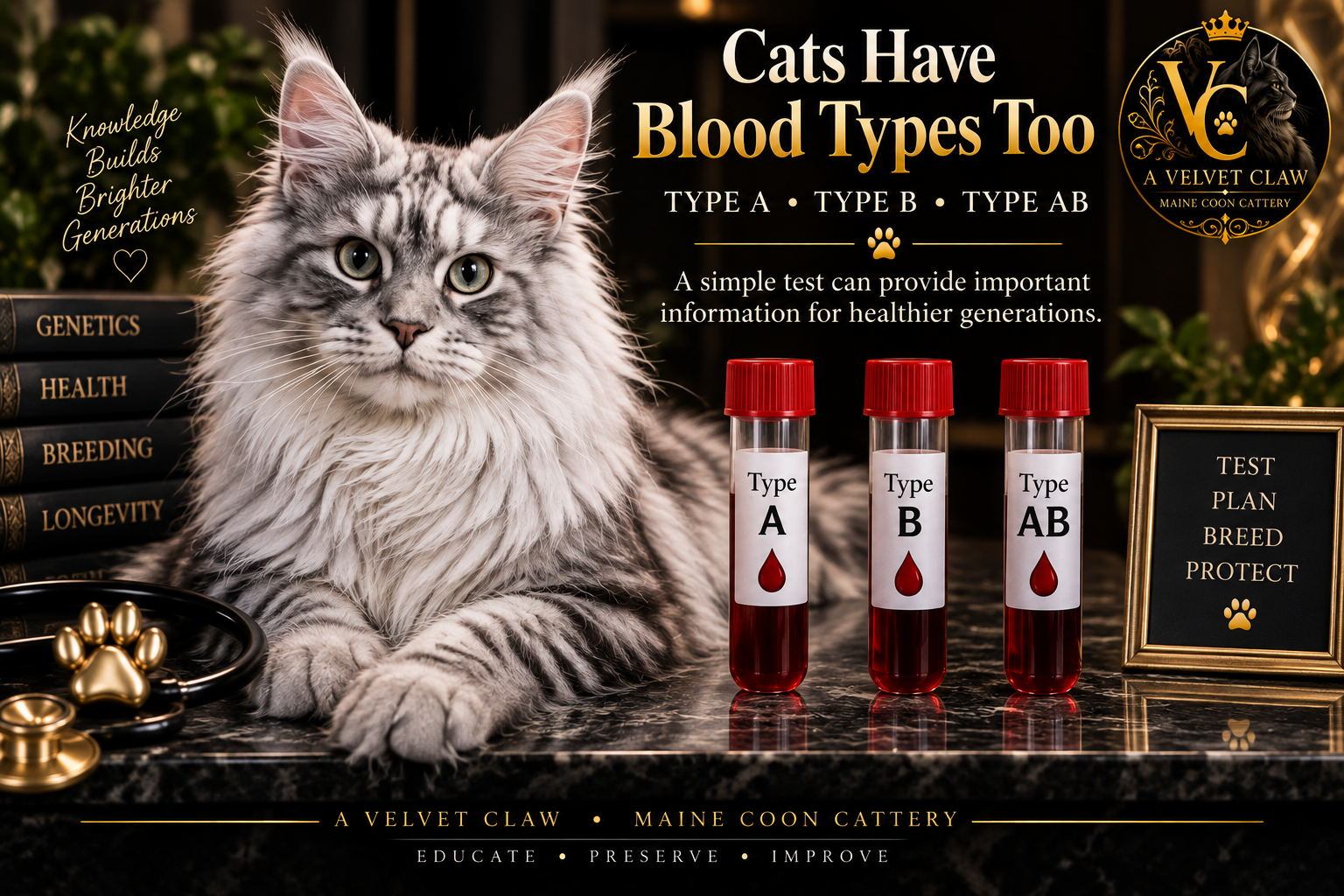
Cats have a major blood-group system known as the AB blood group system.
The three recognized types are:
Type A — the most common
Type B — less common
Type AB — rare
These blood types are determined by antigens on the surface of a cat's red blood cells. Cats also naturally have antibodies against certain blood-group antigens they don't possess. And that's where blood type becomes especially important in breeding.
2. Why Does Blood Type Matter When Planning a Litter? 🐾
The biggest breeding concern involves a: Type B queen
bred to a: Type A or AB tom
That pairing can potentially produce Type A or AB kittens. The kittens themselves may be completely healthy while developing inside their mother. The problem can begin after birth, when they nurse.
3. What Is Neonatal Isoerythrolysis? 🩺
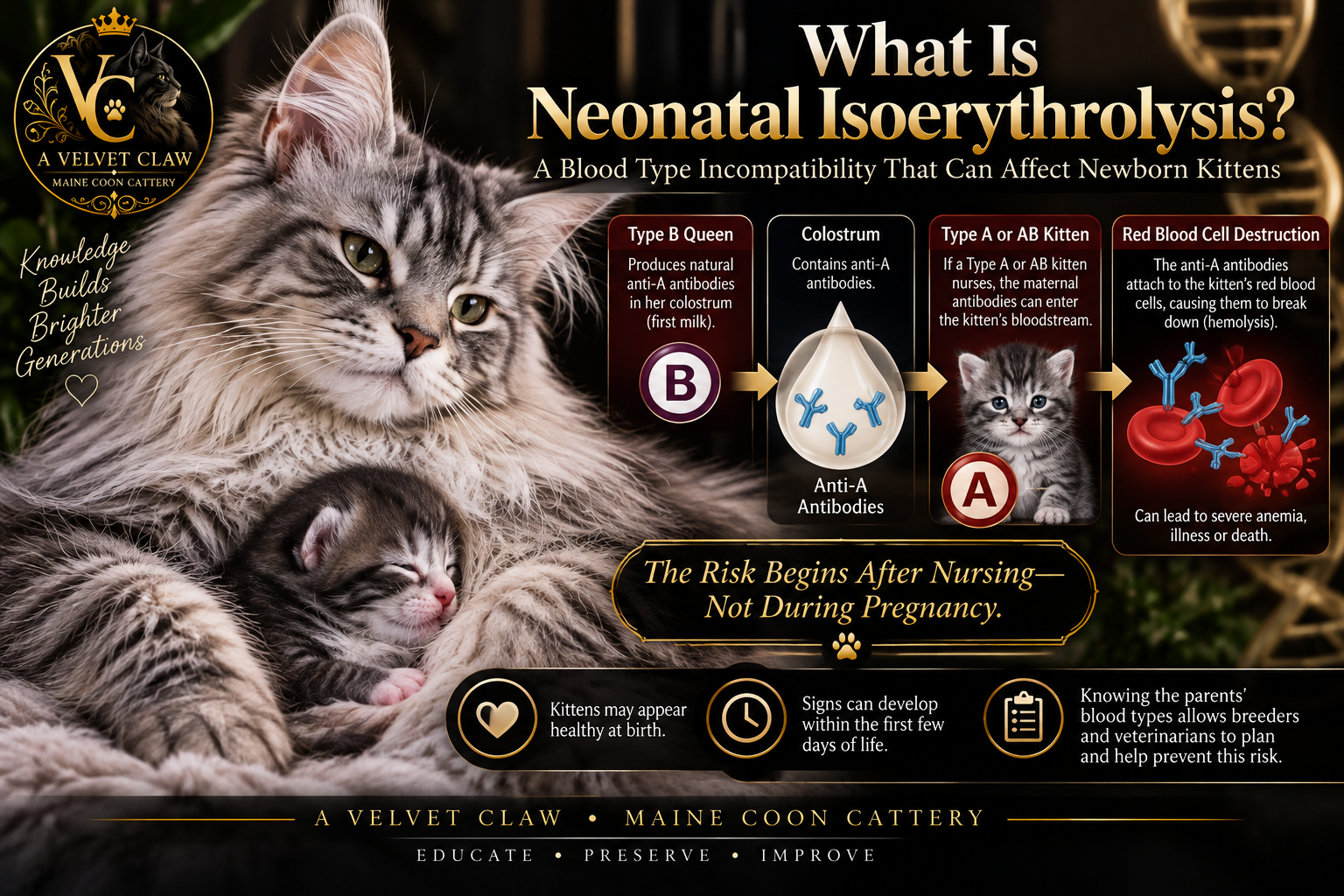
Here's the simplest way to understand it. A Type B queen naturally has strong anti-A antibodies. Those antibodies are present in her first milk, called colostrum.
If she gives birth to a Type A or AB kitten and that kitten nurses during the period when its intestine can absorb maternal antibodies, the queen's anti-A antibodies can enter the kitten's bloodstream.
Those antibodies then attack the kitten's red blood cells. The red blood cells begin to break apart—a process called hemolysis.
This is feline neonatal isoerythrolysis. So strangely enough, neither parent necessarily has to be sick.
The kitten doesn't have to be born sick.
It's the incompatibility between their blood types and maternal antibodies that creates the danger.
4. The Kitten May Look Completely Normal at Birth 💔
This is one of the frightening things about NI. Affected kittens can initially appear healthy. They may be born normally and begin nursing like their littermates. Then problems can develop.
Depending on severity, signs may include weakness, poor nursing, pale or yellowish tissues, dark red-brown urine, anemia and potentially death. Severe hemolytic anemia can develop within the first few days of life. That's why prevention is so important.
A breeder doesn't want to discover a blood-type incompatibility after kittens are already in danger.
5. Wait—How Can the Mother's Milk Hurt Her Own Kitten? 🥺
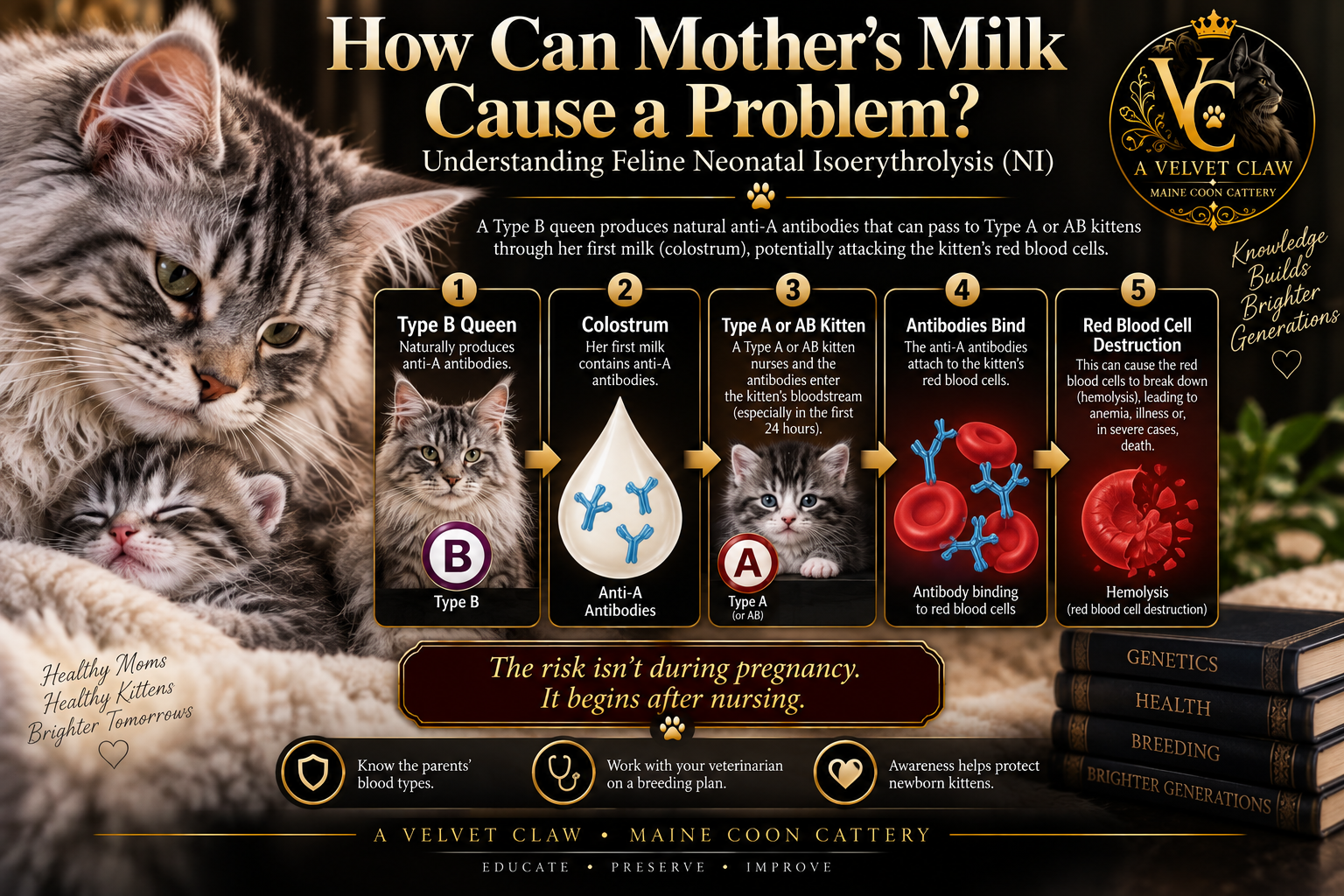
It sounds completely backwards. Colostrum is normally incredibly important to newborn kittens because it provides maternal antibodies that help protect them early in life. But in an incompatible litter, some of those antibodies can recognize the kitten's red blood cells as foreign.
Think of it like a case of mistaken identity. The mother's immune system produced antibodies against Type A red blood cells. The kitten inherited Type A blood from its father. The antibodies enter the kitten through colostrum and essentially say: “That doesn't belong here.”
Then they attack. The queen isn't rejecting her kittens. She isn't unhealthy. Her body is simply doing exactly what her immune system is designed to do—the problem is that those antibodies are incompatible with some of her kittens' red blood cells.
6. Why Are Type B Queens the Main Concern? 🩸
Cats have naturally occurring antibodies to blood types they don't possess, but their strength isn't equal. Type B cats generally have strong naturally occurring anti-A antibodies, while Type A cats tend to have lower concentrations of anti-B antibodies. Type AB cats don't have anti-A or anti-B antibodies.
That's why the classic high-risk situation is: Type B Queen × Type A/AB Tom
rather than simply: “Two cats with different blood types.” That distinction is important.
7. Does This Actually Matter in Maine Coons?
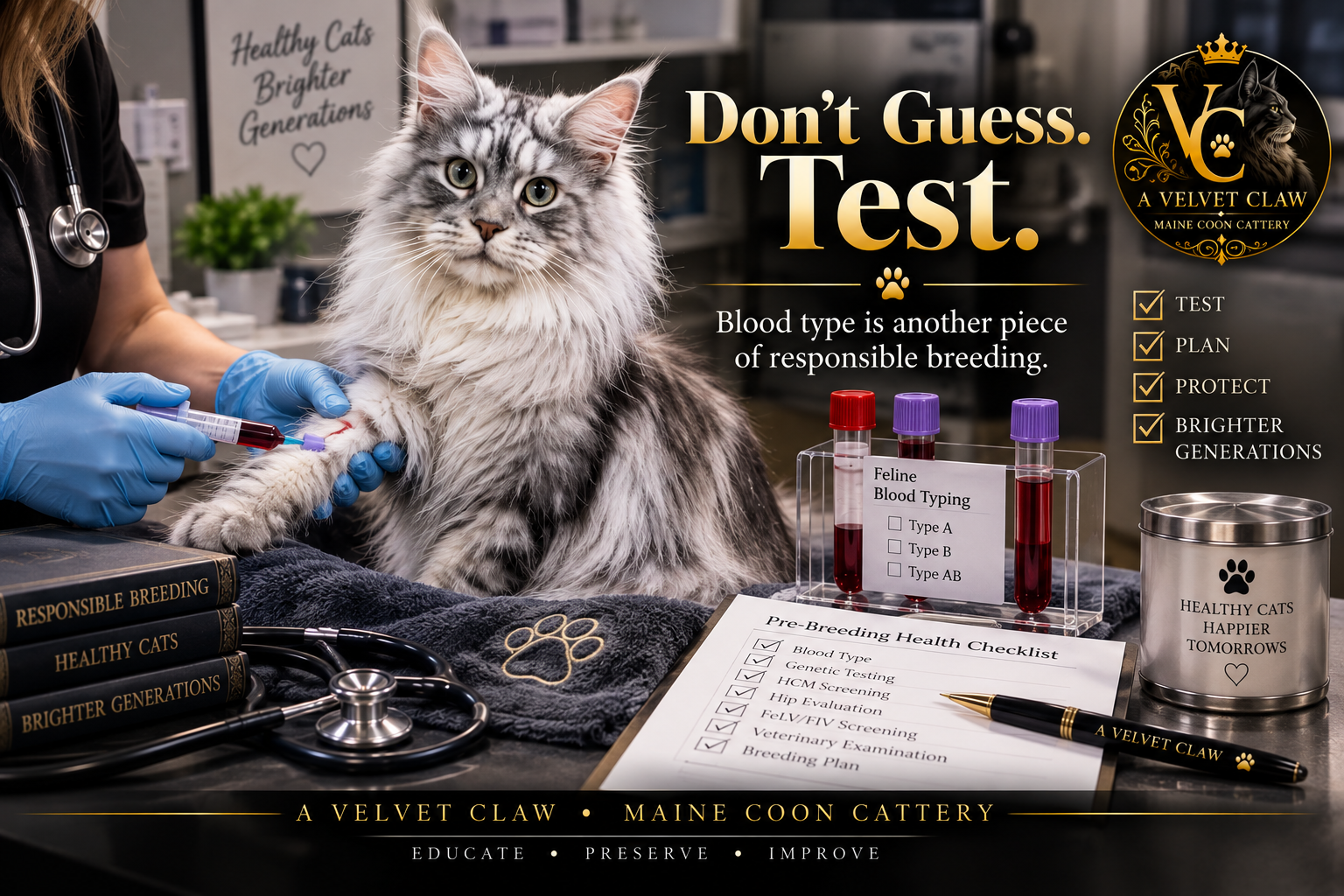
Yes. Type A appears to be much more common in Maine Coons, but Type B occurs in the breed as well. Published blood-type frequencies vary by population, geography and study, so a breeder shouldn't assume a Maine Coon's blood type simply because of its breed.
And that's really the point. Don't guess. Test. A relatively uncommon blood type can still matter tremendously when the individual cat standing in front of you happens to have it.
8. How Can Breeders Know a Cat's Blood Type? 🔬
Blood type can be determined through veterinary blood typing, and genetic testing can also provide useful information about the feline AB blood group. For example, genetic testing can identify known variants associated with Type B and some AB blood types.
But there's an important limitation. Current DNA testing detects known variants. Rare or currently unidentified variants may not be detected, so genetic blood-group results aren't always equivalent to directly determining the cat's blood type.
For breeding decisions where blood-type compatibility matters, breeders should work with their veterinarian and understand exactly what type of test was performed and what the result actually tells them.
9. Blood Type and Genotype Aren't Always the Same Thing 🧬
Here's where things get interesting. A cat can look genetically straightforward on the surface—or in this case, type straightforward—while carrying something hidden.
Within the feline AB system, Type A is genetically dominant over known Type B alleles. That means a Type A cat can potentially carry a Type B-associated allele without actually having Type B blood itself.
Sound familiar? It's very similar to what we discussed in our carrier genetics article. What you can see—or measure as the phenotype—isn't always the whole genetic story. And that's another reason breeders study both phenotype and genotype when planning future generations.
10. What Happens If a Breeder Has an Incompatible Pairing? ⚠️
This is where veterinary planning becomes essential. Historically, prevention strategies for an at-risk litter have included preventing susceptible kittens from nursing the Type B queen during the period when maternal antibodies can cross the kitten's intestinal lining, while providing appropriate alternative nutrition and care. The period of greatest concern is approximately the first 24 hours after birth.
However, newborn kitten management is medically delicate. So this isn't something we'd recommend someone simply attempt after reading instructions online.
An at-risk breeding should have a veterinarian-guided plan in place before the kittens arrive. Better still, blood-type information can be incorporated into breeding decisions beforehand whenever possible.
11. Why Not Just Avoid Every Type B Cat? 🤔
This is similar to the question we discussed with genetic carriers. A Type B cat isn't defective. A Type B Maine Coon isn't unhealthy simply because of its blood type. Blood type is simply a biological characteristic.
Automatically eliminating otherwise healthy breeding cats based on a single trait can unnecessarily reduce genetic diversity. Responsible breeding is about understanding compatibility and managing risk, not labeling normal genetic variation as “good” or “bad.”
The question isn't: “Is Type B bad?”
It's: “What does this blood type mean for this particular pairing?” That's a much better breeding question.
12. Blood Type Matters Beyond Breeding Too 🏥
There's another reason knowing a cat's blood type can become important: Blood transfusions.
Because cats naturally possess antibodies against certain blood-group antigens, incompatible transfusions can cause serious immune reactions. Veterinary professionals therefore use blood typing and crossmatching when selecting appropriate blood products.
Interestingly, researchers have also identified feline blood-group antigens beyond the traditional AB system. So even knowing that two cats are both “Type A” doesn't eliminate every possible transfusion incompatibility—which is one reason veterinary crossmatching remains important.
13. Another Test Kitten Families May Never See 🖤
This is one of my favorite parts of responsible breeding education. A future kitten family sees: A beautiful Maine Coon kitten.
The breeder sees everything that came before that kitten. Pedigree research. Genetic testing. HCM screening. Hip evaluation. Veterinary care. Temperament. Genetic diversity. Mate selection.
And yes… Blood type.
Most of that work happens long before pregnancy—and often long before a kitten family ever knows their future kitten exists.
14. Responsible Breeding Happens Before the Kittens Are Born 🐾
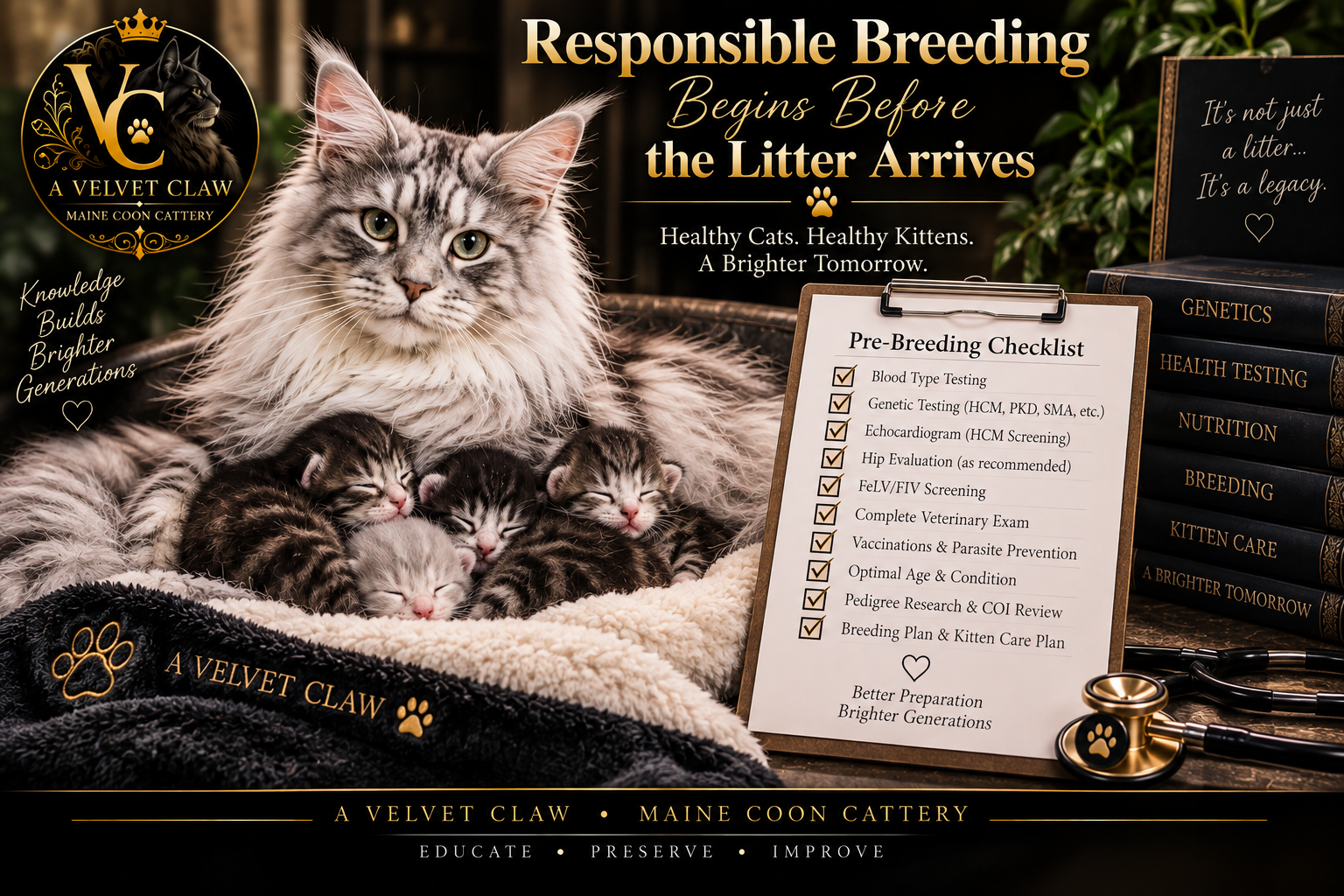
Responsible breeding isn't simply reacting when something goes wrong. It's asking: “What could go wrong—and what information can we gather beforehand to reduce that risk?”
Blood typing gives breeders another piece of that puzzle. It doesn't guarantee that every kitten will be perfectly healthy. No test can do that. But knowing the parents' blood types can identify a preventable risk and allow breeders and their veterinarians to make informed decisions before newborn kittens are involved. And that matters. A lot.
🖤 Sometimes the Smallest Detail Makes the Biggest Difference
A letter on a laboratory report may not look very important. A. B. AB.
Three tiny designations. But when you're responsible for bringing new lives into the world, details matter. Knowing a breeding cat's blood type isn't about collecting another test result for a website.
It's about understanding the biology behind the cats we're breeding and using that knowledge responsibly. Because responsible breeding doesn't begin when kittens arrive.
It begins with the decisions we make before they're ever conceived. 🩸🧬🐾
🖤 Keep Learning With A Velvet Claw
At A Velvet Claw, we believe responsible breeding should be something families can understand, not something that happens behind a curtain. Follow along for more Maine Coon genetics, health testing, development, responsible breeding education—and plenty of Maine Coon floof along the way. 🖤💛🐾
Better knowledge. Better decisions. Brighter generations.
Fur - ever grateful: Lexie & Melina
Maine Coon blood type • Maine Coon blood typing • Maine Coon blood type breeding
Feline blood types • Neonatal isoerythrolysis • Neonatal isoerythrolysis in kittens