
The daily dedication, planning, and behind-the-scenes work that goes into raising Maine Coon kittens responsibly.
What Goes On Behind the Scenes at a Responsible Cattery?
The daily dedication, planning, and behind-the-scenes work that goes into raising Maine Coon kittens responsibly.
When you see a photograph of a beautiful Maine Coon kitten, it’s easy to fall in love.
Those magnificent ear tufts, oversized paws, expressive eyes, and fluffy little bodies have a way of capturing hearts almost instantly.
Social media is filled with adorable kitten videos, playful moments, and heartwarming photographs.
But what you don’t always see is everything happening behind the scenes.
The cleaning. The planning. The veterinary appointments. The health testing. The recordkeeping. The sleepless nights. The difficult decisions.
Responsible breeding involves far more than raising adorable kittens and finding families who want them.
Behind every thoughtfully raised litter is an enormous commitment to the health, safety, and well-being of the cats involved.
Today, we’re taking a closer look at the responsibilities that often go unnoticed inside a responsible cattery.
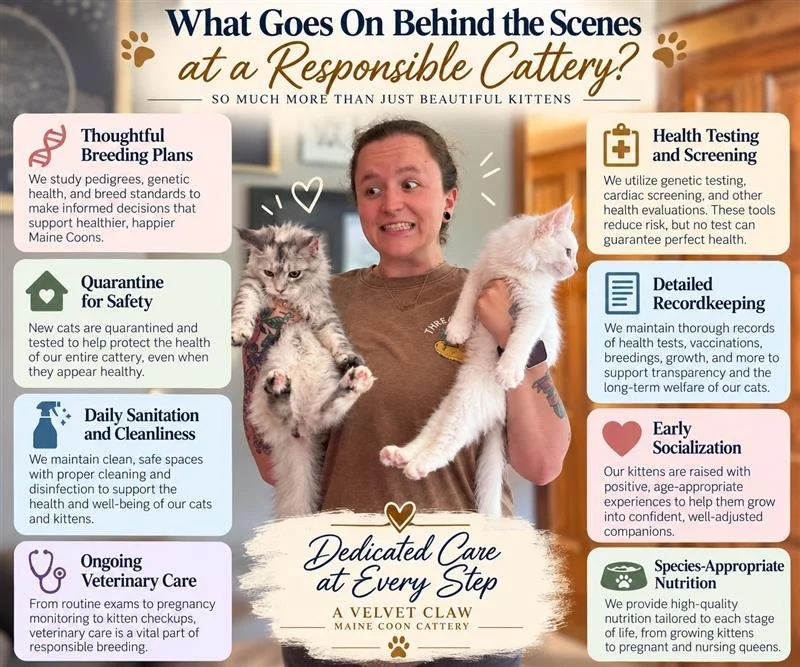
1. It Begins Long Before Kittens Are Born
One of the biggest misconceptions about breeding is that the work begins when a litter arrives.
In reality, responsible breeding starts long before a pairing ever takes place.
Breeders spend time researching pedigrees, studying genetic diversity, reviewing family health histories, and evaluating the strengths and weaknesses of potential breeding cats.
For Maine Coons, particular attention is given to inherited health concerns, including hypertrophic cardiomyopathy (HCM), hip dysplasia, and other conditions relevant to the breed.
Responsible health screening may include DNA testing, veterinary cardiac examinations, and hip evaluations.
And here’s something important:
A clear genetic test does not guarantee that a cat will never develop a hereditary condition.
For example, DNA testing for a known HCM-associated variant cannot identify every possible cause of heart disease.
That’s why responsible breeding programs consider multiple sources of health information rather than relying on a single test result.
Careful planning helps breeders make informed decisions, but it cannot eliminate every risk.
2. Quarantine: Protecting the Entire Cattery
When a new cat arrives at a cattery, the temptation to introduce everyone immediately can be strong.
After all, who doesn’t want to see their cats become friends?
But responsible breeders understand that introducing a new animal involves potential health risks.
Even a cat that appears perfectly healthy may be carrying an infectious organism that hasn’t yet caused noticeable symptoms.
A quarantine period allows breeders to observe a newcomer for changes in appetite, behavior, stool consistency, respiratory health, and general well-being.
Depending on veterinary recommendations and the individual cat’s history, this process may also involve examinations, diagnostic testing, and parasite screening.
During quarantine, separate housing, dedicated supplies, appropriate hand hygiene, and careful cleaning procedures can help reduce the risk of spreading disease.
Quarantine doesn’t guarantee that every infection will be detected.
But it provides an important opportunity to identify concerns before introducing a new cat to the rest of the household.
Responsible breeders understand that protecting one cat often means taking precautions to protect them all.
3. Sanitation Is an Everyday Responsibility
Cleanliness is one of the least glamorous but most important parts of operating a cattery.
Cats need clean litter boxes, fresh drinking water, sanitary feeding areas, and comfortable resting spaces.
Kittens are particularly vulnerable to certain infectious diseases because their immune systems are still developing.
Maintaining a healthy environment involves regular cleaning, appropriate disinfection, and careful monitoring of shared spaces.
But cleaning and disinfecting aren’t exactly the same thing.
Cleaning removes visible dirt and organic material.
Disinfection involves using an appropriate product according to its label directions to reduce or inactivate specific microorganisms.
Not every household cleaner is effective against every feline pathogen.
And some cleaning products can be harmful to cats if used incorrectly.
Responsible breeders must consider product safety, proper dilution, contact times, ventilation, and whether animals should be removed from an area during cleaning.
The goal isn’t simply to make a room look clean.
The goal is to maintain an environment that supports the health and safety of the cats living there.
4. Veterinary Care Is More Than an Annual Appointment
Veterinary care is another significant part of responsible breeding.
Breeding cats and kittens may require examinations, vaccinations, parasite prevention, diagnostic testing, and reproductive care.
Pregnant queens may need additional monitoring depending on their individual circumstances.
Newborn kittens require close observation, particularly during their earliest days.
Breeders may monitor nursing, weight gain, activity, and developmental milestones to identify potential concerns.
And sometimes, unexpected medical situations arise.
A kitten may develop diarrhea, an upper respiratory infection, or another health concern requiring veterinary attention.
A breeding cat may need further evaluation before proceeding with a planned pairing.
Responsible breeders must be prepared to recognize warning signs and seek professional veterinary care when necessary.
This includes planning financially for unexpected expenses.
Veterinary care isn’t an occasional inconvenience. It’s an essential part of responsible animal husbandry.
5. Genetic Testing and Health Screening Require Careful Decisions
Health testing is one of the most important—and sometimes most misunderstood—parts of responsible breeding.
DNA testing can identify certain known genetic variants associated with inherited conditions.
However, not every disease has a reliable DNA test, and not every positive result means an animal will develop clinical symptoms.
Likewise, a negative result for a particular variant doesn’t mean a cat is free from every possible genetic health concern.
Responsible breeders must understand what each test measures and how the results relate to breeding decisions.
They may also evaluate pedigrees, family history, genetic diversity, and veterinary screening results.
For Maine Coons, responsible HCM screening involves more than testing for a single known genetic variant.
Veterinary echocardiograms performed by appropriately qualified professionals can provide additional information about heart structure and function.
Hip evaluations can also help breeders assess orthopedic health.
These tools reduce uncertainty and support better decisions, but no combination of tests can promise perfect health.
Responsible breeding isn’t about claiming to eliminate every genetic risk. It’s about using available knowledge to make thoughtful, informed decisions.
6. Recordkeeping: The Work Nobody Sees
Behind the beautiful kitten photographs is another responsibility that rarely gets attention.
Documentation.
Responsible breeders maintain records that help them monitor the health, development, and history of their cats.
Depending on the breeding program, these may include:
Pedigrees and registration documents
Genetic testing and veterinary screening results
Vaccination and parasite prevention records
Veterinary examinations and treatment histories
Breeding and reproductive records
Kitten birth weights and growth information
Feeding and developmental observations
Placement agreements and health documentation
Accurate records support continuity of care and help breeders recognize patterns or concerns over time.
They also make it easier to provide new families with relevant information when their kittens go home.
Documentation may not be exciting, but it’s an important part of accountability.
Responsible breeders don’t simply remember what happened. They work to maintain reliable records of the care they’ve provided.
7. Socialization Is More Than Playing With Kittens
One of the most enjoyable parts of raising kittens is watching their personalities develop.
But socialization involves much more than cuddling adorable babies.
During their early development, kittens learn about their environment, other animals, people, and everyday experiences.
Appropriate positive experiences can help them become more comfortable with normal household activity.
Depending on their age and developmental readiness, kittens may gradually experience gentle handling, grooming tools, household sounds, different surfaces, and age-appropriate play.
The key is to introduce these experiences thoughtfully.
Forcing a frightened kitten into an overwhelming situation isn’t good socialization.
Responsible socialization should be gradual, positive, and respectful of each kitten’s individual temperament.
Some kittens are naturally bold and adventurous.
Others are more cautious and need additional time.
Neither personality is inherently wrong.
The goal isn’t to create identical kittens. It’s to help each kitten develop confidence and appropriate coping skills.
8. Nutrition Changes as Kittens Grow
Feeding a cattery involves more planning than simply filling food bowls.
Pregnant and nursing queens have different nutritional needs than typical adult cats.
Growing kittens require diets that support rapid development.
Food selection, feeding frequency, body condition, and individual tolerance all matter.
Responsible breeders monitor whether kittens are eating appropriately and gaining weight as expected.
As kittens begin transitioning to solid food, their digestive systems must adjust.
Food changes may need to happen gradually, and some kittens require additional monitoring.
Breeders must also maintain clean feeding areas and appropriate food storage practices.
Nutrition is an ongoing responsibility that changes with each stage of development.
9. Responsible Breeding Sometimes Means Making Difficult Decisions
Not every part of breeding is joyful.
Sometimes health testing raises concerns.
Sometimes a planned breeding must be postponed.
Sometimes a kitten needs additional time before leaving.
And sometimes a breeder must decide that a particular cat should not remain in a breeding program.
These decisions can carry emotional and financial consequences.
But responsible breeding requires the willingness to place animal welfare ahead of convenience or profit.
That commitment matters most when circumstances don’t go according to plan.
The true measure of a breeding program isn’t whether everything always goes perfectly. It’s how responsibly challenges are handled.
10. The Work Doesn’t End When a Kitten Goes Home
For many families, pickup day feels like the beginning of an exciting new adventure.
For the breeder, it’s also the culmination of months of preparation and care.
But responsible breeding doesn’t simply end when the kitten leaves.
New families may have questions about feeding, grooming, introductions, veterinary care, and adjusting to a new environment.
Breeders should provide accurate information about the kitten’s known health history and reasonable guidance regarding its transition.
They should also establish clear policies concerning contracts, health provisions, and what happens if a family can no longer care for its cat.
A breeder cannot control every future circumstance.
But thoughtful communication and responsible policies can help protect the long-term welfare of the animals they produce.
Behind the Scenes at A Velvet Claw
At A Velvet Claw Maine Coon Cattery, we believe responsible breeding begins with understanding the commitment involved.
Beautiful Maine Coons may be what first capture someone’s attention, but their health, safety, development, and long-term well-being are what matter most.
We believe in learning, asking questions, making informed decisions, and continually working to improve our knowledge and practices.
From understanding genetic health and the importance of quarantine to maintaining a clean environment and supporting positive kitten development, every part of responsible care matters.
We also believe prospective families deserve to understand the work that happens beyond the photographs.
Because responsible breeding isn’t simply about the kittens everyone gets to see.
It’s about the decisions, preparation, and dedication that happen when nobody is watching.
Final Thoughts: More Than What You See in a Photograph
The next time you see an adorable Maine Coon kitten curled up in a blanket or playing with a favorite toy, remember that there’s much more to responsible breeding than that beautiful moment.
There are health decisions being made.
Records being maintained.
Living spaces being cleaned.
Veterinary appointments being scheduled.
Kittens being monitored, handled, and cared for.
And breeders working to make thoughtful decisions for the animals who depend on them.
Responsible breeding isn’t defined by beautiful photographs or impressive pedigrees alone. It’s demonstrated through consistent care, transparency, and a commitment to doing what’s right for the cats.
At A Velvet Claw, that’s the kind of responsibility we believe every cat deserves.
Extraordinary Cats. Brighter Tomorrows.
A Velvet Claw Maine Coon Cattery
Fur-ever grateful, Melina & Lexie - Owners A Velvet Claw
www.avelvetclaw.com