
Understanding vaccine protection, common side effects, rare reactions, and why responsible vaccination matters for every kitten.
Bringing home a new Maine Coon kitten is an exciting experience filled with preparation, anticipation, and plenty of questions.
What food should you purchase? When should you schedule the first veterinary appointment? How do you introduce your kitten to other pets?
And perhaps one of the most important questions:
What vaccinations does my kitten need, and how do I know they’re protected?
Vaccinations are an essential part of preventive veterinary medicine, but they’re also an area where misunderstandings can develop.
Some families believe that one vaccination provides complete protection. Others worry that every reaction following a vaccine means something has gone terribly wrong.
Responsible breeders want families to understand what vaccines actually do, why kittens need a series of vaccinations, which reactions may occur, and why no preventive measure can eliminate every possibility of illness.
Because protecting a kitten’s health begins with understanding the science behind that protection.
Why Vaccinations Matter
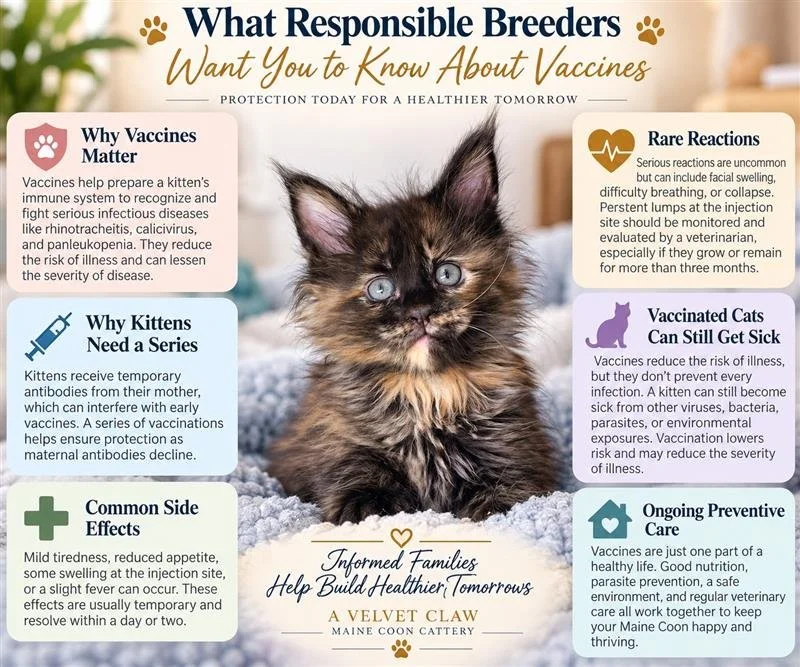
Vaccines help prepare a kitten’s immune system to recognize and respond to specific infectious diseases.
Rather than waiting for a kitten to encounter a dangerous pathogen naturally, vaccination helps the immune system develop protective responses in advance.
For cats, one of the most important routine vaccinations is commonly referred to as FVRCP.
This combination vaccine targets three significant feline diseases:
Feline viral rhinotracheitis: Associated with feline herpesvirus type 1, which can cause respiratory illness and eye problems.
Feline calicivirus: A virus that can cause respiratory symptoms, oral ulcers, and other complications.
Feline panleukopenia: A highly contagious and potentially life-threatening viral disease that can severely affect a cat’s immune and gastrointestinal systems.
Vaccination can substantially reduce the risk of serious illness, particularly from panleukopenia.
However, protection varies by disease, and vaccinated cats can sometimes still become infected with certain respiratory viruses.
Vaccination may reduce the severity of illness even when it doesn’t completely prevent infection.
Vaccines are powerful tools for disease prevention, but they are not guarantees that a cat will never become sick.
Why Kittens Need More Than One Vaccine
One of the most common questions new kitten families ask is why their kitten needs multiple vaccinations.
The answer involves maternal antibodies.
Shortly after birth, kittens receive antibodies from their mother, primarily through colostrum, the first milk produced after delivery.
These antibodies help provide temporary protection while a kitten’s immune system develops.
But there’s a complication.
Maternal antibodies gradually decline, and while they’re present, they can sometimes interfere with a kitten’s response to vaccination.
Because the timing of that decline varies between individual kittens, veterinarians recommend a series of vaccinations rather than relying on a single dose.
For routine FVRCP vaccination, current veterinary guidelines generally recommend starting at approximately 6–8 weeks of age and repeating doses every 3–4 weeks until at least 16 weeks of age. Some kittens may need additional doses depending on their circumstances and veterinary recommendations.
This schedule helps reduce the likelihood that a kitten remains unprotected as maternal antibodies disappear.
A kitten that has received its first vaccination has begun developing protection, but that doesn’t mean its vaccination series is complete.
What About Rabies Vaccination?
Rabies is a serious viral disease that affects the nervous system and can be transmitted to humans.
Because of its public health significance, rabies vaccination is especially important.
The timing of a kitten’s first rabies vaccination depends on the vaccine’s approved labeling, veterinary guidance, and applicable laws.
In many cases, kittens receive their first rabies vaccination around 12–16 weeks of age.
Families should work with their veterinarian to ensure their kitten receives rabies vaccination according to local requirements.
Even cats that live indoors can potentially be exposed to rabies, particularly through unexpected contact with bats or other infected animals.
Indoor living reduces many risks, but it does not eliminate every possibility of exposure.
What About Feline Leukemia Vaccination?
Feline leukemia virus, commonly called FeLV, can cause serious health problems, including immune suppression, anemia, and certain cancers.
Current feline vaccination guidelines generally recommend FeLV vaccination for kittens, with continued vaccination decisions based on individual risk factors as cats mature.
Veterinarians may recommend testing for FeLV before vaccination.
A kitten’s lifestyle, household composition, and potential exposure to other cats all influence future vaccination decisions.
Responsible breeders should encourage families to discuss these factors with their veterinarian rather than assuming every cat requires exactly the same lifelong vaccination schedule.
Common Side Effects After Vaccination
Like people, cats can experience temporary side effects following vaccination.
Most reactions are mild and resolve without complications.
Some kittens may experience:
Mild tiredness or reduced activity
Temporary tenderness near the injection site
A slightly decreased appetite
Mild, short-lived fever
A small amount of localized swelling
These effects often improve within a day or two.
A kitten may sleep more than usual after receiving vaccinations, but it should still be responsive and able to eat, drink, and move comfortably.
If symptoms are persistent, worsening, or concerning, families should contact their veterinarian.
A mild reaction doesn’t necessarily mean something is wrong, but significant changes in a kitten’s behavior or health should never be ignored.
Rare but Serious Vaccine Reactions
Although uncommon, more serious reactions can occur following vaccination.
Signs of a potentially severe allergic reaction may include:
Swelling around the face or muzzle
Difficulty breathing
Collapse or extreme weakness
Repeated vomiting or diarrhea shortly after vaccination
Sudden, severe distress
These symptoms require immediate emergency veterinary attention.
Severe allergic reactions are rare, but families should know what to watch for.
There is also a rare but important concern involving persistent injection-site lumps and feline injection-site sarcomas.
Most small post-vaccination lumps are not cancerous, but any persistent or growing lump should be evaluated by a veterinarian.
Veterinarians commonly use the 3-2-1 rule for monitoring injection-site masses:
A lump remains present for three months after vaccination.
A lump measures more than two centimeters across.
A lump continues growing one month after vaccination.
If any of these occur, veterinary evaluation and further investigation are recommended.
Families should not wait for these thresholds if a lump appears concerning or their veterinarian advises earlier assessment.
Understanding rare complications is not a reason to avoid appropriate vaccination.
It is a reason to remain informed and maintain a good relationship with your veterinarian.
Why Vaccinated Kittens Can Still Become Sick
This is something responsible breeders especially want new families to understand.
Vaccination does not provide immediate immunity.
The immune system needs time to respond, and young kittens may still be vulnerable while completing their vaccination series.
Additionally, not every feline infectious disease has an available vaccine.
A vaccinated kitten can still develop illnesses caused by other viruses, bacteria, parasites, or environmental exposures.
For example, vaccinations against certain respiratory pathogens may reduce the severity of disease without completely preventing infection or shedding.
This means a kitten may have received appropriate veterinary care and vaccinations yet still develop sneezing, eye discharge, or other symptoms.
That situation deserves veterinary attention, but it does not automatically mean the breeder failed to vaccinate the kitten appropriately.
Vaccination reduces risk. It does not eliminate every possible cause of illness.
Why Responsible Breeders Keep Vaccination Records
Accurate health records are an important part of responsible breeding.
When a kitten leaves for its new home, families should receive documentation of vaccinations that have been administered.
Records should include relevant information such as the vaccine given and administration date, along with other details documented by the administering veterinary professional.
These records allow the new family’s veterinarian to review the kitten’s history and determine what vaccinations or boosters are still needed.
Families should not assume that every kitten follows an identical schedule.
Age, medical history, previous vaccinations, and individual risk factors can influence veterinary recommendations.
Clear documentation helps prevent confusion and supports continuity of care.
Why Responsible Breeders May Postpone Vaccination
Sometimes, a kitten isn’t an appropriate candidate for routine vaccination on a particular day.
For example, a veterinarian may recommend postponing vaccination when a kitten has a significant illness or another medical concern that requires evaluation.
The decision depends on the kitten’s condition and the veterinarian’s assessment.
This does not mean that every mild symptom requires delaying vaccination.
It means health decisions should be individualized rather than based solely on a calendar.
Responsible breeders understand that following veterinary guidance is more important than forcing every kitten onto an inflexible schedule.
What Families Should Do After Bringing a Kitten Home
One of the best ways to protect your new Maine Coon is to establish a relationship with a veterinarian early.
Bring your kitten’s vaccination records to the first appointment.
Your veterinarian can review which vaccines have already been administered, determine what remains necessary, and help establish an appropriate preventive care schedule.
Until your kitten has completed its recommended vaccination series, take reasonable precautions to limit exposure to potentially infectious animals and environments.
Avoid unnecessary contact with unfamiliar cats whose health or vaccination status is unknown.
Practice good hygiene, introduce resident pets thoughtfully, and monitor your kitten for changes in appetite, activity, breathing, or litter box habits.
And remember that vaccination is only one part of preventive care.
Nutrition, parasite prevention, sanitation, veterinary examinations, and a safe living environment all contribute to long-term health.
Our Philosophy at A Velvet Claw
At A Velvet Claw Maine Coon Cattery, we believe that responsible breeding includes helping families understand the importance of preventive veterinary care.
Vaccinations are an important part of that conversation.
We want future kitten families to understand why vaccines are recommended, why kittens require multiple doses, and why continuing veterinary care after pickup is essential.
We also believe families deserve balanced information.
That means acknowledging both the substantial benefits of vaccination and the possibility of side effects or rare adverse reactions.
Responsible education shouldn’t create unnecessary fear.
It should help families make informed decisions in partnership with their veterinarian.
Our goal is to encourage thoughtful, science-based care that supports the health and well-being of every Maine Coon throughout its life.
Final Thoughts
Vaccines have made an enormous difference in protecting cats from serious infectious diseases.
But understanding vaccination requires more than knowing which injection a kitten received.
Families should understand how immunity develops, why boosters are necessary, which side effects may occur, and why a vaccinated kitten can still become sick.
Most importantly, they should recognize that responsible preventive care is an ongoing commitment.
A breeder provides the beginning of that journey.
The kitten’s new family and veterinarian continue it.
Because responsible breeding doesn’t end with a vaccination record. It includes helping families understand how to protect the cats they love.
Extraordinary Cats. Brighter Tomorrows.
A Velvet Claw Maine Coon Cattery
Fur-ever grateful, Melina & Lexie - Owners A Velvet Claw
www.avelvetclaw.com