
Understanding why doing what’s right for a kitten sometimes means making the hardest decisions.
When someone contacts a breeder about bringing home a Maine Coon kitten, the experience is usually filled with excitement.
Families imagine the tiny paws, magnificent ear tufts, playful personalities, and years of companionship ahead.
And responsible breeders share that excitement.
After all, few things are more rewarding than watching a kitten grow and knowing it will become a cherished member of someone’s family.
But there’s something about responsible breeding that isn’t always easy to understand.
Sometimes, a responsible breeder has to say no.
Not because they don’t want to place their kittens in loving homes. Not because they enjoy disappointing people. And certainly not because those decisions are easy.
Sometimes, saying no is the most responsible thing a breeder can do.
Responsible Breeding Is About More Than Producing Kittens
From the outside, breeding may appear relatively straightforward.
Two beautiful, healthy cats produce a litter of kittens. Those kittens grow, receive veterinary care, and eventually join their new families.
But ethical breeding involves far more than that.
Every breeding decision should consider the health, temperament, genetic background, physical maturity, and overall well-being of the cats involved.
Responsible breeders must also consider their ability to provide appropriate care for a mother and her kittens, including veterinary services, suitable housing, nutrition, sanitation, and emergency resources.
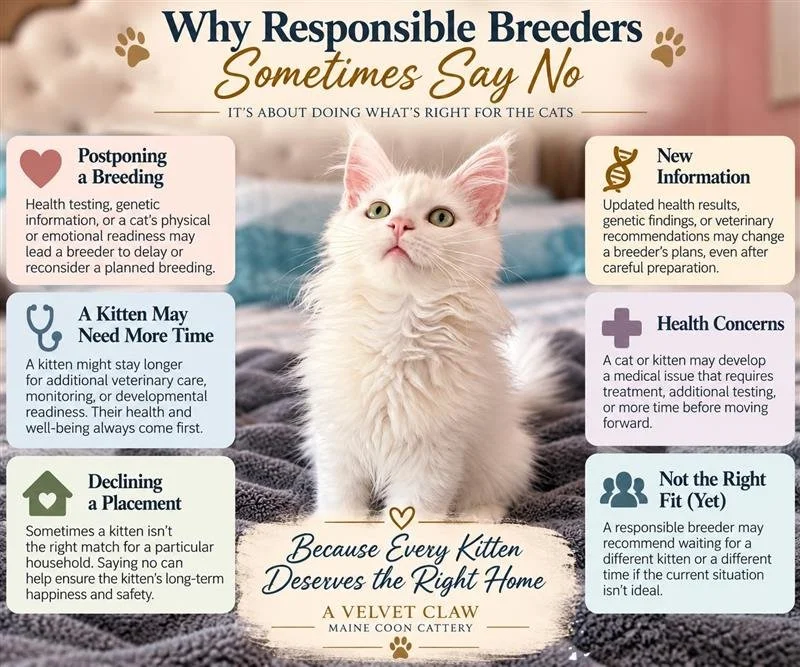
And sometimes, after considering all those factors, the best decision is not to proceed.
Just because a cat can be bred doesn’t mean that cat should be bred.
Sometimes, Breeding Plans Have to Change
A breeder may spend months researching pedigrees, reviewing health testing, and carefully selecting a potential pairing.
But even the most thoughtfully developed plans can change.
Perhaps a health screening reveals something that requires further evaluation.
Maybe a female isn’t physically or behaviorally ready for breeding.
Perhaps a veterinarian recommends postponing a pregnancy because of a medical concern.
Or the breeder may determine that a particular pairing isn’t appropriate after reviewing genetic information or family health history.
In those situations, responsible breeders must be willing to reconsider their plans.
That may mean postponing a breeding, selecting a different pairing, or deciding not to breed a particular cat at all.
These decisions can be disappointing, especially after considerable time and financial investment.
But responsible breeding means placing the welfare of the cats above personal expectations.
A breeding plan should never be more important than the cats involved.
Sometimes, a Kitten Isn’t Ready to Go Home
Imagine waiting months for your new Maine Coon kitten.
You’ve purchased the supplies, prepared a special room, and counted down the days until pickup.
Then your breeder contacts you with unexpected news.
Your kitten needs to stay a little longer.
Understandably, that can be disappointing.
But there are legitimate reasons a responsible breeder may postpone a kitten’s departure.
A kitten may need additional veterinary evaluation, treatment, time to recover from an illness, or further monitoring of its weight, appetite, or development.
Sometimes, a kitten may simply need more time to reach an appropriate level of physical or behavioral readiness.
Even when a kitten seems playful and energetic, that doesn’t necessarily mean every aspect of its development or health has been fully evaluated.
A responsible breeder should communicate the reason for a delay and explain the next steps.
A pickup date is a plan. A kitten’s health and readiness must come first.
A few extra days or weeks with the breeder may feel frustrating in the moment, but when the delay is medically or developmentally justified, it can be an important part of protecting the kitten.
Sometimes, a Breeder Must Decline a Placement
This is one of the most sensitive parts of responsible breeding.
A family may genuinely love Maine Coons and have wonderful intentions, yet a particular kitten may not be the right match for their household.
Perhaps the family is looking for a calm, quiet companion, but the available kitten has an especially energetic personality.
Maybe the household has an existing pet that struggles significantly with other animals.
Or perhaps expectations about veterinary care, safe housing, or lifelong responsibility don’t align with the breeder’s reasonable placement requirements.
Responsible breeders should approach these situations thoughtfully, respectfully, and without unfair assumptions.
Declining a placement should never be about making someone feel inadequate.
It should be about whether the breeder can reasonably conclude that the arrangement is appropriate for the kitten.
And sometimes, the right answer is to recommend waiting for another kitten or reconsidering the timing.
The goal isn’t simply to find a home. It’s to find the right home.
Saying No Can Have a Financial Cost
Breeding responsibly requires significant financial investment.
Health screening, veterinary care, genetic testing, nutrition, housing, sanitation, and raising kittens all come with expenses.
Postponing a breeding may delay an anticipated litter.
Keeping a kitten longer may increase veterinary and daily care costs.
Declining a placement may mean losing a potential sale.
Those realities are part of running a breeding program.
But financial considerations should never override a cat’s health or welfare.
A responsible breeder must be prepared to make decisions that protect their animals, even when those decisions are inconvenient or costly.
Ethics matter most when doing the right thing isn’t the easiest or most profitable option.
Responsible Breeders Cannot Control Everything
Even with careful planning, unexpected situations happen.
A cat may develop a health concern.
A kitten may need additional medical attention.
A planned pairing may no longer be appropriate.
A family’s circumstances may change before pickup.
Responsible breeding does not mean that everything will always go according to plan.
It means responding appropriately when things don’t.
That includes recognizing concerns, seeking veterinary guidance, communicating honestly, and making adjustments when necessary.
Sometimes the responsible answer is yes.
Sometimes it’s not yet.
And sometimes it’s no.
Communication Makes Difficult Decisions Easier to Understand
When a breeder needs to change plans, communication matters enormously.
Families deserve reasonable explanations when a kitten’s pickup is postponed or a placement cannot proceed.
Likewise, breeders deserve respectful communication when they raise legitimate concerns about a kitten’s welfare.
A responsible breeder should not use vague claims about ethics to avoid accountability, withhold known health information, or disregard contractual obligations.
Transparency, documented policies, and fair treatment are essential.
Written agreements should clearly explain relevant health provisions, pickup expectations, deposits, refunds, and other placement terms.
Ethical decisions and professional communication should go hand in hand.
When both parties understand the reasons behind a decision, even disappointing news can become an opportunity to build trust.
What This Means at A Velvet Claw
At A Velvet Claw Maine Coon Cattery, we believe responsible breeding requires patience, thoughtful decision-making, and a willingness to put the well-being of our cats first.
We understand how exciting it is to welcome a Maine Coon into your family.
We also understand how much anticipation and emotion can be involved in that process.
Our goal is to approach breeding and placement decisions with care, transparency, and respect for both our cats and the families interested in them.
That means recognizing that responsible decisions aren’t always the most convenient ones.
It means understanding that health, development, temperament, and readiness deserve thoughtful consideration.
And it means remembering that every kitten is a living being with individual needs—not simply a reservation, a purchase, or a pickup date.
We believe the responsibility we accept when bringing kittens into the world includes making difficult decisions when their welfare requires it.
Final Thoughts: Sometimes No Is an Act of Care
It’s easy to recognize responsible breeding when everything goes perfectly.
Healthy kittens, happy families, beautiful photographs, and exciting homecoming days are the moments everyone loves to celebrate.
But responsible breeding is also revealed in the moments that aren’t so easy.
When a breeder postpones a planned pairing because of a health concern.
When a kitten stays longer because additional care is needed.
When a breeder declines a placement because it isn’t the right match.
These decisions may not always be popular.
They may not always be convenient.
But when they’re made thoughtfully, transparently, and for legitimate welfare reasons, they reflect something important.
Responsible breeding isn’t about saying yes to every opportunity. It’s about having the integrity to say no when necessary.
Because the greatest responsibility a breeder has isn’t to a schedule, a waiting list, or a sale.
It’s to the cats and kittens entrusted to their care.
And that responsibility should always come first.
Extraordinary Cats. Brighter Tomorrows.
A Velvet Claw Maine Coon Cattery
Fur-ever Grateful, Melina & Lexie - Owners A Velvet Claw
A Velvet Claw | Trust, Care, Delivery - Book Now
Premium Maine Coon breeding and first-class pet transportation services across the USA. Trust our expert team for safe, comfortable kitten delivery and travel care.