
Understanding how stress, environmental changes, and infections can affect kittens during the transition to their forever homes.
Bringing home a new Maine Coon kitten is one of the most exciting experiences for a family. You’ve waited, prepared your home, purchased supplies, and dreamed about the moment your newest family member finally arrives.
Your kitten may have received a veterinary examination, appeared healthy, been eating normally, and shown no signs of illness before leaving the breeder.
Then, a few days after arriving home, something changes.
Maybe your kitten starts sneezing. Perhaps their stool becomes loose, their appetite decreases, or they seem a little quieter than expected.
Naturally, you begin to worry.
How could a kitten that appeared perfectly healthy suddenly become sick?
This is an important question, and one that responsible breeders wish more families understood.
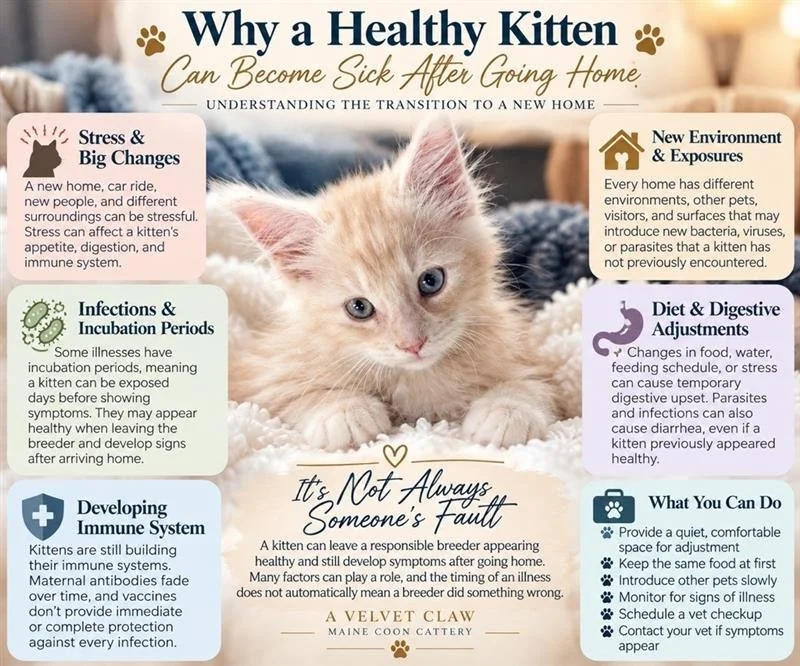
The answer involves several factors, including stress, environmental changes, developing immune systems, and infectious diseases that may not show symptoms immediately.
A Healthy Kitten Can Still Be Vulnerable
When a breeder describes a kitten as healthy, that assessment reflects the information available at that time.
A veterinary examination can help identify many health concerns, but it cannot detect every possible illness or guarantee that symptoms won’t develop later.
Some infectious diseases have incubation periods, meaning a kitten may be exposed to an organism days before showing noticeable symptoms.
During that time, the kitten may continue eating, playing, and behaving completely normally.
This means a kitten can appear healthy when leaving the breeder and develop symptoms after arriving home.
It also means that illness appearing after pickup does not automatically establish where or when exposure occurred.
The timing of symptoms alone cannot determine the cause or source of an illness.
The Hidden Impact of Stress
Moving to a new home is an enormous transition for a young kitten.
Think about everything that changes in a single day.
The kitten leaves behind familiar smells, routines, surroundings, and feline companions. They may experience a car ride, unfamiliar sounds, new people, different household activity, and an entirely new environment.
Even when the new family is loving and attentive, these changes can be stressful.
Stress affects the body in several ways.
Stress hormones can influence digestion, appetite, behavior, and immune responses. In some kittens, stressful transitions may contribute to temporary digestive upset or make an underlying condition more noticeable.
A kitten who seemed perfectly comfortable at the breeder’s home may temporarily eat less, hide, or experience softer stools while adjusting.
However, stress should never automatically be assumed to be the cause of illness.
Sneezing, diarrhea, lethargy, or appetite changes can also indicate medical conditions that require veterinary attention.
Why Respiratory Symptoms Sometimes Appear After Pickup
Upper respiratory infections are among the health concerns that can affect young cats.
Some respiratory pathogens, including feline herpesvirus, can remain in a cat’s body after the initial infection. Stress may contribute to reactivation and the return of symptoms in some cats.
Other infections may have been acquired before or after the move but were still in their incubation period when the kitten appeared healthy.
Signs of respiratory illness can include:
Sneezing or nasal congestion
Watery or irritated eyes
Nasal or eye discharge
Reduced appetite
Decreased energy
Not every sneeze means a kitten has an infection. Environmental irritants, dust, and other factors can also cause sneezing.
However, persistent symptoms, eye inflammation, or discharge should be discussed with a veterinarian.
A kitten experiencing difficulty breathing, marked lethargy, or refusal to eat needs prompt veterinary evaluation.
Why Digestive Upset Is Common During Transitions
A kitten’s digestive system can be sensitive to sudden changes.
A new home may introduce different feeding schedules, unfamiliar treats, different water, or a change in food.
Even when families purchase high-quality food, switching diets too quickly can contribute to digestive upset.
Stress may also influence gastrointestinal function.
But there’s another important consideration.
Parasites and infectious organisms, including Giardia and certain feline intestinal pathogens, can cause diarrhea even when a kitten previously appeared healthy.
Some infections can be present without obvious symptoms, and a single negative fecal examination does not rule out every possible intestinal infection.
This is why responsible breeders encourage families to monitor stool consistency, maintain familiar feeding routines initially, and contact their veterinarian if diarrhea develops.
Repeated watery diarrhea, vomiting, blood in the stool, poor appetite, or signs of dehydration should never be dismissed as normal adjustment.
Young kittens can become dehydrated quickly.
A Kitten’s Immune System Is Still Developing
Kittens are not simply miniature adult cats.
Their immune systems are still developing, and their protection against infectious diseases changes as they grow.
Early in life, kittens receive maternal antibodies, primarily through colostrum shortly after birth.
These antibodies provide temporary protection, but they gradually decline.
Vaccinations help the kitten’s immune system develop its own protection against important infectious diseases.
However, vaccines do not provide immediate or complete protection against every infection.
Maternal antibodies can also interfere with responses to certain vaccines, which is one reason kittens receive a series of vaccinations rather than a single dose.
A kitten that has received age-appropriate vaccinations may still be susceptible to some infections, particularly before completing the recommended vaccine series.
Responsible breeders follow veterinary guidance regarding vaccination, but families must continue that care after bringing their kittens home.
A New Environment Means New Exposures
Every household has its own environment.
Other pets, visitors, shared objects, and unfamiliar surroundings may introduce organisms that a kitten has not previously encountered.
Resident cats can sometimes carry infectious organisms without showing obvious signs of illness.
Likewise, a new kitten may carry an organism without showing symptoms, potentially exposing established household pets.
This is one reason gradual introductions and an initial separation period are valuable.
Providing a new kitten with a quiet, dedicated room allows the family to monitor eating, drinking, litter box habits, and overall behavior while arranging appropriate veterinary care.
When other cats live in the home, families should discuss introduction timing and disease-prevention measures with their veterinarian.
Does Illness After Pickup Mean the Breeder Did Something Wrong?
Not necessarily.
This is an important distinction.
The development of an illness shortly after pickup does not, by itself, prove that a breeder was negligent or that the kitten was knowingly placed while sick.
Some conditions develop despite appropriate preventive care, health monitoring, sanitation, and veterinary examinations.
At the same time, responsible breeding practices matter enormously.
A breeder should take reasonable steps to reduce disease risks, provide appropriate veterinary care, maintain sanitary conditions, monitor kittens for illness, and communicate known health concerns honestly.
If a kitten becomes ill shortly after placement, both the breeder and the new family should take the situation seriously.
It is reasonable for families to ask questions, share veterinary findings, and seek clarification about the kitten’s prior health.
Responsible breeding is not about pretending illness can never happen. It is about prevention, transparency, and appropriate action when concerns arise.
What New Families Can Do to Help
The transition to a new home should be as gentle and predictable as possible.
Families can help by:
Preparing a quiet, comfortable room for the kitten’s initial adjustment
Continuing the breeder’s familiar food and feeding schedule before making gradual changes
Providing clean water, appropriate litter boxes, hiding places, and comfortable resting areas
Allowing the kitten to explore at its own pace
Introducing resident pets gradually and safely
Avoiding unnecessary exposure to unfamiliar animals while vaccination protection is developing
Scheduling a veterinary wellness examination soon after arrival, according to the veterinarian’s advice and any purchase contract
Contacting a veterinarian promptly when signs of illness appear
These steps cannot eliminate every risk, but they can make the transition safer and more comfortable.
Communication Between Breeders and Families Matters
One of the most valuable things a family can do when a health concern develops is communicate.
If a kitten begins showing symptoms, the first priority should be appropriate veterinary care.
The breeder should also be informed, particularly if a contagious illness is suspected or diagnosed.
This information may help the breeder evaluate the health of other cats or kittens in their care and determine whether additional precautions are necessary.
Families should feel comfortable sharing veterinary findings and asking questions.
Likewise, breeders should approach those conversations with concern, professionalism, and a willingness to review relevant information.
Blame and assumptions do not help a sick kitten.
Clear communication, timely veterinary care, and a shared commitment to the kitten’s well-being do.
Our Commitment at A Velvet Claw
At A Velvet Claw Maine Coon Cattery, we believe education is an essential part of responsible breeding.
We want families to understand not only the joys of welcoming a Maine Coon kitten but also the realities of caring for a young animal whose body and immune system are still developing.
We believe responsible breeders should take health concerns seriously, communicate openly, and make decisions with the welfare of their cats and kittens at the center.
We also believe new families deserve accurate information about what can happen during the transition from a breeder’s home to their own.
A healthy start is incredibly important.
But a healthy start is not a promise that a kitten will never become sick.
Understanding that difference helps families recognize potential problems, seek veterinary care when needed, and build a more informed relationship with their breeder.
Final Thoughts
A kitten can leave a responsible breeder appearing healthy and develop symptoms after arriving in its new home.
Stress, changes in routine, developing immunity, previously acquired infections, and new environmental exposures can all play a role.
Sometimes the explanation is relatively simple. Other times, veterinary testing and treatment are necessary.
The important thing is not to assume that every illness is caused by stress—or that every illness means someone did something wrong.
Instead, focus on observation, prevention, communication, and appropriate medical care.
Because responsible breeding doesn’t mean promising that nothing will ever go wrong. It means doing everything reasonably possible to give kittens a healthy beginning and supporting informed, responsible care throughout their lives.
At A Velvet Claw, we believe every kitten deserves that kind of commitment.
Extraordinary Cats. Brighter Tomorrows.
A Velvet Claw Maine Coon Cattery - Melina & Lexie
www.avelvetclaw.com
A Velvet Claw | Trust, Care, Delivery - Book Now
Premium Maine Coon breeding and first-class pet transportation services across the USA. Trust our expert team for safe, comfortable kitten delivery and travel care.