
If you’ve spent much time around Maine Coons, you’ve probably discovered that they have opinions. Some will chirp at you from across the room, trill when you walk through the door, and carry on an entire conversation while you make dinner. Others barely make a sound unless they have something very important to say. And then there are the ones who apparently believe every thought should be shared with the household. 😂
So why are some Maine Coons incredibly talkative while others are quiet?
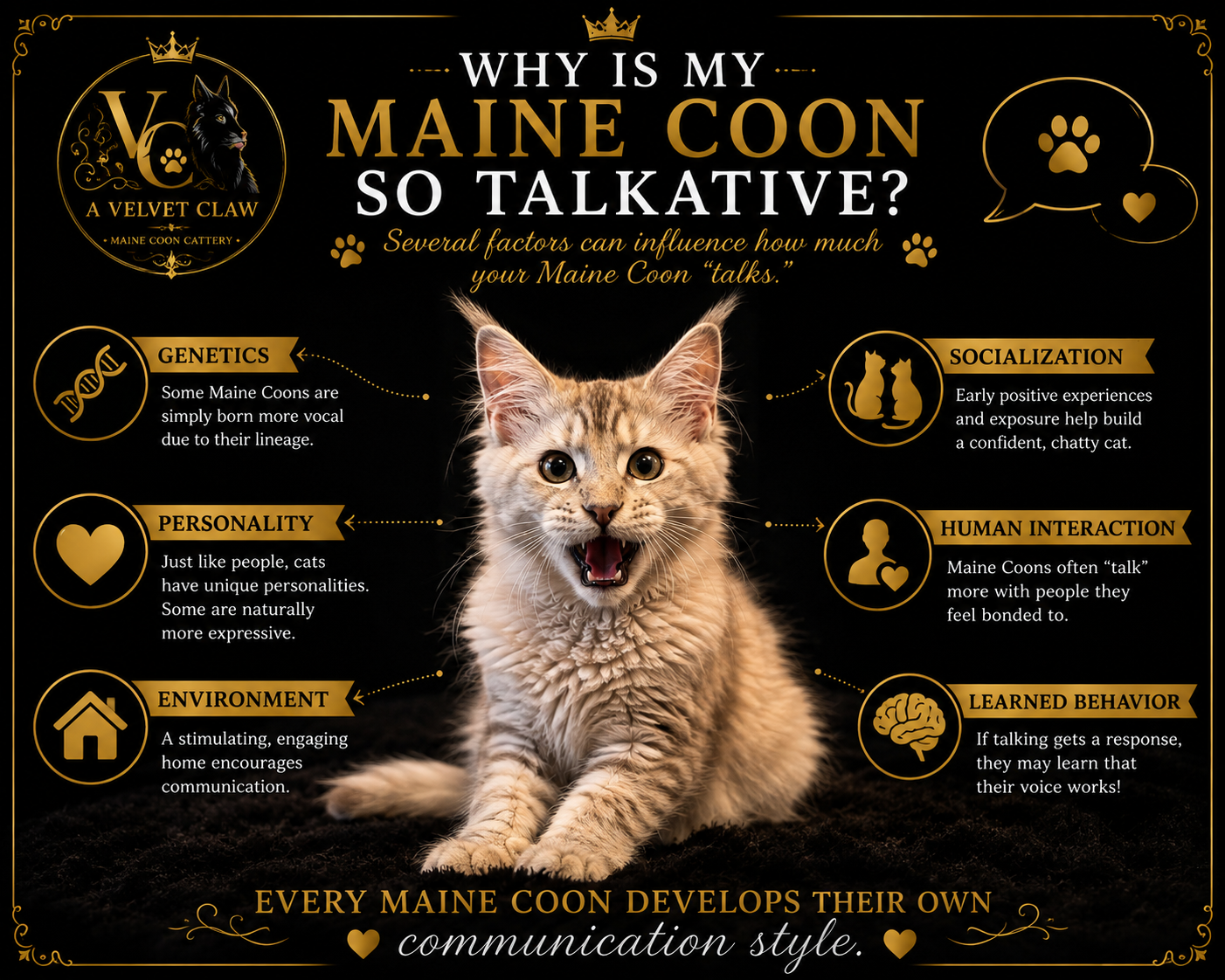
Like many things about this breed, there isn’t one simple answer. A Maine Coon’s vocal personality can be influenced by genetics, individual temperament, environment, socialization, learning and even the relationship they develop with their humans.
Let’s talk about it.
Maine Coons Have Their Own Vocabulary

One of the charming things about Maine Coons is that many of them don't rely on the traditional “meow” nearly as much as you might expect.
Instead, owners often hear an assortment of:
🐾 Chirps
🐾 Trills
🐾 Purrs
🐾 Squeaks
🐾 Little murmurs
🐾 Short meows
🐾 Question-like sounds
🐾 And noises that don't seem to have an official name at all
Sometimes it sounds less like owning a cat and more like living with a tiny woodland creature who has been assigned to narrate your life. The classic Maine Coon trill is especially recognizable. It often sounds like a combination of a purr and a meow and may be used as a greeting, to get attention or simply while interacting with people. But not every Maine Coon is equally chatty.
🧬 Genetics Can Play a Role
Just like physical traits, certain aspects of temperament and behavior can have a genetic component. If you spend enough time around generations of cats, you may notice similarities within family lines. A particularly social, interactive parent may produce kittens that tend toward similar characteristics—although there's never a guarantee. The same can happen with vocal behavior.
Some family lines may simply contain cats that are more inclined to communicate vocally. That doesn't mean every kitten from a talkative parent will grow up to be a chatterbox. Genetics are only one piece of a much larger puzzle.
Every kitten is still an individual.
🐱 Personality Matters

This may be the biggest reason of all. Maine Coons have individual personalities.
One may be confident, outgoing and determined to participate in everything happening in the house. Another may be equally affectionate but much quieter and more observant.
One cat might greet you every morning with: “Brrrrrp?”
Another might simply stare at you. Both may be asking exactly the same question: “Where's breakfast?” 😂
Being quiet doesn't mean a Maine Coon is less intelligent, affectionate or bonded to its family. Some cats simply communicate differently.
🏡 Environment Can Influence How Much They “Talk”
Cats learn a great deal from the environment around them. A Maine Coon raised in a home where people frequently talk to the cats may discover pretty quickly that vocalizing gets a response.
You say:
“Hi, baby!”
Your Maine Coon trills.
You answer.
They chirp.
You answer again.
Congratulations.
You've accidentally started a conversation. 😂
Over time, that interaction can reinforce vocal behavior because the cat learns: When I make this sound, my human interacts with me.
For a highly social Maine Coon, that's a pretty good reward.
❤️ Some Maine Coons Become More Vocal With Their Favorite People
You may even notice that a Maine Coon is relatively quiet around strangers but suddenly becomes extremely talkative with someone they trust. That's one of the sweetest parts. Vocalization can become part of the communication system between a cat and its person. You eventually start recognizing what different sounds seem to mean.
There's the: “Hello!” trill.
The: “Follow me.” chirp.
The: “Excuse me, I believe my bowl is visible at the bottom.” complaint.
And, of course: “I have absolutely no reason for making this noise. I simply wanted you to know where I am.”
Eventually, you aren't just hearing noises. You're having conversations.
🐾 Maine Coons May Learn Which Sounds Work
Cats are surprisingly good at figuring out what gets results. Imagine a Maine Coon chirps beside the treat cabinet.
You laugh. Then you give them a treat.
The next day? Chirp. Treat.
A few days later? CHIRP. They've trained you.
And they're probably quite pleased with their progress. 😂 Cats can learn that particular vocalizations result in attention, food, play, doors being opened or humans following them somewhere. A naturally vocal Maine Coon may become even more talkative when those sounds consistently receive a response.
🐈 Kittens May Learn From Other Cats
Kittens are constantly observing the cats around them. They learn social boundaries, play behavior and communication from their mother, littermates and other cats in their environment. That doesn't mean kittens simply copy another cat's personality. But their early experiences help shape how they interact with the world.
A kitten growing up surrounded by confident, social cats and frequent positive human interaction may have plenty of opportunities to practice communicating. And sometimes that communication comes with sound effects. 😂
🎵 Why Do Maine Coons Chirp and Trill So Much?
Although chirping and trilling aren't exclusive to Maine Coons, these sounds are frequently associated with the breed. Cats can use trills in friendly social interactions. Mother cats may also use trill-like sounds when communicating with kittens. That may help explain why these little noises seem to fit so naturally into social interactions.
A Maine Coon might trill when:
Greeting you
Walking into a room
Asking you to follow
Seeking attention
Playing
Excited
Interacting with another cat
Watching something interesting
And sometimes... They trill because they're walking down the hallway. Apparently the hallway needed an announcement. 😂
🤫 What About the Quiet Maine Coon?
Completely normal. Not every Maine Coon is going to wander around the house holding lengthy conversations. Some communicate much more through body language.
A quieter Maine Coon may:
Follow you from room to room.
Sit beside you.
Slow blink at you.
Head-butt your hand.
Touch you with a paw.
Sleep nearby.
Wait outside the bathroom like a tiny security guard.
A cat doesn't need to be vocal to be deeply attached to its family. Quiet doesn't mean unhappy, unfriendly or “less Maine Coon.” It may simply be that cat's personality.
🔊 Can a Maine Coon Become More Vocal Over Time?

Absolutely. A kitten that starts out relatively quiet may become more vocal as confidence grows. Moving into a new home can be overwhelming. Some kittens initially observe their surroundings quietly before their full personality begins to emerge.
Weeks or months later, their family may suddenly realize: Oh. You DO have a lot to say. 😂
Interactions with people can also change over time. As a Maine Coon learns that its humans respond to certain sounds, it may begin using those sounds more frequently.
⚠️ A Sudden Change in Vocalization Is Different
There is an important distinction between a Maine Coon who has always been talkative and a cat whose vocal behavior suddenly changes. If a normally quiet cat suddenly begins vocalizing excessively—or a very vocal cat suddenly becomes unusually quiet—it's worth paying attention.
Changes in vocalization can sometimes accompany:
Pain or discomfort
Stress or anxiety
Hunger or thirst changes
Cognitive changes in older cats
Hearing changes
Illness
Changes within the household
The sound itself doesn't necessarily tell you what's wrong. The change from that individual cat's normal behavior is what matters. If the change is sudden, significant, persistent or accompanied by other symptoms, contacting your veterinarian is the safest choice.
🖤 There Is No “Correct” Maine Coon Personality
We sometimes talk about Maine Coons as though every one comes with the same personality installed at the factory. They don't. Some are fearless. Some are cautious. Some want to be involved in absolutely everything. Some prefer watching the chaos from a comfortable distance. Some will trill at you all day long.
And some apparently operate under a strict: “This meeting could have been an email.” policy. 😂
That's part of what makes living with them so much fun. Breed characteristics can give us an idea of what Maine Coons are often like, but they don't erase individuality.
Every Maine Coon Has Something to Say 🐾

Whether they communicate with a booming meow, a tiny chirp, a ridiculous little trill or simply one very judgmental stare, Maine Coons have an incredible way of making themselves understood. Their level of vocalization can be influenced by genetics, personality, early experiences, environment and the relationships they build with the people around them.
So if your Maine Coon talks to you constantly? Talk back. You may be encouraging the behavior... but let's be serious—you were going to answer them anyway. 😂🖤💛🐾
Fur - ever grateful: Lexie & Melina
Maine Coon vocalization • Maine Coon sounds • talkative Maine Coon
Maine Coon chirping • Maine Coon trilling • why are Maine Coons so vocal