
When someone purchases a beautiful Maine Coon for a breeding program, it's easy to assume that cat will eventually become a mother or father. But that's not always what happens. A kitten can come from wonderful lines, have an impressive pedigree, be absolutely gorgeous, and have been purchased specifically with breeding in mind—and still never produce a single litter.
Why? Because breeding potential is not the same thing as breeding suitability.
When we bring home a young cat for a breeding program, we're making plans based on the information available to us at that moment. That kitten still has months—or even years—of growing, developing, health screening and maturing ahead. Sometimes everything develops exactly as hoped. Sometimes it doesn't.
And one of the responsibilities of an ethical breeder is being willing to change the plan when new information tells us we should.
Buying a Breeding Cat Is Really Buying Potential
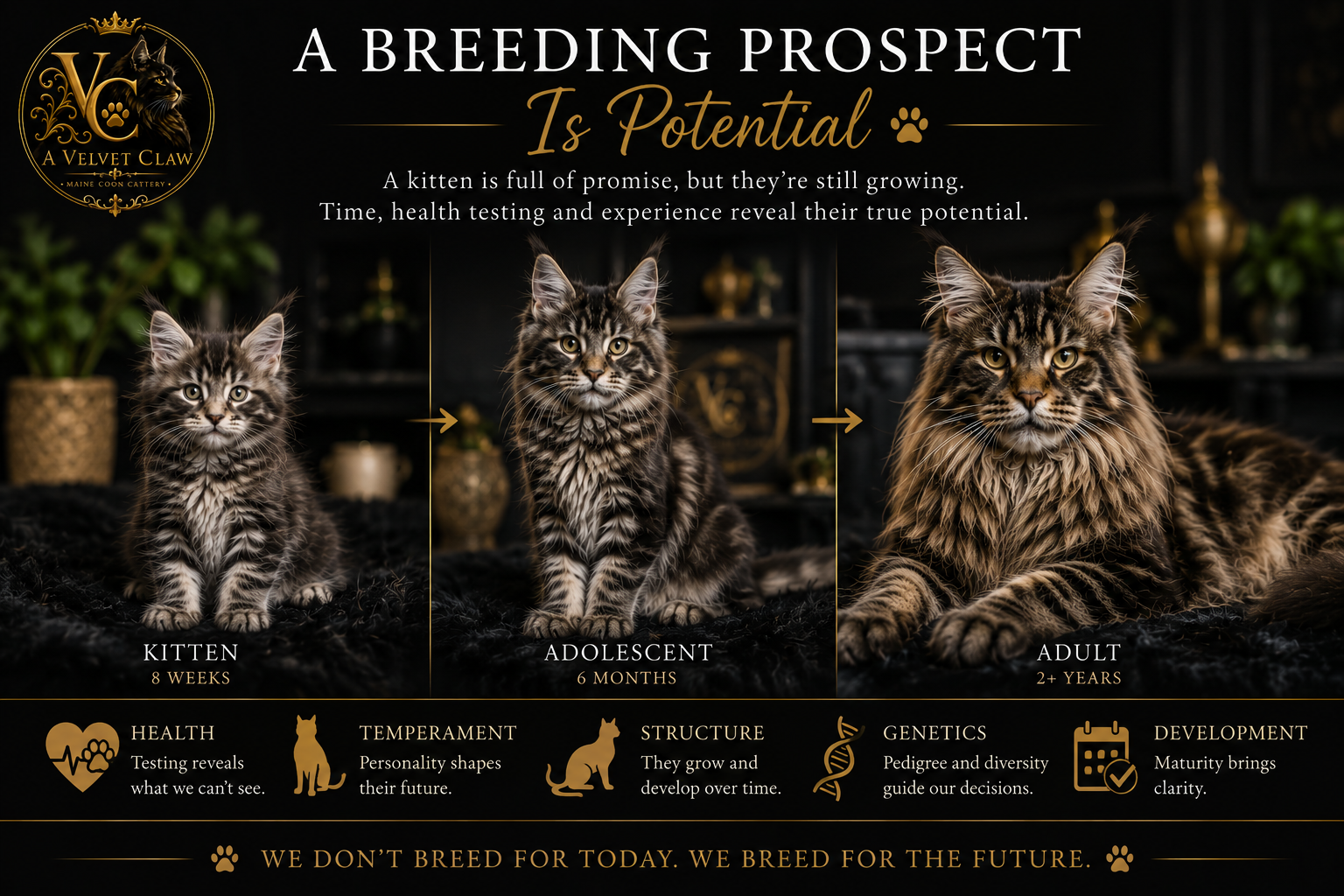
A young Maine Coon is still developing. We can study the parents. We can research the pedigree. We can look at health information within the lines. We can evaluate the kitten's structure and temperament. But we cannot see the future. That adorable little kitten still needs to grow into an adult. As that happens, a breeder learns much more about the cat.
We begin to see:
Adult structure
Size and proportions
Temperament
Personality
Coat development
Bite and dental development
Reproductive development
Health-testing results
Cardiac health
Hip development
Overall maturity
A kitten who looked incredibly promising at 12 or 16 weeks may develop differently than expected. That's simply biology. So when a responsible breeder purchases a kitten for breeding, they're really saying: “We hope this cat will eventually become part of our breeding program.”
Not: “This cat will absolutely be bred.” That's an important distinction.
1. Health Testing May Change Everything
This is probably one of the most obvious reasons a breeder might decide not to breed a cat. Some health testing cannot be completed—or isn't most informative—when a kitten is very young. As the cat matures, additional screening may provide information the breeder didn't have when the kitten was purchased. If a concerning result appears, the breeder may need to reconsider that cat's future within the program. That can be incredibly disappointing.
A breeder may have spent months or years planning around that cat. They may have invested significant money into purchasing, importing, raising, showing or health testing them. They may already have imagined future pairings. None of that changes the responsibility to make the best decision possible with the information now available. The money already spent should never be the reason to create a litter that shouldn't be created.
2. A Beautiful Cat Isn't Automatically a Good Breeding Cat
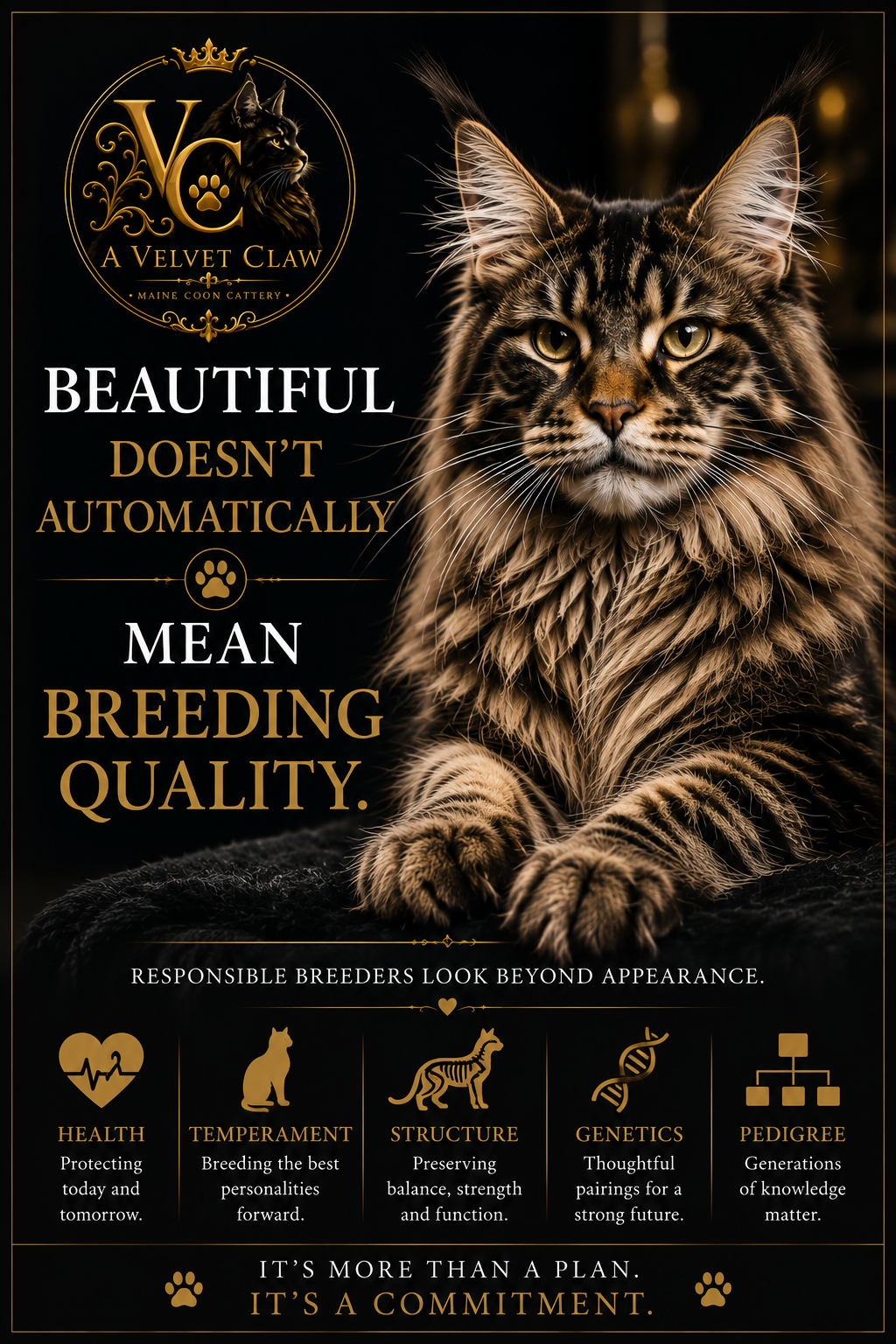
Maine Coons are breathtaking It's very easy to fall in love with a dramatic muzzle, huge ears, beautiful coat, enormous paws or impressive size. But breeding decisions can't be based on appearance alone. A responsible breeder looks at the entire cat.
That includes: Health. Temperament. Structure. Pedigree. Genetics. Development.
A cat can be absolutely stunning and still not be the right choice for a particular breeding program. And that's okay. That cat hasn't somehow become less valuable. They can still be an extraordinary companion. Their worth was never dependent upon their ability to reproduce.
3. Temperament Can Change the Plan
Temperament matters enormously. Maine Coons are beloved not only because they're beautiful, but because of the wonderful personalities associated with the breed. Breeding cats contribute more than physical characteristics to future generations. Temperament can have a genetic component too. As kittens mature, their personalities become clearer. A breeder may decide that a particular temperament isn't something they want to intentionally carry forward.
That doesn't necessarily mean the cat is “bad.” Perhaps they're extremely fearful. Maybe they're unusually reactive. Maybe they struggle significantly with handling or normal household situations despite appropriate socialization. There can be many reasons.
Responsible breeding means considering what we're potentially passing forward—not simply what we can see in a photograph.
4. Structure Matters

A Maine Coon purchased as a young kitten still has a tremendous amount of physical development ahead. Remember, Maine Coons mature slowly. Their bodies can continue changing for years. As a breeding prospect develops, a breeder evaluates how that cat is maturing. There may be structural traits the breeder doesn't want to reinforce within future generations. This is especially important when choosing a mate.
Responsible breeders aren't trying to create identical cats. They're looking at the strengths and weaknesses of each individual and asking: “Would this pairing complement both cats?” If the answer eventually becomes no, plans need to change.
5. The Pedigree May Reveal New Information
A pedigree is more than a list of impressive names. It represents generations of genetic history. Sometimes new information becomes available after a cat has already joined a breeding program. Perhaps a health concern begins appearing among relatives. Maybe additional information becomes available about longevity or temperament within the line. Maybe studying a potential pairing reveals more shared ancestry than the breeder is comfortable with. Responsible breeders continue learning about their lines.
And when new information appears, it shouldn't be ignored simply because a cat was already purchased. New information should influence future decisions.
6. Two Excellent Cats Can Still Be the Wrong Pairing
This is something many people outside breeding don't realize. You can have an outstanding male. You can have an outstanding female. And they still might not belong together. Responsible breeding isn't simply about finding two “good” cats. It's about determining whether those two specific cats complement each other. If both have the same structural weakness, pairing them could potentially reinforce it. If their pedigrees are too closely related for the breeder's goals, another pairing may make more sense. If there's a health concern appearing in both lines, combining those lines may not be worth the risk.
Sometimes the answer isn't: “This cat shouldn't be bred.”
It's: “This cat shouldn't be bred to that cat.” That's why thoughtful pairing decisions matter.
7. Genetic Diversity Matters
Maintaining genetic diversity is another consideration within a breeding program. Breeders can study pedigrees and use tools such as coefficient of inbreeding—often called COI—to better understand relationships between cats. COI is not a magical number that determines whether a pairing is automatically good or bad.
It's simply another piece of information. A thoughtful breeder considers genetic diversity alongside health, temperament, structure, pedigree and the goals of the breeding program. Sometimes a pairing that looks wonderful on the surface simply doesn't make sense genetically. And that's another reason plans may change.
8. Reproductive Health Can Make the Decision for Us
Not every cat develops normally from a reproductive standpoint. A male purchased as a future sire may have a reproductive issue. A female intended as a future queen may develop a condition that makes pregnancy unsafe or inappropriate. Fertility problems can occur. Hormonal or anatomical issues can appear.
At that point, the question shouldn't be: “How do we make this cat breed anyway?”
It should be: “What is best for this cat?” Sometimes the responsible answer is retirement before a breeding career ever begins.
9. The Cat's Own Well-Being Comes First
This may be the most important reason of all. Just because a cat can reproduce doesn't automatically mean they should. The individual cat matters. If breeding, pregnancy or raising kittens would place a queen at unreasonable risk, her health comes first. If a cat isn't thriving within a breeding environment, that matters too. Breeding cats aren't equipment. They're not inventory.
They're living animals whose quality of life should always matter more than a breeding plan. Sometimes loving a breeding prospect means recognizing that their happiest future isn't in a breeding program at all.
10. Financial Investment Should Never Override Better Judgment
Breeding cats can represent a significant investment. There's the purchase price. Transportation. Registration. Veterinary care. Health testing. Food. Grooming. Showing, depending on the program. And months or years of raising that cat before breeding is even considered. So imagine discovering after all of that investment that the responsible decision is not to breed them. That's hard.
But responsible breeding sometimes requires making financially painful decisions. The fact that money has already been invested doesn't make an unsuitable breeding decision suddenly appropriate. Sometimes doing the right thing costs money. That's part of the responsibility breeders accept.
11. Retiring a Breeding Prospect Isn't a Failure
This is something worth saying clearly. If a breeder purchases a promising kitten and later decides not to breed that cat, it doesn't necessarily mean someone made a mistake. It may actually demonstrate that the process worked exactly as it should. The breeder gathered information. The cat matured. Health testing was performed. Development was evaluated. The pedigree was studied. Temperament was considered.
And based on everything learned, the breeder made a decision. That's what responsible evaluation looks like. The irresponsible choice would be ignoring concerning information because the original plan was already made.
12. Plans Should Be Allowed to Change
Breeding programs shouldn't be rigid. Science changes. Cats develop. Health information becomes available. Pedigrees evolve. Goals change. And sometimes a cat surprises us—in wonderful ways or difficult ones.
A breeder should always be willing to say: “Based on what we know now, we're changing our plan.” Changing your mind because you learned something isn't inconsistency. It's growth.
Responsible Breeding Requires Being Willing to Say “No”
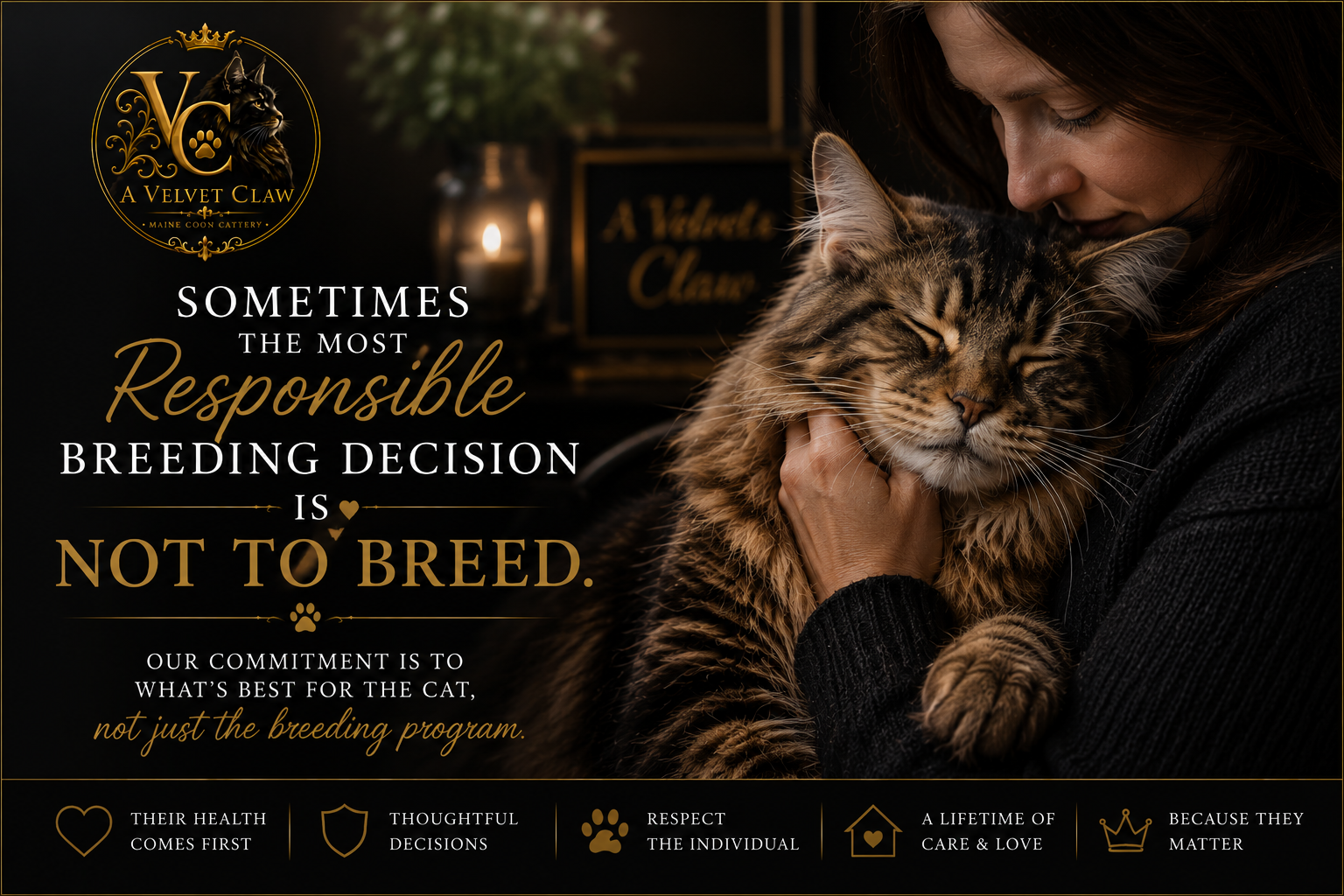
There's a lot of excitement involved in planning a Maine Coon breeding program. Choosing future queens and sires is exciting. Studying pedigrees is exciting. Imagining future pairings is exciting. And of course, kittens are exciting. But some of the most important decisions a breeder makes never result in kittens at all.
Sometimes responsible breeding means saying:
No, we won't make that pairing.
No, we won't breed this cat yet.
No, we're not comfortable with this health result.
No, this isn't the right match.
Or even:
No, this wonderful cat won't become part of our breeding program after all.
Those decisions aren't nearly as adorable as a basket full of Maine Coon kittens. But they're every bit as important.
Their Worth Is Never Defined by Their Ability to Reproduce
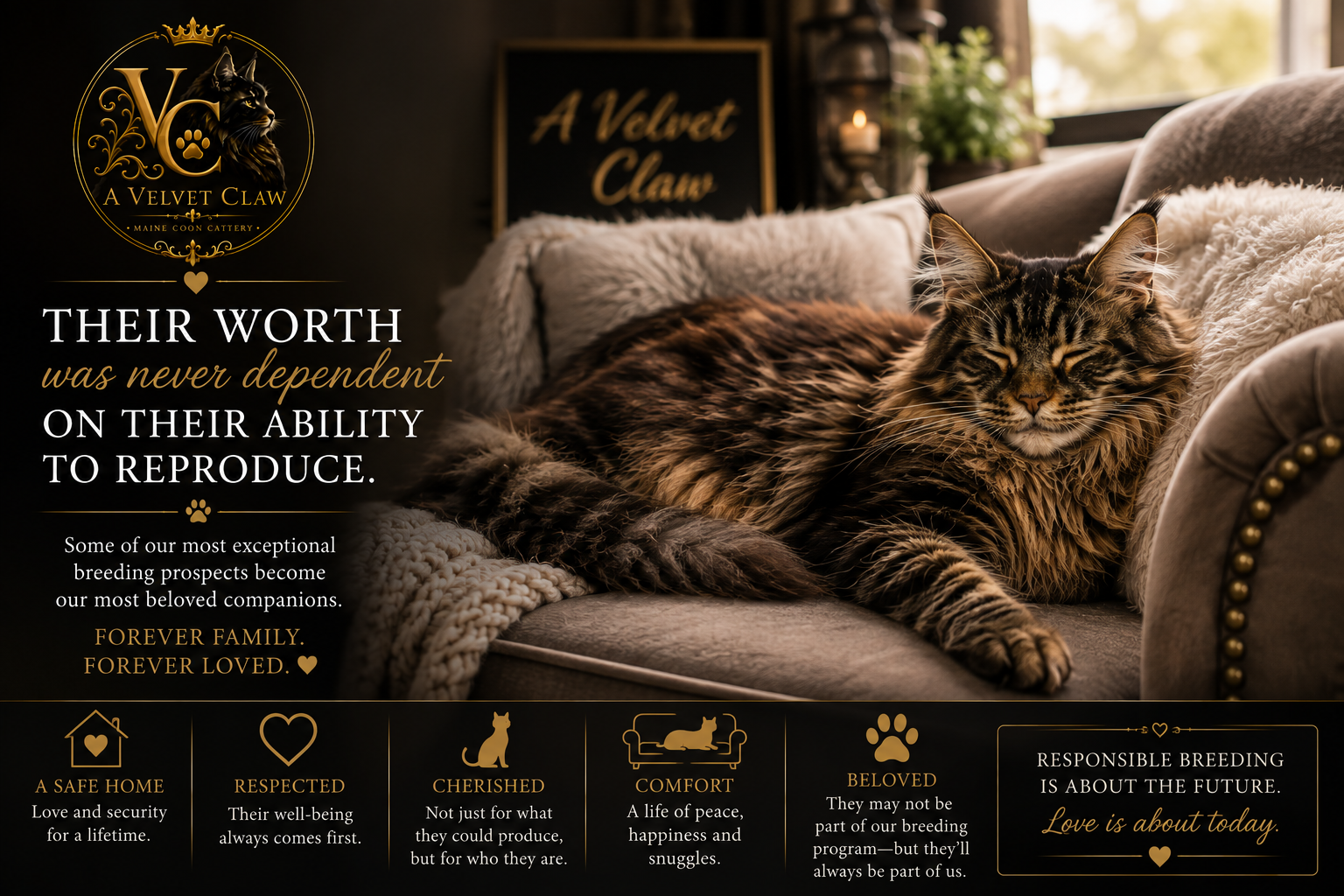
A breeding prospect that becomes a beloved companion hasn't “failed.” They're still the same beautiful cat. They're still worthy of exceptional care. They're still worthy of love. And sometimes their greatest contribution to a responsible breeding program is the information they gave us—even if they never produce kittens themselves.
At A Velvet Claw, we believe responsible breeding isn't about producing as many litters as possible. It's about knowing when to breed, why to breed—and when not to breed at all. Because ultimately, the goal isn't simply more Maine Coons.
It's healthier, thoughtfully bred generations and a future for this incredible breed that we're proud to be part of. 🖤💛🐾
Fur - ever grateful: Lexie & Melina
Responsible Maine Coon breeding • Maine Coon breeding prospect • Maine Coon breeding program
Maine Coon health testing • Maine Coon breeding decisions • ethical Maine Coon breeding