
An educational look at kitten development, biological sex identification, and why responsible breeding includes acknowledging uncertainty.
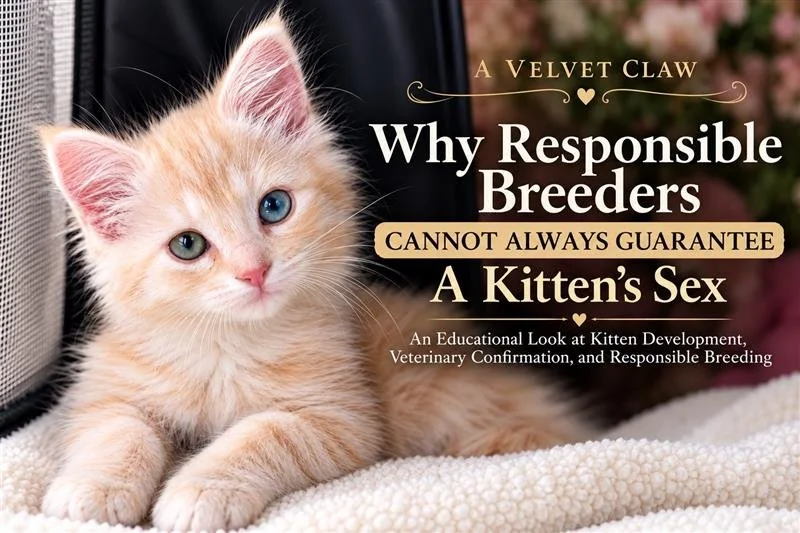
When welcoming a new kitten into your family, there are so many exciting details to consider. Their personality, their coloring, their temperament, and, of course, whether your new companion is male or female.
For some families, a kitten’s sex is simply a preference. For others, it may influence their decision because of existing pets, household dynamics, or personal expectations.
But here’s something that responsible breeders wish more families understood:
Even an experienced breeder or licensed veterinarian can occasionally make a mistake when identifying the biological sex of a young kitten.
And that doesn’t automatically mean anyone was careless, dishonest, or inexperienced.
It means biology isn’t always as straightforward as we expect.
Why Can Identifying a Kitten’s Sex Be Difficult?
Unlike adult cats, newborn kittens have very small external reproductive structures.
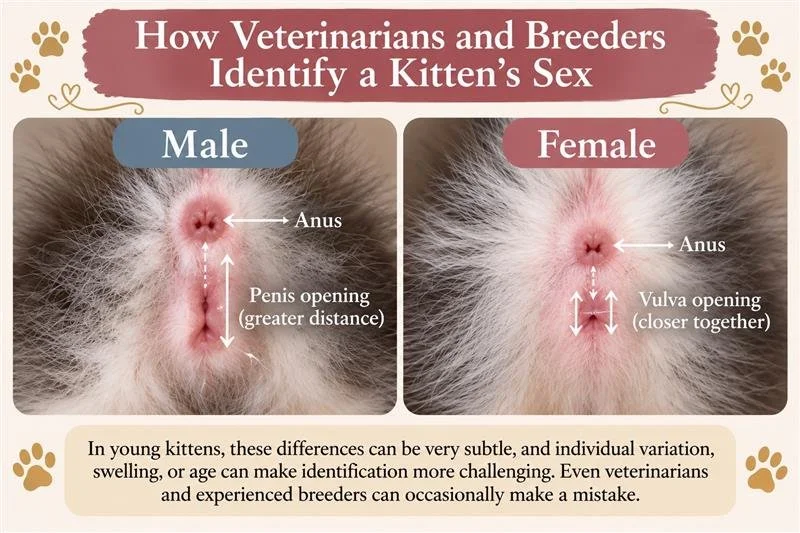
Veterinarians and breeders typically identify a kitten’s sex by examining the area beneath the tail, including the distance between the anus and genital opening and the appearance of those structures.
Generally:
Male kittens have a greater distance between the anus and genital opening.
Female kittens typically have openings positioned closer together.
However, these differences can be subtle, particularly during the earliest stages of development.
Swelling, individual anatomical variation, and the kitten’s age can make identification more challenging.
Even someone who has examined hundreds of kittens can occasionally encounter an unusually difficult case.
Can a Veterinarian Guarantee a Kitten’s Sex?
Veterinarians are trained to examine feline anatomy and can generally identify a kitten’s biological sex accurately.
However, no examination is completely immune to human error or unusual anatomy.
In rare circumstances, differences in sexual development may also make a kitten’s reproductive anatomy less typical.
Additional testing may be recommended when a veterinarian identifies an anatomical concern or when examination findings are unclear.
A veterinary examination provides valuable professional confirmation, but responsible breeders should avoid promising absolute certainty when uncertainty remains.
Does This Mean Breeders Shouldn’t Identify Their Kittens as Male or Female?
Absolutely not!
Responsible breeders should make every reasonable effort to identify their kittens accurately.
That includes examining kittens as they develop, reevaluating an uncertain identification, and seeking veterinary confirmation when necessary.
The important distinction is between providing information based on a careful assessment and making a promise that cannot account for every possible circumstance.
A breeder should never use the possibility of an identification error as an excuse for careless practices.
Instead, responsible breeding means recognizing that accuracy, honesty, and transparency all matter.
What Happens if a Kitten’s Sex Was Identified Incorrectly?
Sometimes a family becomes attached to a kitten they believe is male, only to discover during a later examination that the kitten is female, or vice versa.
Naturally, this can be surprising or disappointing, particularly when the family had a strong preference.
When an honest identification mistake occurs, responsible communication becomes essential.
A reputable breeder should:
Inform the family promptly when the mistake is discovered.
Explain how the original identification was made.
Share any relevant veterinary findings.
Discuss available options according to the purchase agreement.
Treat the family’s concerns respectfully.
The goal should never be to dismiss the family’s feelings or assign blame.
The goal is to handle an unexpected situation with professionalism and integrity.
Biological Sex and Gender: Understanding the Difference
Although people often use the terms sex and gender interchangeably, they do not mean exactly the same thing.
Biological sex refers to reproductive and anatomical characteristics. Gender generally refers to human social identities, roles, and experiences.
In feline breeding, when breeders describe a kitten as male or female, they are referring to the kitten’s biological sex.
For this reason, biological sex identification is the appropriate terminology when discussing veterinary examinations and kitten placement.
Why Responsible Breeders Don’t Promise Perfection
Responsible breeding involves extensive planning, health screening, genetic testing, veterinary care, socialization, and thoughtful placement.
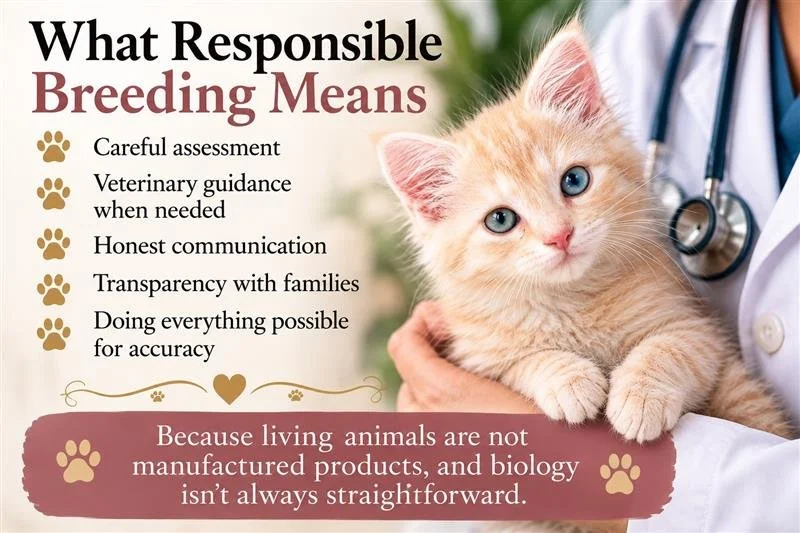
But even with all those precautions, living animals are not manufactured products.
Nature introduces variations that cannot always be predicted or controlled.
Responsible breeders should be confident in their knowledge while remaining willing to acknowledge uncertainty.
There is a meaningful difference between saying:
“Based on our examinations, this kitten has been identified as male.”
And saying:
“I guarantee there is absolutely no possibility this identification could be incorrect.”
The first communicates an informed assessment.
The second makes an absolute promise that may not be appropriate in every circumstance.

Our Philosophy at A Velvet Claw Maine Coon Cattery
At A Velvet Claw Maine Coon Cattery, we believe responsible breeding begins with education, transparency, and respect for both our kittens and the families who welcome them home.
We believe families deserve accurate information, thoughtful answers, and honest communication.
We also believe that responsible breeders should never be afraid to acknowledge that biology can sometimes present unexpected circumstances.
Our commitment is to approach kitten identification carefully, seek veterinary guidance when needed, and communicate openly with our future kitten families.
Because responsible breeding isn’t about claiming that mistakes are impossible.
It’s about doing everything reasonably possible to prevent mistakes and handling them responsibly if they occur.
⸻
With love, education, and a commitment to responsible breeding,
A Velvet Claw Maine Coon Cattery
Fur-ever grateful, Melina & Lexie - Owners A Velvet Claw
Where education, transparency, and the well-being of our Maine Coons always come first.