
Understanding the Difference Between Health Testing, Responsible Breeding, and Lifetime Health Guarantees
When welcoming a new Maine Coon kitten into your family, you want reassurance that your newest companion will enjoy a long, happy, and healthy life.
And understandably so.
Responsible breeders want exactly the same thing.
But there’s something every prospective kitten owner should understand: Even the most responsible breeder, using extensive genetic testing, veterinary screening, and carefully planned breeding practices, cannot guarantee that a kitten will never experience a health problem.
That doesn’t mean health testing isn’t important. In fact, quite the opposite.
It means understanding what responsible breeding can accomplish—and where the limits of science and biology begin.
Health Testing Is About Reducing Risk, Not Eliminating It
One of the most important responsibilities of an ethical breeder is making informed breeding decisions based on the health of their cats.
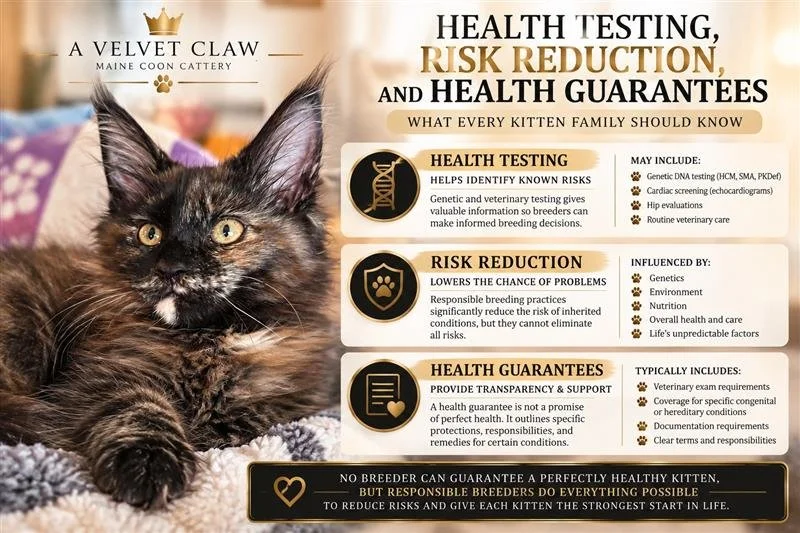
For Maine Coons, this may include:
Genetic DNA testing: Screening for known inherited disease variants, including the Maine Coon-associated HCM variant, spinal muscular atrophy (SMA), and pyruvate kinase deficiency (PKDef).
Cardiac screening: Echocardiograms performed by qualified veterinary professionals to evaluate heart structure and function.
Hip evaluations: Screening for hip dysplasia, a condition that can affect Maine Coons and other large-breed cats.
Routine veterinary care: Physical examinations, vaccinations, parasite prevention, and other age-appropriate preventive care.
These screenings provide valuable information that helps breeders make thoughtful decisions.
However, no screening test can identify every possible medical condition a cat might develop.
A negative genetic test is not a lifetime certificate of perfect health.
Why a Clear Genetic Test Doesn’t Mean a Cat Is Free From Every Disease
Genetic testing is one of the most powerful tools available to responsible breeders, but it has limitations.
Consider hypertrophic cardiomyopathy (HCM), a heart condition that can affect Maine Coons.
A cat may test negative for the known Maine Coon-associated HCM genetic variant and still develop HCM later in life.
Why?
Because not every case of HCM is explained by that particular genetic variant. Other genetic factors and biological influences may contribute.
This is why responsible breeding programs should not rely on DNA testing alone when evaluating breeding cats for HCM.
Regular cardiac screening is another important part of responsible health management, although even a normal echocardiogram cannot guarantee that HCM will never develop.
The same principle applies to other health concerns.
Science helps us identify and reduce known risks, but it cannot predict every future medical outcome.
Genetics Are Only One Piece of the Puzzle
A kitten’s health is influenced by more than its genetic inheritance.
Nutrition, environment, infectious disease exposure, physical development, accidents, and other factors can all affect a cat’s well-being throughout its life.
Some conditions are inherited. Others are acquired. Some arise from a combination of genetic and environmental influences.
And occasionally, health problems develop despite everyone involved doing everything reasonably possible to prevent them.
This is an important distinction.
A cat developing a medical condition does not automatically mean that its breeder acted irresponsibly.
What matters is whether the breeder took appropriate preventive steps, made informed breeding decisions, and responded responsibly to known health concerns.
What About Health Guarantees?
You may have noticed that many responsible breeders offer written health guarantees as part of their kitten contracts.
These guarantees are important, but their purpose is sometimes misunderstood.
A health guarantee is not a promise that a kitten will never become sick.
Instead, it typically outlines specific protections, responsibilities, and remedies related to certain health conditions.
Depending on the breeder’s contract, these may include:
A veterinary examination within a specified period after adoption.
Coverage provisions for certain congenital or hereditary conditions.
Requirements for veterinary documentation if a covered condition is diagnosed.
Clearly defined remedies and responsibilities for both the breeder and kitten owner.
The exact terms vary between breeders.
A responsible breeder should be willing to explain those terms before a family commits to bringing a kitten home.
A meaningful health guarantee is about transparency and accountability—not promising something biology cannot guarantee.
What Responsible Breeders Can Promise
Although no breeder can promise perfect health for life, responsible breeders can make meaningful commitments to the families who trust them.
They can commit to:
Transparency: Sharing relevant health testing information and answering questions honestly.
Thoughtful breeding decisions: Evaluating health, temperament, genetic diversity, and overall suitability rather than selecting breeding cats based solely on appearance or size.
Appropriate veterinary care: Providing kittens with age-appropriate medical attention and preventive care before they leave for their new homes.
Continued education: Staying informed about developing research, breed-specific health concerns, and responsible breeding practices.
Accountability: Taking reported hereditary health concerns seriously and considering that information when making future breeding decisions.
These commitments matter far more than an unrealistic promise that nothing will ever go wrong.
Why Responsible Breeding Still Matters
If health testing cannot guarantee a perfectly healthy kitten, you might wonder why it matters so much.
The answer is simple.
Reducing preventable risk is always worthwhile, even when eliminating every risk is impossible.
Consider the difference between a breeder who makes breeding decisions without understanding inherited health conditions and one who actively screens, evaluates, documents, and makes informed choices.
Neither can predict the future with certainty.
But one is actively working to reduce known risks and improve the likelihood of healthier outcomes.
That is a meaningful difference.
Responsible breeding is not about creating genetically perfect animals.
It’s about making informed, ethical decisions with the knowledge and resources available.
What Kitten Families Should Look For
When researching a Maine Coon breeder, don’t focus exclusively on whether they advertise a health guarantee.
Ask meaningful questions.
What health screenings are performed on the breeding cats? Are results available for review? How frequently are cardiac evaluations performed? What happens if a hereditary health concern is identified?
A responsible breeder should be comfortable discussing these subjects.
And perhaps most importantly, they should be willing to acknowledge that even excellent breeding practices have limitations.
Honesty about those limitations is a sign of responsible breeding, not a reason to distrust a breeder.
Our Philosophy at A Velvet Claw
At A Velvet Claw Maine Coon Cattery, we believe responsible breeding begins with education, transparency, and a genuine commitment to the well-being of the cats entrusted to our care.
We believe families deserve accurate information—not unrealistic promises.
We also believe that understanding the limitations of genetic testing and veterinary screening helps future kitten owners make more informed decisions.
Our goal is to approach breeding thoughtfully, continue learning, and make decisions that prioritize feline health and welfare.
Because responsible breeding isn’t about guaranteeing perfection.
It’s about doing everything reasonably within our control to give each kitten the strongest possible start in life.
And that is a responsibility we take seriously.
⸻
Final Thoughts
A healthy kitten is the hope of every responsible breeder and every loving family.
But health is not something that can be guaranteed for a lifetime.
What can be expected is honesty, appropriate screening, informed decision-making, and a commitment to responsible care.
When choosing a breeder, look beyond promises of perfection.
Look for knowledge, transparency, accountability, and a genuine dedication to the breed.
Because the best breeders don’t promise the impossible.
They work diligently to reduce the risks they can—and remain honest about the ones they cannot.
Extraordinary Cats. Brighter Tomorrows.
A Velvet Claw Maine Coon Cattery - Melina & Lexie
www.avelvetclaw.com
A Velvet Claw | Trust, Care, Delivery - Book Now
Premium Maine Coon breeding and first-class pet transportation services across the USA. Trust our expert team for safe, comfortable kitten delivery and travel care.