
Have you ever stood in the pet food aisle, staring at dozens of bags and cans, wondering which one is actually best for your cat?
You’re not alone!
With phrases like “grain-free,” “premium,” “high-protein,” and “natural” covering pet food packaging, choosing the right nutrition can feel overwhelming.
And when you’re raising a magnificent Maine Coon, you want to make sure you’re giving them the nutrition they need to thrive.
But here’s something every cat owner should know:
The front of the bag is designed to catch your attention. The information on the back helps you evaluate what’s actually inside.
Let’s break down how to read a cat food label and what really matters when choosing food for your gentle giant.
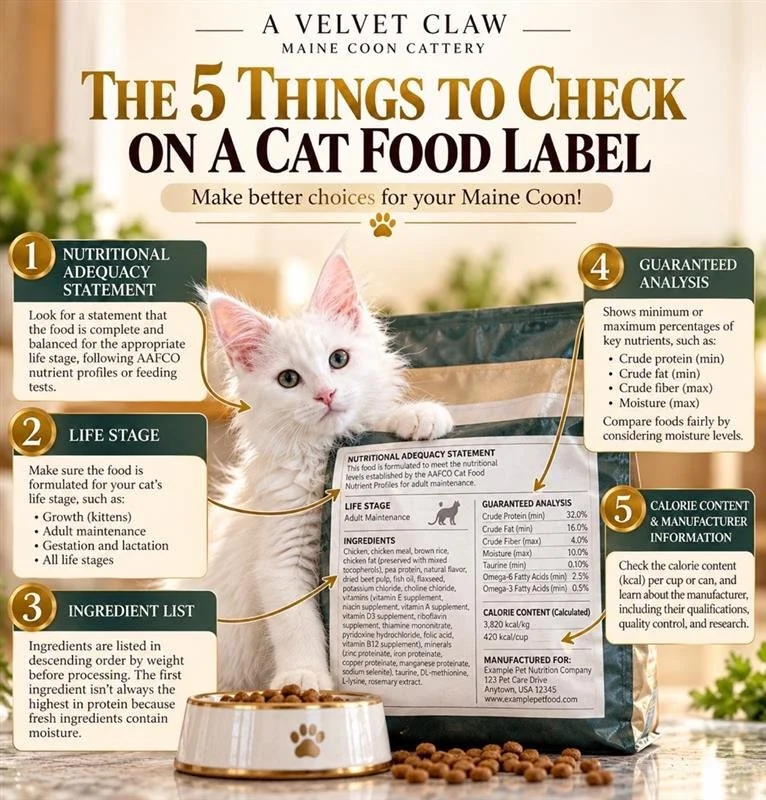
1. Start With the Nutritional Adequacy Statement
Before getting caught up in ingredient lists or fancy marketing claims, look for the nutritional adequacy statement.
This is one of the most important pieces of information on a cat food label.
In the United States, many complete diets carry a statement referencing standards established by the Association of American Feed Control Officials (AAFCO).
You may see wording indicating that the food is formulated to meet AAFCO nutrient profiles or that feeding tests substantiate nutritional adequacy.
Look for a statement identifying the food as complete and balanced for the appropriate life stage.
Common life-stage designations include:
Growth
Adult maintenance
Gestation and lactation
All life stages
For growing Maine Coon kittens, food appropriate for growth is especially important.
A food labeled for supplemental or intermittent feeding only is not intended to serve as the sole diet.
Important: AAFCO establishes model nutritional standards but does not individually approve or certify pet food products.
2. Understand the Ingredient List
Ingredients are generally listed in descending order by weight before processing.
This means the ingredient listed first contributes the greatest weight to the formula before manufacturing.
However, there’s an important detail many owners overlook.
Fresh meat contains substantial moisture.
For example, fresh chicken may appear high on an ingredient list partly because of its water content, while chicken meal is a more concentrated ingredient with much of that moisture removed.
This doesn’t automatically make one ingredient better or worse.
The overall nutritional formulation matters more than the position of a single ingredient.
3. What About Meat Meals and By-Products?
These ingredients often receive a negative reputation, but their names don’t tell the whole story.
Properly processed meat meals can provide concentrated animal protein.
Animal by-products may include nutritious organ tissues that provide valuable nutrients.
In fact, cats require several nutrients naturally found in animal tissues, including taurine and preformed vitamin A.
The quality, processing, nutritional composition, and digestibility of ingredients are more important than whether their names sound appealing to humans.
A food isn’t automatically inferior because it contains a properly defined by-product.
4. Learn to Read the Guaranteed Analysis
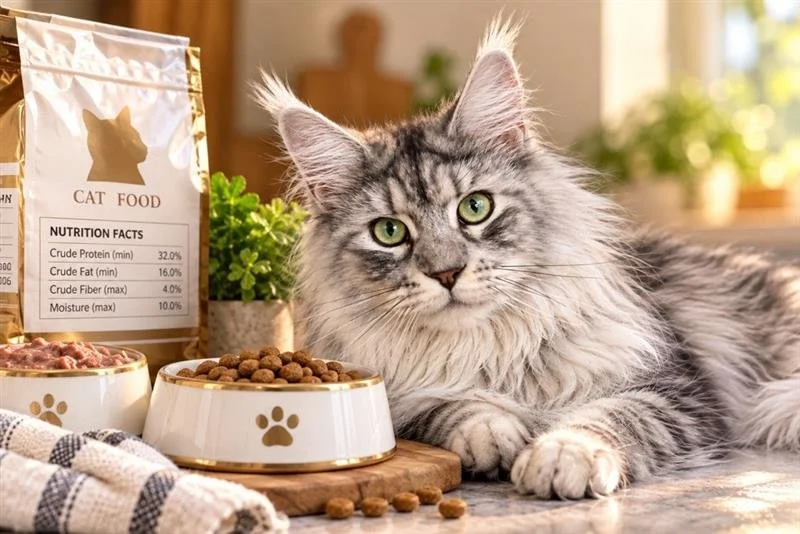
Most cat food labels include a guaranteed analysis showing certain nutrient percentages.
Common listings include:
Crude protein — minimum percentage
Crude fat — minimum percentage
Crude fiber — maximum percentage
Moisture — maximum percentage
Depending on the product, additional nutrients may also be listed.
Here’s where things get interesting.
You cannot fairly compare the protein percentages of wet and dry food without accounting for their different moisture levels.
For example:
A dry food containing 32% protein and 10% moisture has approximately 35.6% protein on a dry-matter basis.
A wet food containing 10% protein and 78% moisture has approximately 45.5% protein on a dry-matter basis.
Even though the wet food appears to contain less protein on the label, it has a higher protein concentration once moisture is excluded.
These figures are illustrative, and guaranteed analysis values are not always the actual nutrient concentrations. For precise comparisons, ask manufacturers for typical nutrient analyses.
The lesson? Always consider moisture when comparing foods.
5. Does Grain-Free Mean Healthier?
Not necessarily!
Grain-free foods have become popular, but cats do not automatically benefit from avoiding grains.
Cats are obligate carnivores, which means they require specific nutrients supplied by animal-derived ingredients.
However, that doesn’t mean they cannot digest appropriately processed carbohydrates.
A properly formulated diet containing grains can meet a cat’s nutritional needs.
Similarly, a grain-free diet isn’t automatically healthier simply because grains have been replaced with peas, lentils, potatoes, or other ingredients.
True food allergies require veterinary evaluation, and grain-free feeding is not a universal solution.
6. What Do Words Like Premium, Natural, and Holistic Mean?
Pet food packaging often includes appealing descriptions.
But these terms don’t all have the same regulatory meaning.
Premium: Does not, by itself, establish superior nutritional quality.
Holistic: Does not have a universally established pet food regulatory definition demonstrating better nutrition.
Natural: Has a specific AAFCO model definition related to ingredient origin and processing, with qualifications and exceptions.
Human-grade: Has specific standards when used appropriately, but it does not automatically mean a food is nutritionally superior.
A beautiful package and impressive wording are not substitutes for sound nutritional formulation.
7. Check the Calorie Content
This is especially important for Maine Coon owners!
Maine Coons are known for their large size, but that doesn’t mean every Maine Coon needs unlimited food.
Calorie requirements depend on:
Age and growth stage
Current weight and body condition
Activity level
Whether the cat is spayed or neutered
Reproductive status
Individual metabolism and health
Look for the calorie content, usually expressed as kilocalories (kcal) per kilogram and per familiar unit, such as a cup or can.
Remember that two foods with similar serving sizes may contain very different amounts of energy.
For growing kittens, calorie intake should support steady development without unnecessary restriction.
Your veterinarian can help you evaluate growth, weight, and body condition.
8. Does Your Maine Coon Need Breed-Specific Food?
Not necessarily.
Some manufacturers offer formulas specifically marketed for Maine Coons.
These products may feature particular kibble shapes, nutrient profiles, or other characteristics intended for the breed.
However, there is no universal requirement that a Maine Coon must eat food labeled specifically for Maine Coons.
A nutritionally complete and balanced diet appropriate for the cat’s life stage can support healthy development regardless of whether the packaging features a Maine Coon.
The individual cat’s needs matter more than the breed pictured on the bag.
9. Look Beyond the Label
One of the most useful things you can do is research the manufacturer.
Questions worth asking include:
Who formulates the food, and what are their qualifications?
Does the company employ appropriately qualified veterinary nutrition professionals?
What quality-control and food safety procedures are used?
Does the manufacturer conduct nutritional research or feeding trials?
Can the company provide detailed nutrient information?
How does the company handle product concerns and recalls?
These questions can reveal much more about a food than marketing language alone.
10. The Best Cat Food Isn’t Always the Most Expensive
A higher price tag doesn’t automatically mean better nutrition.
Likewise, a food with attractive packaging or a long list of trendy ingredients isn’t necessarily the healthiest choice.
The best food for your Maine Coon should be:
Complete and balanced for the appropriate life stage
Manufactured with appropriate quality and safety controls
Suitable for your cat’s individual health needs
Well tolerated and consistently eaten
Appropriate for maintaining healthy growth or body condition
A cat’s health, growth, energy, and overall condition provide important information about whether a feeding plan is working.
Final Thoughts From A Velvet Claw
At A Velvet Claw Maine Coon Cattery, we believe education is one of the most valuable things we can offer our extended Maine Coon family.
Understanding how to read a cat food label empowers you to look beyond advertisements and make thoughtful nutritional decisions.
The next time you’re comparing foods, remember:
Don’t judge a food by its packaging. Look at the nutritional adequacy, life-stage suitability, calorie content, manufacturer expertise, and your cat’s individual needs.
Because our gentle giants deserve more than clever marketing.
They deserve thoughtful, informed care.
With love and whiskers,
A Velvet Claw Maine Coon Cattery
Extraordinary Cats. Brighter Tomorrows.
www.avelvetclaw.com
⸻
Educational disclaimer: This article provides general information and does not replace individualized veterinary nutritional advice.