
A Velvet Claw Maine Coon Cattery | Extraordinary Cats. Brighter Tomorrows. | FELINE DENTAL HEALTH WEEK 🧷
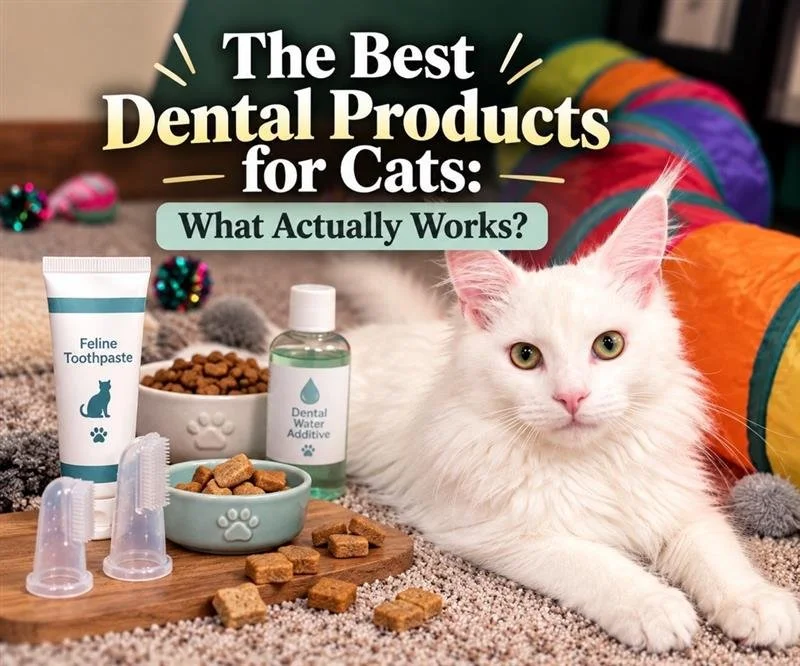
🦷 The Best Dental Products for Cats: What Actually Works?
Dental treats, special foods, water additives, toothpaste, and dental gels… but which ones actually help keep your cat’s teeth healthy?
If you’ve ever walked down the pet care aisle and found yourself staring at dozens of products promising cleaner teeth, fresher breath, and healthier gums, you’re not alone!
With so many options available, it can be difficult to determine which products are worth purchasing and which may not provide the benefits you’re expecting.
At A Velvet Claw Maine Coon Cattery, we believe informed cat parents make better decisions for their feline companions.
That’s why today we’re breaking down the most common feline dental care products, explaining how they work, and helping you understand what to look for before spending your money.
Because when it comes to your cat’s health, evidence matters more than advertising.
🪥 1. Cat Toothpaste: One of the Most Useful Dental Care Products
Let’s start with one of the most effective tools available for home dental care: cat-safe toothpaste used with regular toothbrushing.
Plaque is a sticky bacterial film that forms on your cat’s teeth throughout the day.
When plaque isn’t removed, it can contribute to gum inflammation and eventually harden into tartar.
Regular brushing helps physically remove plaque before it hardens.
What should you look for?
Choose toothpaste that is:
Specifically formulated for cats
Safe for pets to swallow as directed
Appropriate for regular use
Recommended by your veterinarian
A flavor your cat will tolerate
Some veterinary dental toothpastes contain enzymes or other ingredients intended to support plaque control.
However, the mechanical action of brushing remains an important part of effective home dental care.
Important: Never use human toothpaste. Some ingredients found in human dental products can be harmful to cats when swallowed.
What about finger toothbrushes?
Soft silicone finger toothbrushes are an option for cats that tolerate them.
They can be particularly helpful when introducing dental care because the owner can control the movement directly with their finger.
However, finger brushes are not automatically safer or more effective than small, soft-bristled pet toothbrushes. Their larger size can make it difficult to reach certain teeth in smaller mouths.
Whichever tool you choose, use gentle pressure, avoid forcing your cat’s mouth open, and stop if your cat shows discomfort.
Our recommendation: Choose a gentle brushing method your cat comfortably accepts and work toward daily brushing.
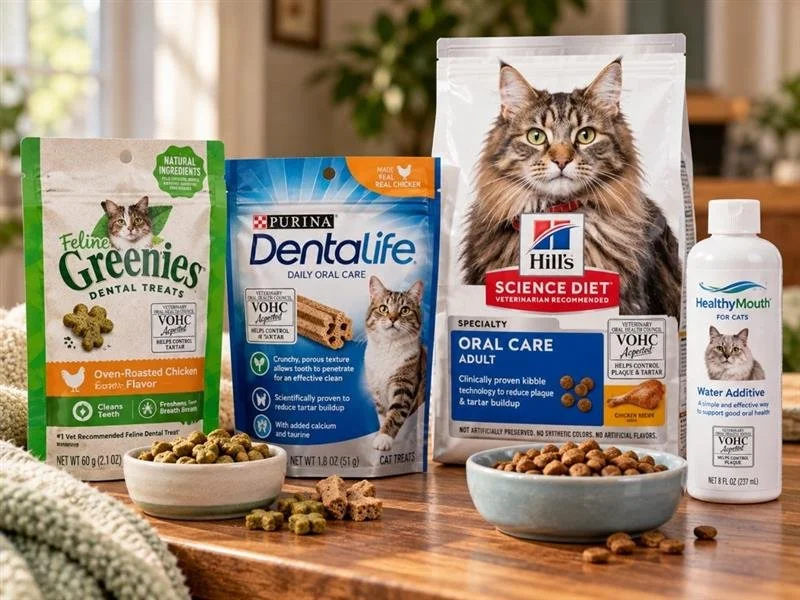
Examples of VOHC-Accepted Feline Dental Products
🐾 2. Dental Treats: Do They Really Clean Teeth?
Dental treats are among the most popular oral care products available for cats.
They’re convenient, easy to offer, and often very appealing to our feline friends.
But here’s something important to understand:
Not every treat labeled “dental” has been proven to improve dental health.
Some dental treats are designed with a texture or shape that helps reduce plaque or tartar as the cat chews.
Others contain ingredients intended to support oral hygiene.
The effectiveness depends on the specific product and the evidence supporting its claims.
What should you look for?
One of the best starting points is the Veterinary Oral Health Council (VOHC) Seal of Acceptance.
Products accepted by the VOHC have submitted evidence demonstrating effectiveness against plaque, tartar, or both, according to the council’s standards.
Look for the seal and check which benefit the product has been accepted for.
Remember, treats still contribute calories to your cat’s daily intake.
They should complement a balanced diet rather than replace regular meals.
And even effective dental treats cannot replace necessary veterinary dental care.
🐱 3. Dental Diets: Can Cat Food Help Clean Teeth?
This is an interesting topic because many cat owners assume that feeding dry kibble automatically cleans their cat’s teeth.
Unfortunately, it’s not quite that simple.
Ordinary dry cat food should not be considered a substitute for dental care.
Many cats break kibble apart without producing enough effective tooth contact to significantly remove plaque.
However, specially formulated veterinary dental diets work differently.
Some contain larger or specially structured kibble designed to maintain contact with the tooth surface as the cat bites.
Others use particular ingredients to help reduce tartar formation.
Certain dental diets have earned VOHC acceptance for their demonstrated benefits.
Does your Maine Coon need a dental diet?
Not necessarily!
A complete and balanced diet appropriate for your cat’s age, health, and nutritional needs should remain the priority.
Dental diets may be useful for some cats, but they aren’t automatically the best choice for every Maine Coon.
Kittens, cats with medical conditions, and cats requiring specialized nutrition may have different dietary needs.
Our recommendation: Discuss dental diets with your veterinarian before making a major change to your cat’s food.
💧 4. Water Additives: Convenient, But Are They Effective?
Water additives are products designed to be mixed into your cat’s drinking water.
They’re often marketed as a convenient way to support oral hygiene without brushing.
Some contain ingredients intended to reduce plaque or tartar accumulation.
But effectiveness varies significantly between products.
Certain water additives have earned VOHC acceptance, while others have limited supporting evidence.
Things to consider
Choose products specifically labeled for cats.
Follow the manufacturer’s dilution instructions.
Look for evidence supporting the product’s dental claims.
Monitor your cat’s water consumption.
Cats can be sensitive to changes in the smell or taste of their water.
If a water additive causes your cat to drink less, discontinue it and provide fresh, untreated water.
Adequate hydration is more important than using a dental additive.
Our recommendation: Water additives may be a useful supplement for some cats, but they should not be relied upon as the only form of dental care.
🦷 5. Dental Gels, Sprays, and Wipes
You may also come across dental gels, oral sprays, and dental wipes.
These products are often marketed toward cats that resist toothbrushing.
Some gels contain ingredients intended to support oral hygiene, while dental wipes may help mechanically remove soft plaque from accessible tooth surfaces.
However, results vary depending on the product and how it’s used.
A dental wipe may be easier for some cats to tolerate, but it generally doesn’t reach every tooth surface as effectively as careful brushing.
And simply applying a gel or spray doesn’t necessarily mean plaque is being removed.
Look for products with supporting evidence, and consult your veterinarian if you’re unsure whether they’re appropriate for your cat.
👑 6. What Is the Veterinary Oral Health Council (VOHC)?
If there’s one thing we hope you remember from today’s blog, it’s this:
The VOHC Seal of Acceptance is a valuable tool when comparing dental products.
The Veterinary Oral Health Council reviews scientific evidence submitted by manufacturers to determine whether products meet its standards for reducing plaque, tartar, or both.
Products that meet the appropriate requirements can earn the VOHC Seal of Acceptance.
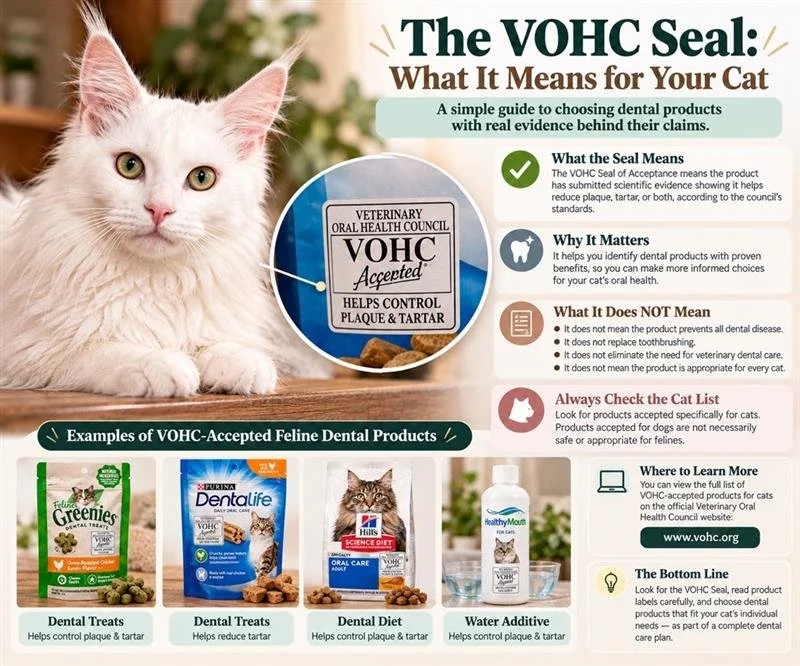
What does the seal mean?
It means the product has demonstrated a particular dental benefit under the council’s evaluation standards.
It does not mean the product prevents every dental disease, replaces brushing, or eliminates the need for veterinary examinations.
The VOHC also does not provide a general certification that a product is appropriate for every individual cat.
You can review accepted products on the official website:
www.vohc.org
When shopping, make sure you’re looking at the list specifically for cats, because products accepted for dogs are not necessarily appropriate for felines.
❤️ 7. What About Natural or Homemade Dental Remedies?
It’s understandable that some cat owners prefer natural approaches to pet care.
However, natural doesn’t automatically mean safe or effective.
Be cautious with homemade dental remedies and products containing essential oils, baking soda, or ingredients not specifically evaluated for feline use.
Certain substances that humans tolerate can be harmful to cats.
And abrasive homemade mixtures may damage sensitive oral tissues.
Our recommendation: Avoid homemade dental treatments unless your veterinarian specifically approves them.
Your cat’s oral health is too important to leave to untested remedies.
🐈 8. Do Maine Coons Need Different Dental Products?
Maine Coons are known for their impressive size, beautiful coats, and distinctive personalities.
But when it comes to dental health, the same fundamental principles apply to Maine Coons as to other domestic cats.
They need:
Regular oral examinations
Consistent plaque control
Appropriate nutrition
Dental products selected for their individual needs
Professional veterinary dental care when indicated
Although Maine Coons may be larger than many other cat breeds, that doesn’t automatically mean they need oversized dental tools or special dental products.
Choose supplies that fit your individual cat’s mouth comfortably.
And remember, a large cat can still have sensitive gums or painful dental conditions.
🏆 So, Which Dental Products Are Actually Worth It?
Here’s how we would prioritize dental care:
First: Regular toothbrushing.
Daily brushing with appropriate supplies is one of the most effective ways to control plaque at home.
Second: Routine veterinary dental care.
Regular examinations and professional cleanings when recommended help identify and address problems that home care cannot resolve.
Third: Evidence-supported dental products.
VOHC-accepted treats, dental diets, and certain other products may provide additional benefits.
Fourth: Products your cat will actually tolerate.
Even a well-supported product isn’t helpful if your cat refuses it, becomes distressed, or stops eating or drinking normally.
The best dental care plan is one that’s effective, appropriate for your cat, and sustainable over time.
🐾 The Bottom Line: Don’t Believe Every Dental Health Claim
Dental care doesn’t have to be complicated, but it should be informed.
A product’s packaging may promise cleaner teeth or fresher breath, but that doesn’t automatically mean it has been scientifically demonstrated to provide those benefits.
Look for evidence.
Read product labels carefully.
Ask your veterinarian questions.
And remember that preventive home care works best alongside regular veterinary dental examinations.
At A Velvet Claw Maine Coon Cattery, our goal is to help cat owners make thoughtful, informed decisions that support their companions throughout every stage of life.
Because extraordinary cats deserve extraordinary care.
🐱 Coming Up Tomorrow!
Have you ever heard of feline tooth resorption, gingivitis, or stomatitis?
Tomorrow, we’re discussing Common Dental Problems in Maine Coons: What Every Owner Should Know.
We’ll explain what these conditions are, the warning signs to watch for, and when veterinary attention is needed.
💬 We’d Love to Hear From You!
Does your cat have a favorite dental treat, toothpaste, or oral care routine?
Have you found a dental product that your cat actually enjoys?
Share your experiences with us!
Extraordinary Cats. Brighter Tomorrows.
A Velvet Claw Maine Coon Cattery - Melina & Lexie
www.avelvetclaw.com
Educational Disclaimer: This article is intended for general feline health education and does not replace professional veterinary advice. Always consult your veterinarian before introducing new dental products or treatments.